The Big Picture
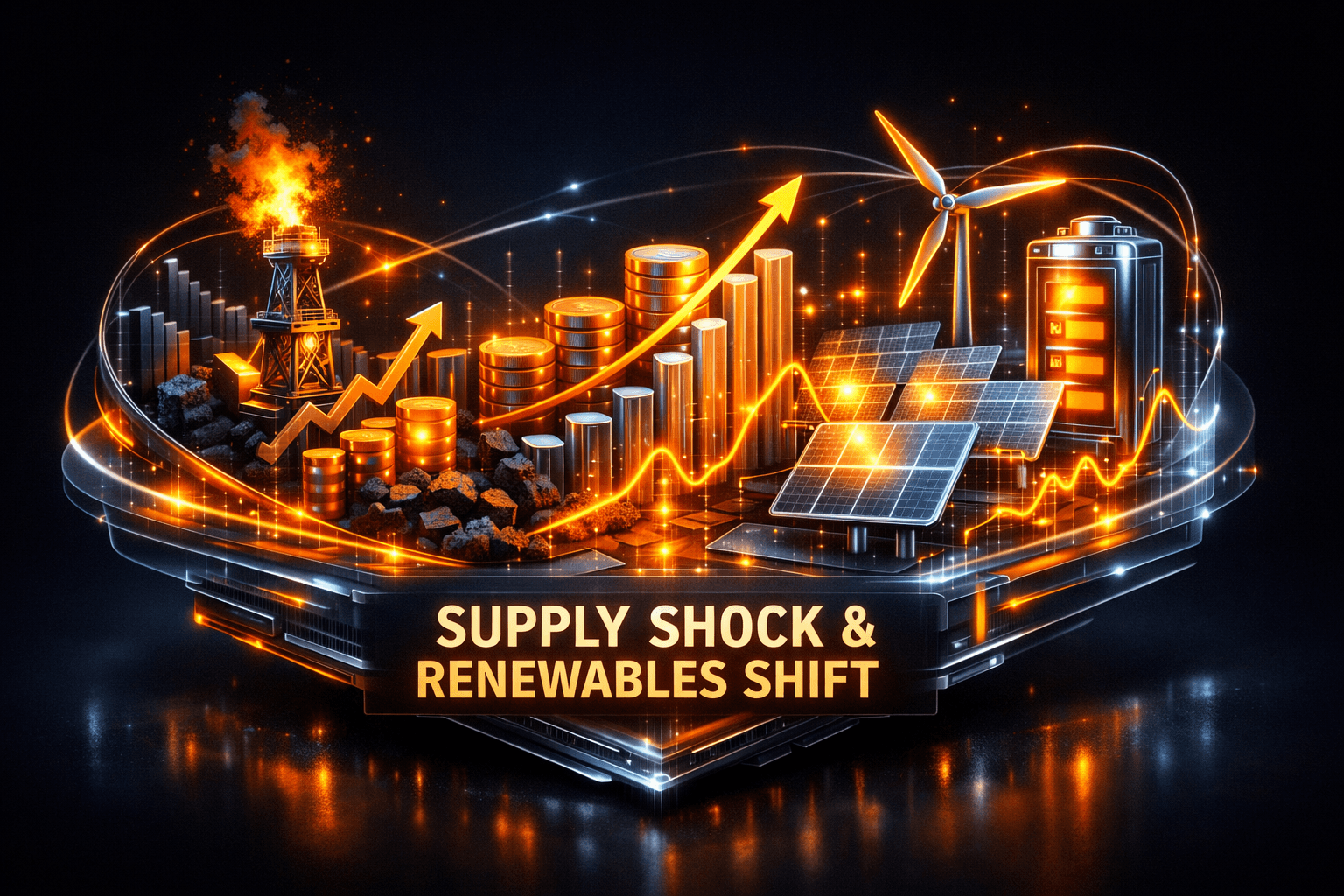
A deepening supply shock from the Middle East has pushed buyers back into coal, lifting near-term demand for thermal fuels and helping upstream producers post stronger results. At the same time, renewables and storage are advancing in pockets from Egypt to Morocco, even as localized risks like theft and regulatory gaps surface.
This matters to you because it creates divergent opportunities and risks across the energy value chain, from commodity-sensitive oil and coal names to solar project developers and battery technology providers. Which exposures matter most to your portfolio will depend on your time horizon and risk tolerance.
Market Highlights
Quick facts and numbers to start your day.
- Coal demand: Kpler data cited by the Financial Times shows global coal imports surged in March and April and are tracking toward the third-highest monthly level on record, as buyers scramble for fuel amid disrupted oil and gas supply.
- Oil & upstream: Saudi Aramco, listed as $2222.SR, reported $33.59 billion in adjusted net income for Q1, rising versus the prior quarter and Q1 2025, reflecting higher oil prices and largely stable production.
- Autos and fuels: China car sales plunged 21.5% in April, with internal combustion engine vehicle sales down by more than 30% and EV and hybrid sales down about 6.8%, a sharp demand shock for gasoline consumption.
- Solar rollout: Egypt installed 800 MW of solar in 2025, and GlobalData expects annual additions above 2 GW through 2028 and cumulative capacity to reach roughly 34.3 GW by 2035.
- Battery and EV tech: Honda, ticker $HMC, is bringing its Mobile Power Pack e: swappable battery system to the US market for B2B commercial deployments as soon as June 2026.
Key Developments
Middle East supply disruption fuels coal rebound and boosts upstream profits
Geopolitical tensions in and around the Persian Gulf have interrupted oil and gas flows, prompting utilities and commodity buyers to turn back to coal as an emergency fuel. That shift helped push coal import volumes sharply higher in March and April, and data suggests imports may hit the third-highest monthly level on record.
The near-term effect is clear, with $2222.SR reporting a strong Q1. For you, that means commodity-sensitive companies are likely to see earnings and cash flow benefits while the disruption persists.
Shipping and security risks escalate in the Strait of Hormuz
Rigzone reports erratic ship signals and increasing interference in the Persian Gulf following fresh attacks, complicating tanker movements and insurance costs. Shipping disruption raises transport risk, and it can amplify price volatility for refined products and LNG.
How long will this last, and how broadly will it affect global supply chains? Those are the open questions to monitor if you have exposure to shipping or commodity price fluctuations.
Renewables advance, but localized challenges and regulatory gaps remain
Renewables news is mixed but constructive. Egypt added 800 MW of solar in 2025 and is on a path to rapid capacity gains through 2035, while Moroccan researchers highlight floating PV on dams as a dual-benefit solution to evaporation and power generation, though regulatory frameworks are lacking.
At the same time, Chilean solar developers report a rise in nighttime theft of cables and conductors, prompting increased security spending. The takeaway is clear, you can expect steady deployment but with execution risks in some markets.
What to Watch
Key catalysts and risks to track over the coming days and weeks.
- Geopolitical developments, especially in the Persian Gulf, and any escalation that further constrains oil and gas flows. That will directly affect commodity prices and upstream cash flows.
- China auto demand data and fuel consumption trends, including weekly gasoline demand prints. Reduced vehicle sales there are a downside risk for oil demand recovery.
- Policy moves in large importers like India, where authorities are urging fuel conservation and exposure to oil import bills is high. Watch fiscal and transport policy for demand-side impacts.
- Renewables milestones and regulatory updates in Morocco and Egypt. Clear frameworks would accelerate floating PV and large-scale solar rollouts, which could shift medium-term power mixes.
- Commercial rollout of battery swap systems, including $HMC's Mobile Power Pack e:, and broader adoption of home battery storage. These technologies affect grid demand patterns and EV economics.
Bottom Line
- Near-term bullish pressure on fossil fuel prices is building due to Middle East supply disruption, which is lifting upstream earnings as shown by Aramco's Q1 results.
- Renewables continue to scale, with strong solar deployment in Egypt and pilot solutions like floating PV in Morocco, but execution risks like theft and regulatory gaps remain in some regions.
- Demand signals are mixed, with China showing sharp weakness in vehicle sales and gasoline demand, creating uncertainty for longer term oil consumption trends.
- Operational and security risks in shipping and regional geopolitics are key wildcards, and they'll drive volatility you may see in energy stocks and commodity prices.
- Technology trends in home batteries and swappable packs are accelerating, offering structural shifts over the medium term even as commodity-driven cyclicality plays out now.
FAQ
Q: How will the Middle East supply disruption affect fuel prices? A: Data suggests the disruption is boosting demand for coal and supporting higher oil prices, which is translating into stronger upstream profits in the near term.
Q: Should I worry about renewables given theft and regulatory issues in some markets? A: Localized problems like solar theft raise project costs, but broader deployment trends in countries such as Egypt and technology strides like battery swaps indicate continued long-term growth.
Q: What indicators should I watch this week to assess energy market direction? A: Watch geopolitics in the Persian Gulf, weekly oil and gasoline demand reports, Chinese auto sales releases, and any regulatory announcements on renewables in North Africa.