The Big Picture
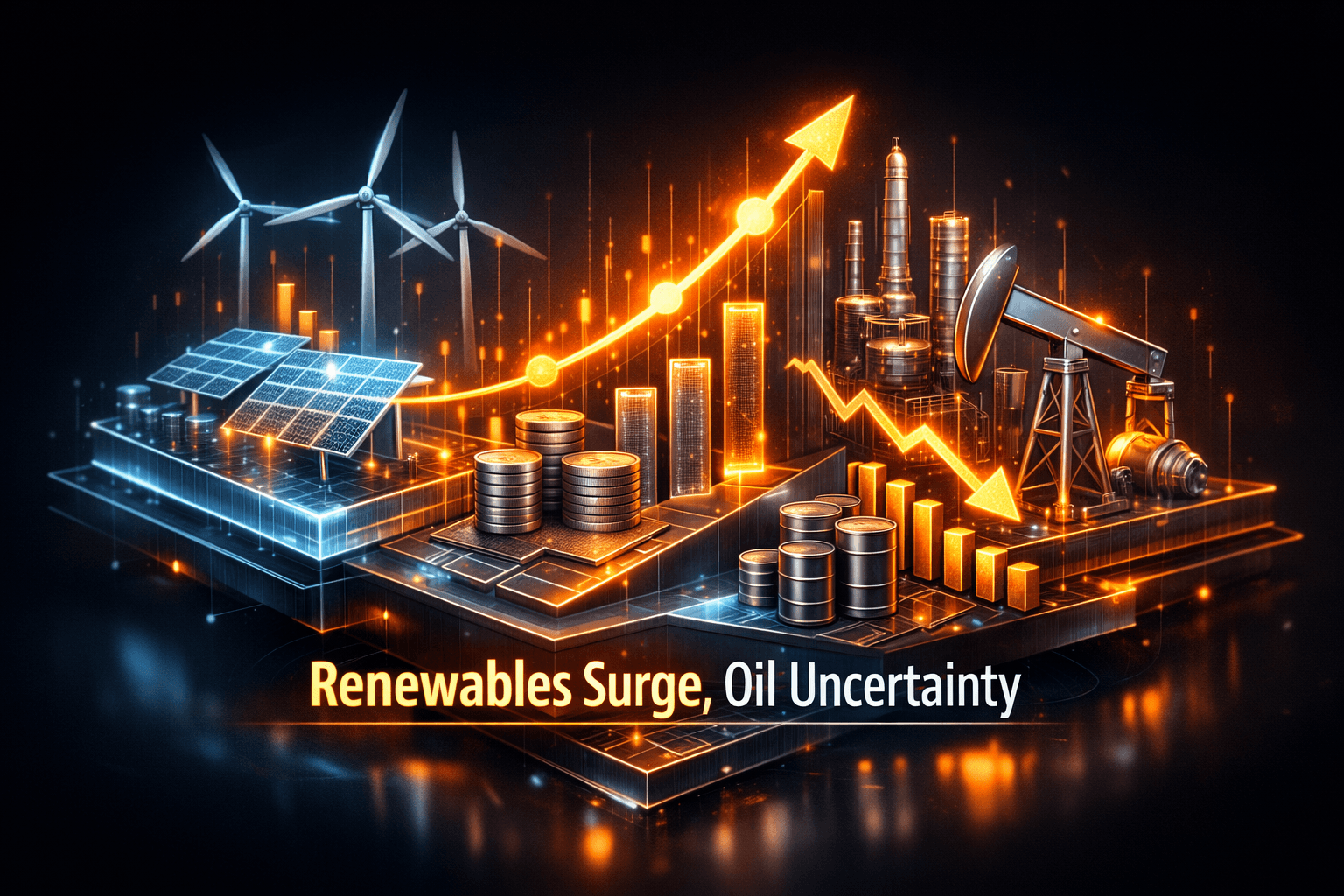
Global energy headlines today give you a clear split, with renewables and solar technology advancing while oil markets face lingering supply uncertainty. Hydro-Quebec's oversubscribed 300 MW solar tender and new perovskite tandem progress point to growing momentum for low-cost solar, even as the IEA warns Gulf output could take up to two years to return to pre-war levels.
That mix matters because it affects where policy, capital, and demand are likely to flow this year. You may see investment shifting between power generation technologies and fossil fuel producers as markets price both faster renewables deployment and potential near-term oil tightness.
Market Highlights
Quick facts and movers to watch this morning.
- Hydro-Quebec's 300 MW solar tender drew 60 bids totaling 481 MW, equal to roughly 160% of the tendered capacity, signaling strong developer interest in Canadian solar projects.
- New Danish analysis shows a least-cost mix of offshore wind and solar at about €46 per MWh, about 53% cheaper than nuclear under the modeled conditions, highlighting cost pressure on large thermal projects.
- Fraunhofer ISE-led researchers reported zinc-doped tin oxide enables perovskite–silicon tandems with 27 to 28 percent efficiencies while removing indium dependence, a potential scaling advantage for PV manufacturers.
- Gazprom, listed as $GAZP, started commercial oil production at a new block in Urengoy, adding incremental supply from the West Siberian basin.
- Volvo Group, shown as $VOLV-B, updated its electric heavy truck lineup with up to 700 kilometers of range, a notable demand signal for electrification in freight transport.
Key Developments
Solar demand and technology: oversubscription and tandem cells
Hydro-Quebec's tender was heavily oversubscribed, with bids totaling 481 MW for a 300 MW call. That shows developer appetite for Canadian solar projects remains high, and you should note that tender oversubscription often tightens pricing and accelerates project timelines.
On the technology side, Fraunhofer ISE's zinc-doped tin oxide work delivered 27 to 28 percent efficiencies for perovskite–silicon tandems without indium tin oxide. That could lower materials constraints and production costs for high-efficiency panels, making utility-scale and rooftop projects more competitive.
System costs favor wind and solar over nuclear
Researchers modeling Denmark's future system find a least-cost mix of offshore wind and solar at about €46 per MWh, significantly undercutting nuclear costs in their scenario. Analysts note this metric factors total system costs, and the result raises questions about long-term capital allocation for large nuclear builds in markets focused on cost and integration.
What does that mean for investors? You may see increased policy and capital support for renewables, while nuclear expansion will likely remain regionally driven where energy security or industrial policy takes precedence.
Oil supply and geopolitics remain mixed
IEA director Fatih Birol told Swiss media that restoring Gulf output to pre-war levels could take around two years, a timeline that supports near-term price resilience for crude. At the same time, Gazprom's Urengoy start increases Russian production capacity, and a Pakistan-flagged tanker became the first to transit the Strait of Hormuz since a U.S. blockade began, easing a flow disruption.
These items underscore a tense balance. Can supply rebuild quickly while demand shifts toward electrification? The answer will shape oil prices and energy sector returns in the months ahead.
What to Watch
Here are the catalysts and risk factors that could move energy stocks and project economics today and over coming weeks.
- Policy updates on renewables procurement in Canada and Europe, which can change the pipeline for tenders like Hydro-Quebec's and affect developers' forward bookings.
- Commodity and materials costs for PV manufacturing, notably the adoption rate of indium-free layers such as ZTO, which could alter cost curves for cell makers and module producers.
- Ongoing developments in the Gulf and Russian production announcements, plus shipping and insurance conditions after the Hormuz transit, which will influence crude volatility and service firms' order books.
- Corporate actions in the oil and gas sector, including Spirit Energy's proposed UK restructuring, where labor costs and asset reviews may affect regional production and service demand.
- Demand-side shifts from electrification, signaled by $VOLV-B's expanded electric truck range, which could raise electricity demand in transport and logistics over time.
You'll want to watch earnings, tender results, and supply notices for clearer signals on capital flows and revenue outlooks.
Bottom Line
- Renewables are showing momentum on both project demand and technology, driven by oversubscribed tenders and improved PV materials and tandem cell performance.
- System-cost analysis favors wind and solar over nuclear in some markets, which may shift policy and investment toward scalable renewables.
- Oil market risk is asymmetric, with Gulf output recovery taking time even as some new supply comes online, keeping price volatility possible.
- Corporate restructurings and geopolitical shipping developments create region-specific risks, so a selective approach remains warranted.
- Watch upcoming tenders, materials adoption, and supply notices to see which trends gain traction and how they influence your energy exposure.
FAQ Section
Q: How does Hydro-Quebec's oversubscribed tender affect project prices? A: Oversubscription usually increases competition, which tends to push contract prices lower and can accelerate project selection and development timelines.
Q: Should I expect nuclear to become cheaper than renewables soon? A: Data in today's stories show renewables and wind-solar mixes are materially cheaper in modeled scenarios, but regional policy and long-term planning can keep nuclear competitive where energy security is prioritized.
Q: How long might oil supply disruptions influence markets? A: The IEA estimates Gulf producers may need up to two years to fully restore output, though timelines will vary by country and depend on repair, investment, and security developments.