The Big Picture
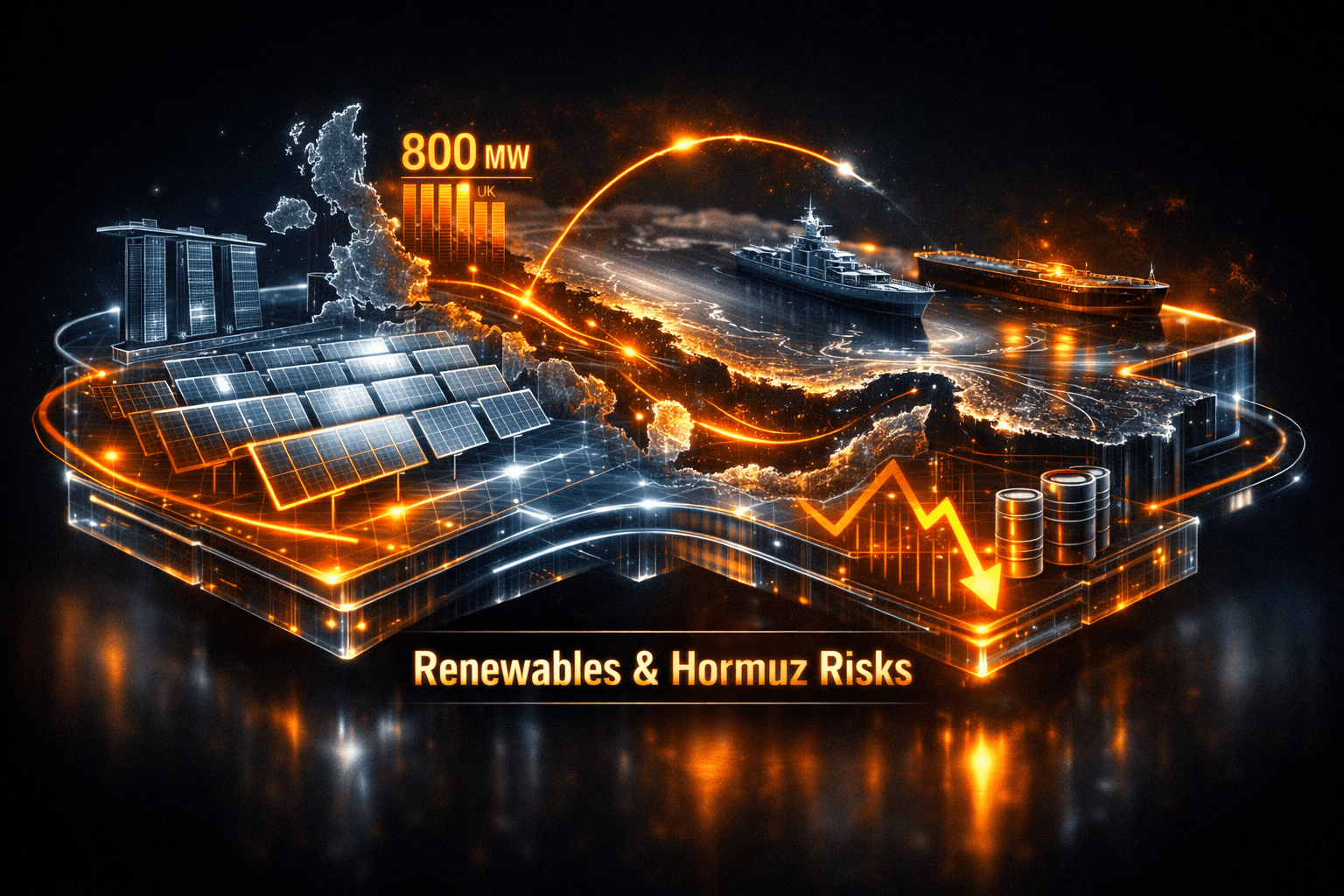
Renewables are grabbing headlines this morning, with record solar installations in Singapore and a landmark 800 MW UK approval underscoring accelerating clean-energy deployment. At the same time, oil-market uncertainty remains high as tanker movements around the Strait of Hormuz and discounted sanctioned LNG cargoes keep price volatility on the table.
Why should you care? The mix of accelerating renewable capacity and persistent geopolitical risks means energy prices and company earnings could diverge depending on which story dominates. That split drives selective opportunities and requires you to watch both project-level developments and macrosecurity events closely.
Market Highlights
Quick facts and moves to note this morning.
- Singapore installed 504 MW of solar in 2025, taking cumulative capacity above 2 GW and prompting a raised 2030 target to 3 GW.
- UK Energy Secretary approved the 800 MW Springwell Solar Farm with battery storage, a record single-site approval for UK PV projects.
- Goldman Sachs ($GS) cut near-term crude forecasts after a ceasefire announcement, projecting Brent around $90 per barrel and WTI near $87 for the current quarter.
- Discounted sanctioned Russian LNG was offered into Asia at up to 40% below recent spot prices, a development that could dampen regional gas pricing.
Key Developments
Renewables Momentum: Singapore, UK, Norway
Singapore's Energy Market Authority reports a record 504 MW of solar added in 2025, lifting cumulative capacity past 2 GW and pushing the 2030 target to 3 GW. That upward revision signals continued government support and stronger project pipelines for developers and installers.
In the UK, the Energy Secretary approved the 800 MW Springwell Solar Farm despite local opposition, and the project will link to a new National Grid substation being built to handle multiple grid-scale solar projects. Norway's order of 20 Candela P-12 electric hydrofoil ferries further illustrates policy-driven demand for electrification in transport and maritime sectors.
Geopolitics and Hydrocarbons: Hormuz, Tankers, Discounts
Chinese-owned oil tankers tested transits through the Strait of Hormuz, advancing then stopping at the chokepoint entrance in what appears to be tentative moves to probe the security situation. Reports of renewed closures or flare-ups are circulating, so basin disruptions remain a live risk for crude flows.
Meanwhile, sanctioned Russian LNG cargoes from Arctic LNG 2 are being offered into South Asian markets via intermediaries at steep discounts. Bloomberg sources cite offers up to 40% below spot, a sign sellers are finding buyers but at a significant price concession. Analysts note this could put downward pressure on regional spot gas if flows continue.
Power Market Signals: Negative Prices Return
AleaSoft's forecasting shows negative hourly electricity prices returned to France and Germany last week, while the British, Dutch and Nordic markets logged their lowest daily averages since October 2025. The Belgian market recorded its lowest daily average since May 2025.
Negative prices typically reflect high renewable generation coinciding with weak demand. That helps you understand why project economics and merchant-generator margins are diverging across Europe, and why storage and flexibility assets are becoming more valuable.
What to Watch
Here are the catalysts and risks to track through the trading day and near term.
- Strait of Hormuz activity and maritime reports, including tanker AIS data and government statements. Will transits normalize or will closures return?
- Oil price reaction to the ceasefire headlines and Goldman Sachs' revisions, with Brent and WTI levels near $90 and $87 respectively. Watch volatility in futures and energy equities tied to exploration and services.
- Renewable project pipelines and permitting updates, especially UK and Singapore timelines for grid connections. You should follow approval-to-connection slippage closely because it affects near-term earnings for builders and developers.
- European power price patterns and negative-price episodes, plus any weekend maintenance that could tighten supply. Storage, demand-response, and battery developers stand to be impacted.
- Sanctioned gas flows and secondary-market pricing, particularly if discounted Russian LNG increases volumes into South Asia or East Asia. That will affect Asian spot LNG prices and shipping economics.
Bottom Line
- Renewables momentum is tangible, with Singapore and the UK delivering headline-scale solar capacity additions and approvals.
- Geopolitical uncertainty around the Strait of Hormuz and discounted sanctioned LNG still creates downside pressure on near-term oil and gas pricing.
- Negative electricity prices in parts of Europe highlight the growing value of flexibility and storage, even as developers push more capacity online.
- Analysts note that near-term energy market direction will hinge on security developments in the Middle East and the pace of renewables connecting to grids.
- Keep a selective approach, monitor catalysts closely, and factor in both policy-driven renewables growth and persistent supply-side risk in hydrocarbon markets.
FAQ Section
Q: How will Singapore's new 3 GW solar target affect regional equipment demand? A: It should increase demand for panels, trackers and balance-of-system components across Asia as developers accelerate procurement and EPC scheduling.
Q: Does the return of negative electricity prices mean rooftop solar is a bad investment? A: Not necessarily. Negative prices are episodic and tend to reward flexibility and storage. Your exposure depends on contract structures and whether you have access to grid services revenue.
Q: Should you expect oil prices to keep falling after Goldman's cut? A: Goldman lowered near-term forecasts reflecting ceasefire hopes, but geopolitical developments around the Strait of Hormuz and supply-side moves could reassert upward pressure quickly. Watch real-time maritime and geopolitical news for signs of renewed risk.