The Big Picture
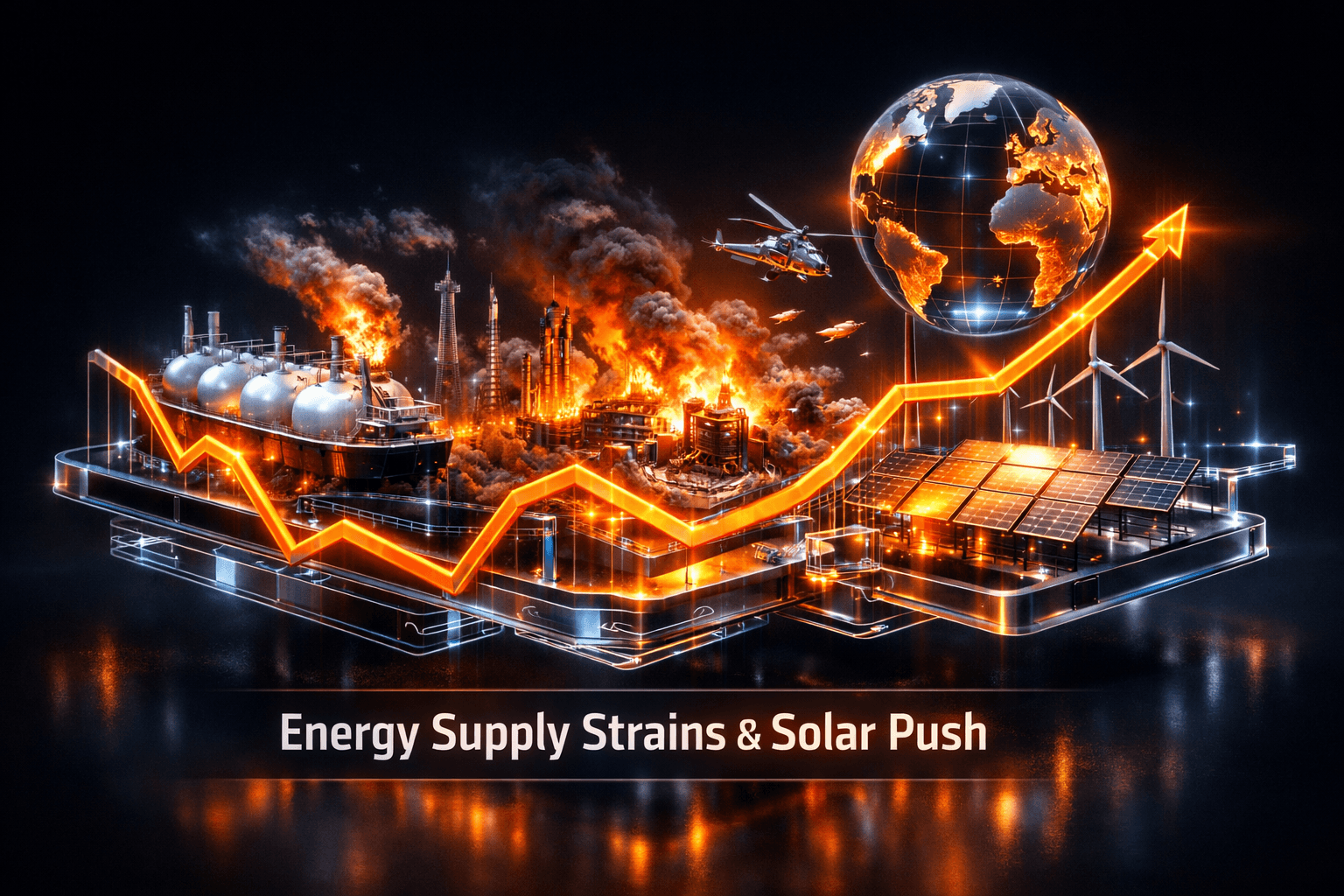
Today the Energy sector is sending mixed signals, with major renewable buildout and infrastructure deals running alongside supply shocks that lifted fuel costs. Renewables are scaling up in multiple regions, even as geopolitical attacks and weather damage squeeze oil and gas flows.
That split matters because it affects both near‑term prices and long‑term investment patterns. Which forces win out this week will shape your exposure to oil, gas, and clean energy names.
Market Highlights
Quick facts and market moves to start the day.
- Gasoline: U.S. national average briefly topped $4.00 per gallon, later quoted around $3.95 to $3.99, according to GasBuddy and AAA.
- Stranded vessels: India reports 28 oil and gas ships stranded near the Strait of Hormuz, including four crude tankers and multiple LPG and LNG carriers.
- Large contract: Siemens Energy secured a GBP 3 billion contract, about $3.96 billion, for Eastern Green Link 4 converter stations, a win for $SIEGY.
- Renewables build: The Philippines is fast tracking 1.28 GW of solar across 12 projects to enter the grid in April.
- Production scale: The new UK North Sea JV led by TotalEnergies and Repsol is expected to produce over 250,000 barrels of oil equivalent per day in 2026, highlighting ongoing investment in baseload hydrocarbon supply, involving $TTE and $REPYY.
Key Developments
Geopolitical and supply disruptions
Tensions in the Middle East are directly pressuring tanker routes and fuel availability. An Iranian drone strike hit a Kuwaiti oil tanker off Dubai, and India says 28 ships are stranded near the Strait of Hormuz, affecting crude, LPG, and LNG flows.
Those events pushed crude prices higher and helped gasoline top $4 per gallon briefly. For you, that adds near‑term price volatility and a potential lift to integrated oil company margins, but also raises transportation and refining cost uncertainty.
Renewables accelerating from Philippines to Arctic PV
Policy and security concerns are accelerating solar deployment. The Philippines will fast track 12 solar projects totaling 1.28 GW for April grid entry to lessen oil exposure, a concrete example of energy security driving renewables adoption.
At the same time a new IEA‑PVPS report finds solar above 60 degrees north viable and expanding, while Italy and Spain set solar production records in March that lowered daily wholesale power prices in parts of Europe. If you are tracking long‑term demand shifts, these stories point to structural growth in solar capacity and grid integration needs.
Industry deals and infrastructure setbacks
On the M&A and contract front, Siemens Energy won a GBP 3 billion contract to build converter stations for Eastern Green Link 4, a significant grid electrification award for $SIEGY and partners like $NGG and $IBE. Also, TotalEnergies and Repsol launched a UK North Sea JV, which will be a major independent producer at over 250,000 boe per day.
Conversely, Chevron reported extensive damage at the Wheatstone LNG plant in Australia after a cyclone, with two liquefaction trains shut and key fin fans damaged. That outage reduces liquefaction capacity and could tighten global LNG balances until repairs are complete. Will repair timelines ease supply pressures soon? That will be a key question for traders today.
What to Watch
Near term, keep an eye on shipping and route clearance updates around the Strait of Hormuz and any further incidents in the Gulf. Continued disruptions would sustain higher crude and refined fuel prices and drive volatility in energy stocks.
Watch repair and restart timelines at Wheatstone LNG from $CVX. Faster repairs would relieve some tightness in LNG markets. Also track how quickly the Philippines brings 1.28 GW of solar online and whether that eases local diesel or oil use for power generation.
On the policy side, monitor announcements on export or shipping insurance, and potential sanctions or naval escorts that could change risk premiums. How will markets price demand resilience versus short‑term supply shocks? Your positioning should reflect that balance and time horizon.
Bottom Line
- Energy headlines are mixed today, with renewable scale‑up and big infrastructure awards offset by geopolitical and weather‑related supply shocks.
- Immediate price pressure is driven by Strait of Hormuz disruptions and the Wheatstone LNG outage, which pushed gasoline above $4 briefly and tightened LNG flows.
- Renewables momentum is real, from the Philippines' 1.28 GW push to Arctic PV growth and European solar records, suggesting longer term structural change.
- Major contracts and JVs, including $SIEGY's GBP 3 billion award and the $TTE/$REPYY UK JV, show continued investment in both grids and hydrocarbon production.
- For you, that means balancing short‑term risk management around supply shocks with selective exposure to renewables and grid modernization opportunities.
FAQ Section
Q: How will the Strait of Hormuz disruptions affect fuel prices? A: Disruptions often raise crude and refined fuel prices quickly by tightening seaborne supply, as seen in recent rises in gasoline and crude prices.
Q: Will the Philippines' 1.28 GW of solar materially change regional fuel demand? A: It can reduce oil use for power generation locally and improve energy security, but the full impact depends on grid connection timing and seasonal demand.
Q: How significant is the Wheatstone LNG outage for global LNG markets? A: Wheatstone is a major liquefaction facility, so sustained shutdowns can tighten LNG availability and support spot prices until repairs are completed.