The Big Picture
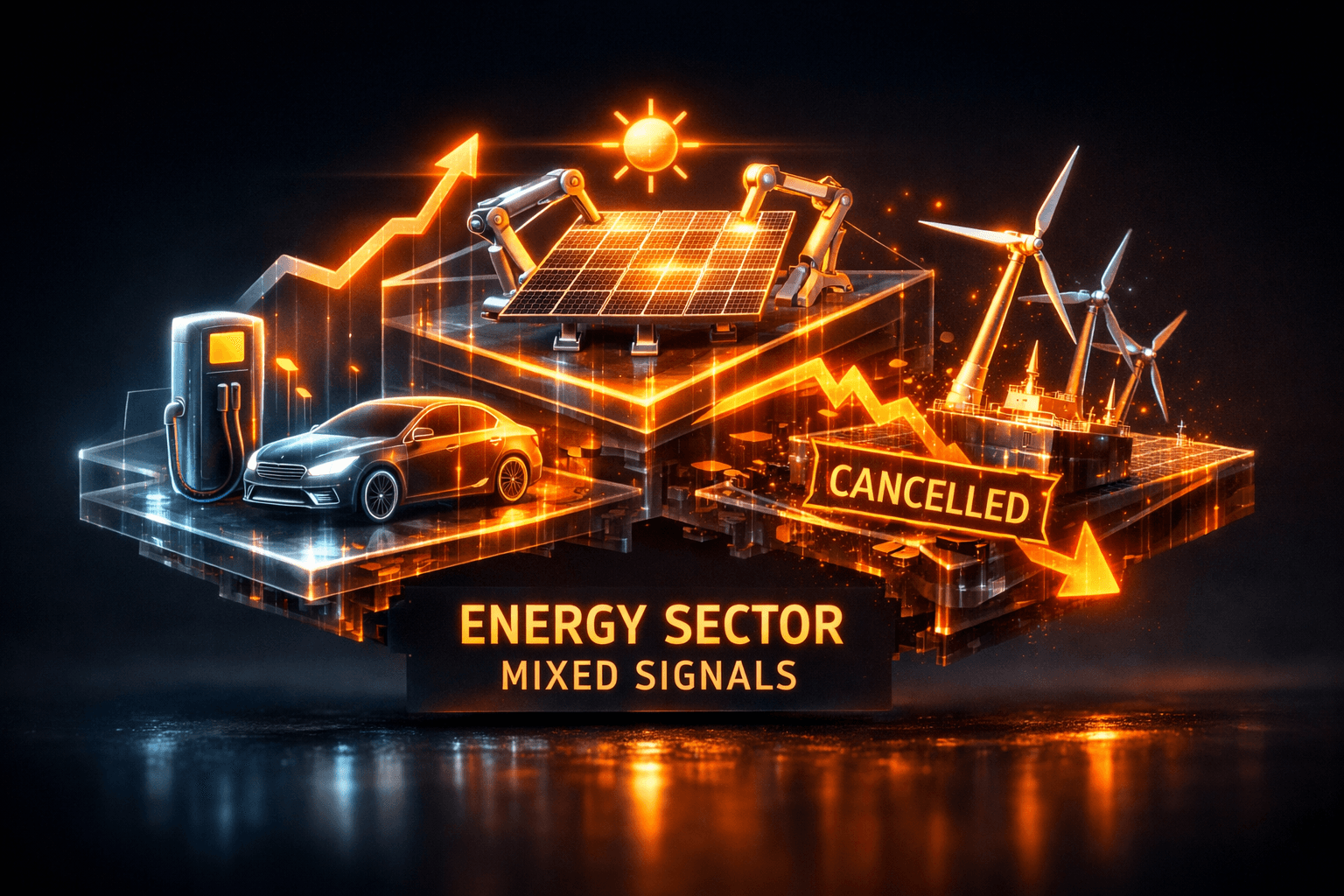
Energy headlines on Sunday paint a mixed picture for the sector, with technological momentum colliding with policy and execution setbacks. You saw strides on EV charging and automated solar construction that could lift long-term clean-energy capacity, but you also saw a high-profile U.S. decision to cancel offshore wind leases and a delay in cleaner ammonia output that underline near-term risks.
This matters because policy and project execution determine how quickly capacity and demand translate into revenue. What will investors be watching when markets reopen on Monday, March 30?
Market Highlights
U.S. markets were closed Sunday, with the last trading session on Friday, March 27. No new equity trading data is reported for today, but the headlines below set the backdrop for Monday.
- EV charging race: Chinese firms are pushing ultrafast chargers toward a five-minute charge target, a potential catalyst for EV adoption and charging infrastructure demand.
- Solar robotics milestone: A Maximo construction robot finished installing 100 MW of solar at AES Bellefield, highlighting automation gains in utility-scale solar construction and potential efficiency improvements for $AES.
- Offshore wind setback: The U.S. agreed to pay about $1 billion to $TTE to cancel planned offshore wind projects that would have totaled over 4 GW of capacity, a major policy reversal for U.S. wind development.
- Project delay: $WDS.AX reported a delay in the start of cleaner ammonia production at its Texas project, caused by third-party feedstock facility construction issues.
- Commercial EVs: Ford's all-new electric Transit City van aims to cut operating costs for fleets, reinforcing demand for commercial electrification and parts suppliers tied to $F.
- Operational note: A Greek shipowner sent another oil tanker through the Strait of Hormuz, showing continued maritime routes for crude exports amid geopolitical attention.
Key Developments
China and the Race to Five-Minute EV Charging
Chinese manufacturers and EV makers are prioritizing ultrafast chargers as a way to overcome the main consumer complaint about EVs, charging time. Faster charging could lower the perceived advantage of ICE refueling for consumers and fleets, which in turn may boost demand for charging hardware, site hosts and grid upgrades.
For you as an investor, that fuels the case for companies in charging networks and grid services, and raises questions about battery and power electronics suppliers. Can infrastructure scale keep pace with hardware innovation?
Solar Construction Automation Proves Out at Scale
A Maximo robot completed a 100 MW installation at the AES Bellefield site, a rare large-scale demonstration of construction robotics in utility solar. The move could reduce labor costs and accelerate build schedules if broadly adopted, increasing the capacity delivered per dollar invested.
That may benefit module makers, EPC contractors, and owners like $AES if the technology spreads. You should watch adoption metrics and cost-per-MW trends for signs of wider impact.
U.S. Offshore Wind Cancellation and the Cost of Policy Reversal
The U.S. decision to compensate $TTE with about $1 billion to walk away from more than 4 GW of planned offshore wind underscores how political choices can wipe out projects already in the pipeline. Those are gigawatts that would have supported supply chains, local jobs and downstream service providers.
Analysts note this raises execution and regulatory risk for renewable developers operating in the U.S. market, and it may shift investment toward onshore projects or international markets with more stable policy frameworks.
What to Watch
Heading into Monday you should track how headlines translate into market reactions and weekly momentum. Here are the concrete items that could move sentiment and sector flows.
- Policy and permitting: Any follow-up from U.S. agencies or legislative responses to the offshore wind cancellation could change risk pricing for developers and suppliers.
- Project timelines: Updates from $WDS.AX on the ammonia project and from other large developers on construction bottlenecks will show whether delays are isolated or systemic.
- Infrastructure deployments: Announcements of charging network rollouts or commercial fleet orders for EV vans, including deliveries from $F, could signal near-term demand strength.
- Technology adoption: Watch for more proof points of solar robotics scaling beyond one-off projects, and for commercial terms from charging suppliers that show cost and throughput outcomes.
- Geopolitics and shipping: Movements through the Strait of Hormuz and related insurance costs can influence oil and shipping-linked names if tensions rise.
Bottom Line
- News flow is mixed, with clear technology wins for EV charging and solar construction counterbalanced by policy and execution setbacks in wind and ammonia projects.
- Policy risk remains a dominant factor in U.S. renewables, as the offshore wind cancellation shows, and it can change economics quickly.
- Infrastructure and automation advances could lower build costs over time, offering upside to contractors and grid service providers if adoption broadens.
- Monitor project timelines and regulatory updates closely when markets reopen on Monday, March 30, because those items will drive near-term sentiment.
- Data and announcements, not headlines alone, will determine which trends are durable. Keep a selective approach and watch for confirmation of adoption or further setbacks.
FAQ Section
Q: Will the five-minute charging goal arrive soon? A: Industry players are racing toward much faster chargers, but widespread five-minute charging depends on battery chemistry, grid upgrades and commercial rollouts, so it will likely be incremental rather than instant.
Q: Does the U.S. canceling offshore wind mean renewable projects are dead in America? A: No, but analysts note it raises political and regulatory risk that could redirect capital to states and countries with clearer support, or to onshore projects that face fewer federal obstacles.
Q: Should I worry about project delays like Woodside's ammonia hold? A: Project delays are common in complex builds. You should watch whether delays are isolated supply-chain issues or signal broader constructability problems that might affect multiple firms.
Investment disclaimer: This article provides sector analysis and reported facts for informational purposes only. It does not recommend buying, selling, or holding any security, nor is it personalized investment advice.