The Big Picture
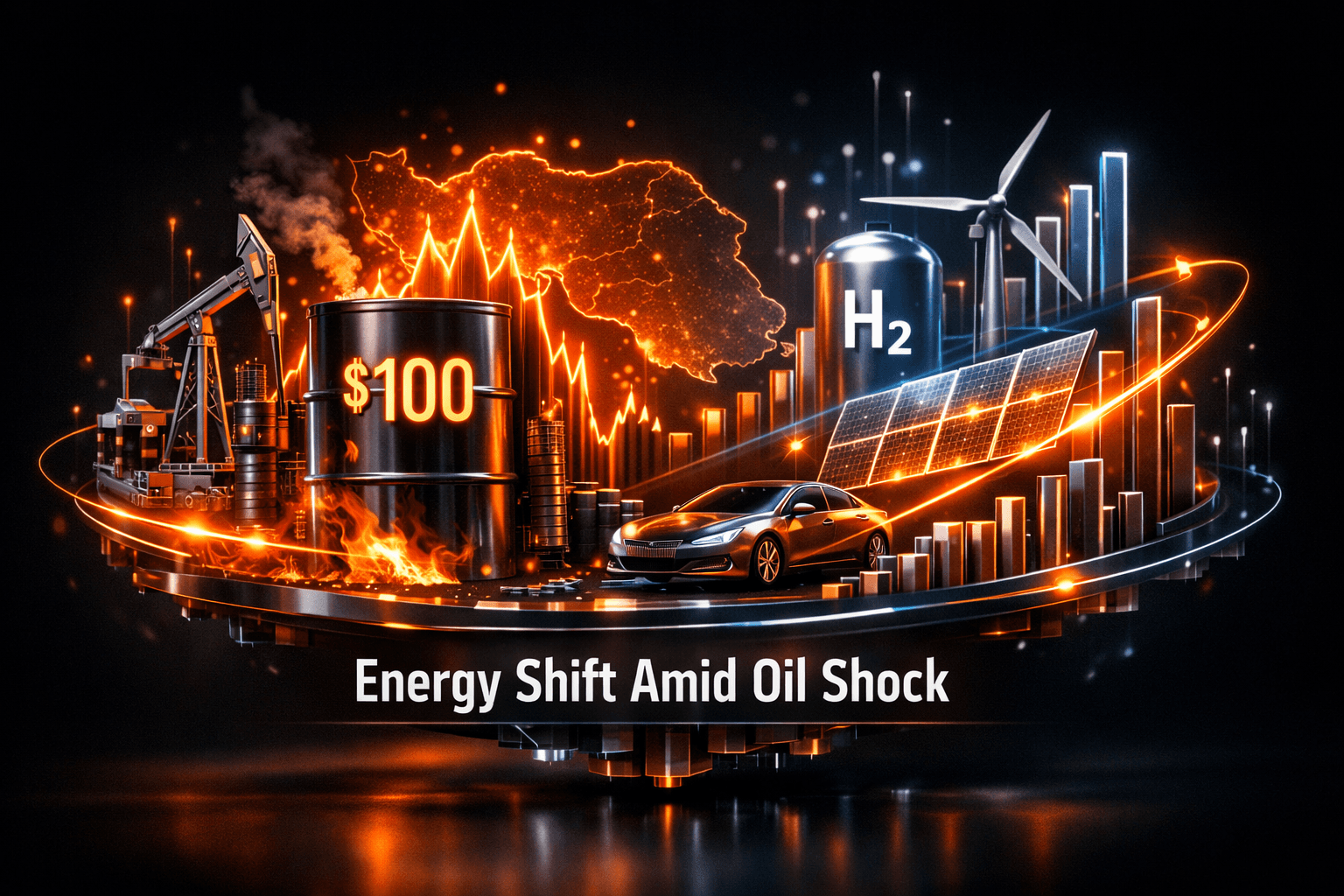
Crude surged past $100 a barrel today, driven by escalating Middle East tensions and port disruptions in Russia, and that price shock is already hastening the global shift toward electrification and renewables. You should pay attention because higher fuel costs are amplifying demand for EVs, solar, heat pumps, batteries and hydrogen, creating follow-through opportunities for companies across the clean-energy value chain.
This matters to investors because the market is reacting to both supply-side oil constraints and accelerating adoption of low‑carbon tech. The near-term picture is volatile, but the broader trend points to stronger sustainable energy demand and expanding capacity over the next few years.
Market Highlights
Key moves and data points that shaped the session.
- Oil prices: Global crude pushed above $100 per barrel amid the US-Israel-Iran confrontation and worries about disruption through the Strait of Hormuz.
- Russia exports: Ports including Ust-Luga halted loadings after drone strikes, and Russian sellers are warning they may declare force majeure on Baltic shipments, tightening seaborne flows.
- Solar and materials: China added 32.48 GW of solar in January and February, while polysilicon prices fell as much as 7.95% in the latest week.
- EVs and autos: Tesla is in the headlines again for product discussion, used EV sales are rising, and industry commentary says the Iran conflict could accelerate EV adoption in China and beyond, putting automakers such as $TSLA and $GM in focus.
- Upstream company: Aker BP, $AKERBP, reported solid 2025 production at 420.1 thousand boe per day but saw a profit slide as realized oil prices and impairments weighed on earnings.
Key Developments
Oil shock and supply disruption tighten markets
Fears of a wider Iran conflict and Ukrainian attacks on Russian Baltic ports combined to send crude above $100 today. Analysts and executives are already revising near‑term supply assumptions, and some traders are positioning for sustained volatility. For you, that means energy commodity exposure will likely drive short-term market swings, while higher fuel costs could pressure consumer spending.
Clean-energy demand accelerates, from EVs to home electrification
Multiple reports show consumers and automakers reacting to higher fuel prices. Data from the UK indicates households are rapidly switching from fossil heating to heat pumps, rooftop solar and EV chargers. Industry commentary also suggests higher fuel costs will further boost EV sales in China where local brands are already leading global deliveries. You may see this momentum reflected in parts of the supply chain, from battery makers to installers.
Renewables supply and tech advances expand capacity
China’s early-2026 solar build of 32.48 GW underscores continued deployment scale, while polysilicon prices fell nearly 8%, easing module production costs. Hydrogen outlooks are bullish, with GlobalData forecasting capacity could reach 82.3 million metric tons per year by 2030. Agrivoltaics and tracker or vertical solar systems are emerging as ways to lift land-use economics, which could change project returns for developers and landowners.
What to Watch
Events and data you should monitor heading into Monday.
- Geopolitics and oil flows, especially developments around Iran and Russian export terminals. Any escalation could keep oil elevated and volatility high.
- Solar module supply and polysilicon price trends. Falling input costs may support margin recovery for panel makers and installers, but watch inventory and shipment updates out of China.
- Battery and storage innovation. Sodium-ion progress and rising used-EV flows will affect residual values and demand for second-life batteries.
- Hydrogen deals and supply chains. Watch technology suppliers and off-takers as agreements and cancellations could reshape project timelines and credit profiles.
- Company reports and guidance. $AKERBP results highlight that upstream earnings remain sensitive to realized prices, while renewables players may report steadier growth metrics. Look for updated guidance that reflects higher power prices or installation forecasts.
How should you approach this? Ask what time horizon you have, and whether your exposure is tilted to commodity cyclicality or secular transition plays. Are you positioned for volatility or for longer-term structural demand? These are questions you should answer before making changes.
Bottom Line
- Oil disruptions and Middle East tensions pushed crude above $100, accelerating the case for electrification and renewables demand.
- Clean-energy indicators are strong, with China installing 32.48 GW of solar early in 2026 and hydrogen capacity forecasts expanding toward 82.3 mtpa by 2030.
- Falling polysilicon prices, down about 7.95% in the latest week, could ease module costs and support deployment economics.
- Upstream results remain mixed, illustrated by $AKERBP’s production resilience but earnings decline, showing sensitivity to realized prices and impairments.
- Expect continued volatility from geopolitical risk, but momentum indicates growing structural demand for EVs, batteries, solar and hydrogen.
FAQ Section
Q: Will higher oil prices speed up EV adoption? A: Yes, data and expert commentary suggest sustained higher fuel costs tend to boost EV demand and associated infrastructure investment.
Q: How do polysilicon price moves affect solar project economics? A: Lower polysilicon prices reduce module costs, which improves project margins and can accelerate deployment, depending on local incentives and grid connections.
Q: What risks should you watch in hydrogen and large-scale renewables? A: Key risks include supply agreements, project financing, technology readiness, and policy shifts that affect off-take and permitting timelines.