The Big Picture
Overnight crypto headlines delivered a split picture, with fresh technical advances arriving alongside renewed regulatory and security pressure. Project Eleven released a fast proof-of-concept for a Bitcoin "key-derivation path" recovery tool, while other stories highlighted stalled rulemaking and national restrictions that could affect access and compliance.
Markets were closed for U.S. equities over the weekend, and crypto continues to trade 24/7. As of Friday, July 17, investors were heading into the long weekend with both opportunity and uncertainty on the table, so you may want to keep an eye on governance votes and regulatory deadlines this week.
Market Highlights
Key facts and moves to note from the newsflow.
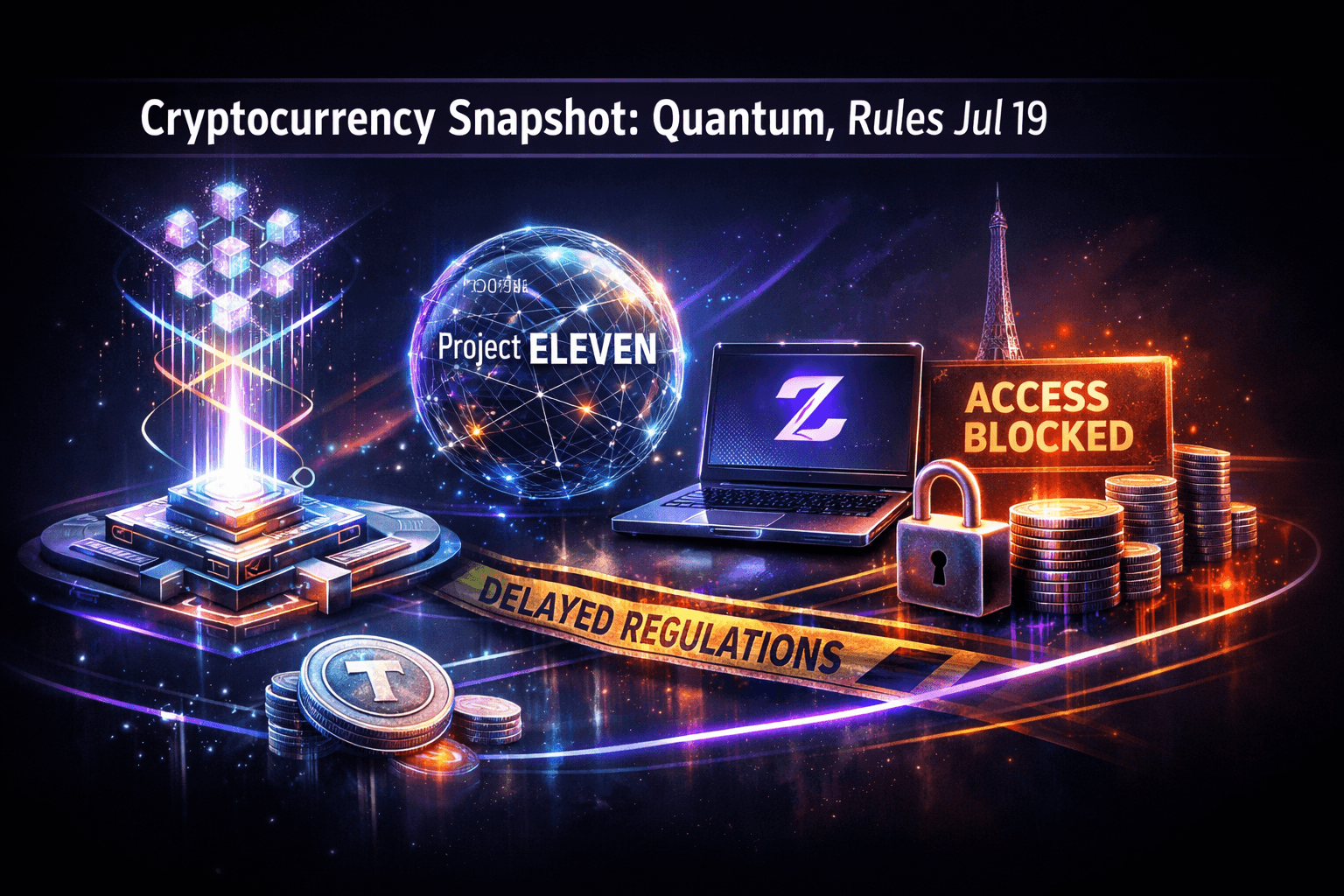
- Project Eleven unveiled a recovery tool that leverages a wallet's own key-derivation path, running in 243 milliseconds on a laptop, addressing part of Bitcoin's quantum-signature risk but not Satoshi's 1.1 million coins.
- Zcash's new Zakura node aims for Visa-scale privacy, targeting roughly 50,000 transactions per second as it moves from about one private TPS today to payment-network scale, a major throughput leap for $ZEC messaging.
- U.S. regulators missed the one-year deadline to finalize GENIUS Act stablecoin rules, compressing the implementation window ahead of the law's Jan 18, 2027 effective date.
- France ordered internet service providers to block Polymarket, citing addictive mechanics and regulatory concerns, a reminder of national-level enforcement risk to platforms.
- Uniswap governance votes open July 19 through July 26 on v4 fees and Robinhood Chain expansion, proposals that would route new fees into the UNI burn mechanism and could increase token burns for $UNI.
- Bitcoin Japan plans a $60 million raise with EVO Fund as it seeks to acquire bitcoin after prior capital went into AI and space-linked stakes.
- Kaspersky disclosed a malware framework targeting crypto investors via social engineering and trojanized GitHub apps, underscoring ongoing operational security risks.
Key Developments
Quantum resilience gets a pragmatic tool
Project Eleven funded a proof that lets a wallet's key-derivation path serve as evidence of ownership if quantum computers can forge signatures. The demonstration runs in 243 milliseconds on a laptop, signaling a practical step rather than a full fix for the most at-risk holdings.
Why does this matter to you? It shows researchers and developers are building recovery and mitigation layers that may lessen some long-term cryptographic risks, but the technique does not retroactively protect historically significant addresses like Satoshi's 1.1 million coins.
Regulatory calendar tightens after missed deadline
U.S. regulators missed the GENIUS Act's one-year deadline to publish final stablecoin rules, though the law's Jan 18, 2027 effective date still stands. That creates a compressed implementation window for firms and regulators alike.
At roughly the same time, France ordered ISPs to block Polymarket over consumer protection concerns. Taken together, these stories remind you that national and federal policy moves can accelerate unpredictably, affecting access, product launches, and compliance costs.
Scaling and governance: Zcash and Uniswap in the spotlight
Zcash's Zakura client is positioned to jump privacy throughput from roughly one private transaction per second toward 50,000 TPS. If the protocol and ecosystem tools scale, that could shift how private transactions are used in payments and service design.
Meanwhile, Uniswap's governance vote starting July 19 could route new protocol fees into UNI token burns under the UNIfication framework. That would potentially increase token deflationary pressure if voters approve the v4 fees and Robinhood Chain expansion proposals.
What to Watch
Here are the catalysts and risks you should monitor this week and in the coming months.
- Uniswap governance vote, July 19-26. Watch turnout and the exact fee mechanics, since approved fee routing would feed the UNI burn system and could affect on-chain metrics for $UNI.
- Regulatory implementation timeline for the GENIUS Act, with Jan 18, 2027 still the effective date. How regulators compress rules and guidance will matter for stablecoin issuers and platforms.
- Zakura rollouts and performance benchmarks. Will Zcash deliver secure, private settlement at high TPS, and how will supporting infrastructure adapt?
- Legal and access risks after France's Polymarket block. Could other jurisdictions follow, and how will platforms change consumer protections to comply?
- Security posture after Kaspersky's malware report. You should double-check operational security, avoid trojanized tools, and apply multi-factor and hardware key best practices.
- Capital deployment by public and private vehicles. Bitcoin Japan's planned $60 million raise to buy bitcoin signals demand from some allocators, but monitor timing and disclosure.
Bottom Line
- Tech innovation is advancing, with practical steps toward quantum resilience and massive TPS goals for privacy networks, showing long-term infrastructure progress.
- Regulatory and national enforcement actions are creating immediate uncertainty, compressing timelines and risking access disruptions for some platforms.
- Governance and fee votes this week could change token economics for leading protocols, so watch on-chain governance outcomes closely.
- Operational security remains a live threat, and the new malware framework report means you should be cautious with developer tools and social engineering attempts.
- Overall, the sector is showing mixed signals, so a selective approach and attention to rulemaking and security are warranted as you follow developments.
FAQ Section
Q: What does Project Eleven's proof mean for Bitcoin security? A: It shows a recoverability approach using a wallet's key-derivation path that can help mitigate some quantum risks, but it does not protect legacy addresses like Satoshi's coins.
Q: Should you expect immediate market moves from the GENIUS Act delay? A: The missed deadline compresses the rulemaking window, which could increase policy uncertainty, but the law's Jan 18, 2027 effective date still governs implementation timing.
Q: How urgent is the malware threat flagged by Kaspersky? A: It's a significant operational risk for developers and investors who use third-party tools; you should verify software sources, use hardware keys, and maintain robust security hygiene.