The Big Picture
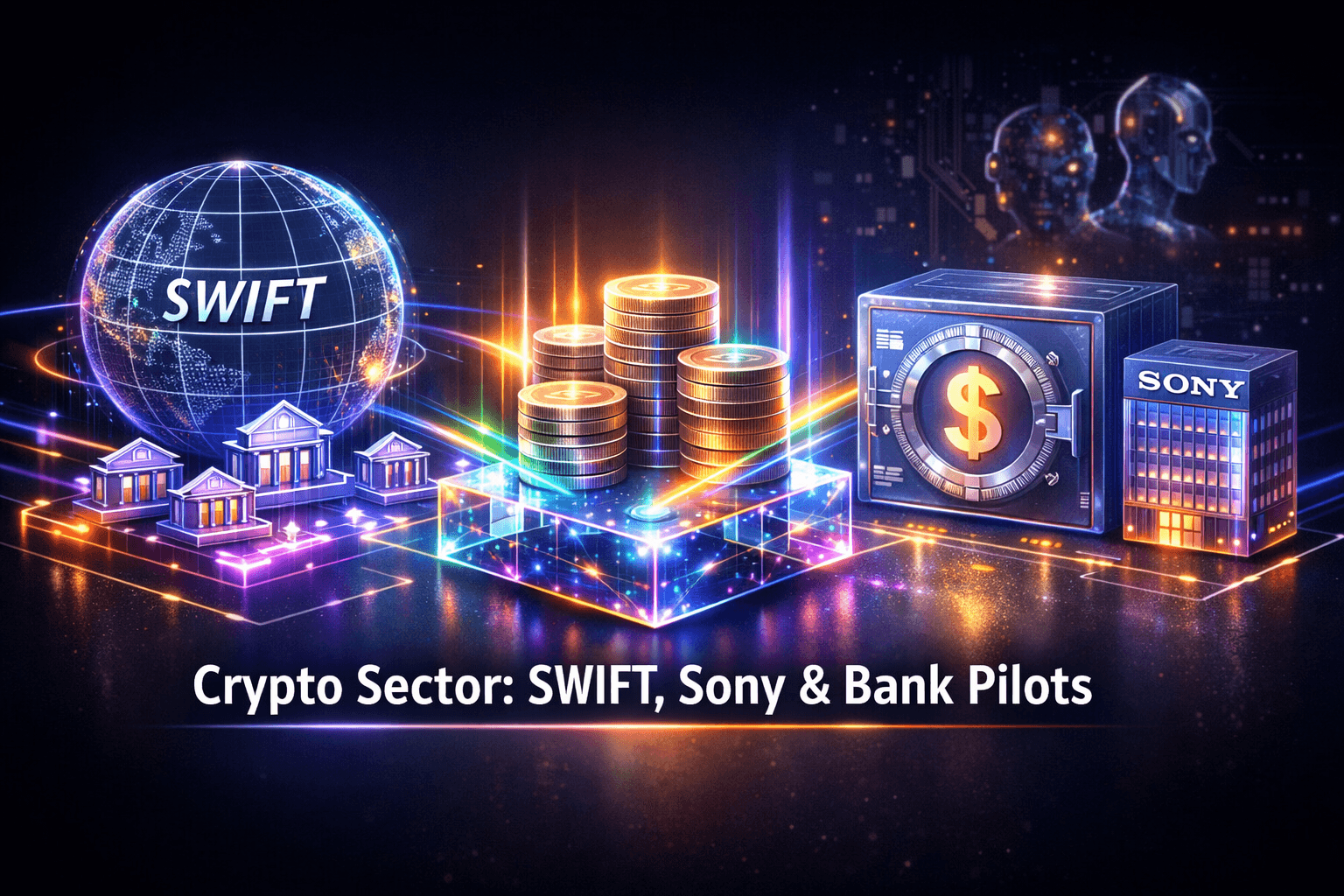
SWIFT's launch of a blockchain ledger to host a 17-bank tokenized deposit pilot is the standout development this morning, signaling a major institutional push into tokenized money. You should note that the pilot is designed to enable 24/7 cross-border payments using tokenized deposits, which could change how banks move liquidity.
At the same time, Sony won conditional regulatory approval to set up a U.S. stablecoin trust bank capitalized with $40 million, adding another credible corporate entrant to the stablecoin business. What does this mean for you as a retail investor? It points to slowly shifting industry plumbing toward bank-led digital asset rails, while enforcement actions and a rotation into AI listings keep markets selective.
Market Highlights
Key overnight developments moved the narrative toward bank adoption and regulatory engagement. You may see heightened attention on payments infrastructure names and regulated stablecoin issuers.
- SWIFT, the global messaging network, launched a blockchain ledger for a tokenized deposit pilot with 17 banks, aiming for 24/7 cross-border payments.
- Sony ($SONY) secured conditional approval to set up a U.S. stablecoin trust bank, with $40 million in capitalization for operations.
- Global enforcement: INTERPOL-led Operation First Light resulted in 5,811 arrests and uncovered a wallet that processed roughly $122.5 million in 10 months; authorities intercepted about $293 million in total.
- Binance is reportedly exploring new licensing paths in Europe and expanding in Asia after a MiCA-related setback, according to company leadership comments.
Key Developments
SWIFT launches tokenized deposit ledger with 17 banks
SWIFT's new blockchain-based ledger is being used in a pilot that includes 17 banks and supports tokenized bank deposits for continuous cross-border settlement. The pilot is notable because it comes from a long-standing intermediary, and it aims to bridge legacy banking systems and tokenized assets.
For you, that means the industry is testing ways to move fiat-like tokens across borders without relying solely on crypto-native rails, which could lower friction for bank clients and open corporate use cases for tokenized liquidity.
Sony gets conditional approval for U.S. stablecoin trust
Sony's New York subsidiary, fully owned by Sony Bank, received conditional approval and will be capitalized with $40 million to support stablecoin operations. The move gives a major consumer tech and financial brand a foothold in regulated stablecoin issuance and custody.
That institutional stamp could help normalize regulated stablecoins among mainstream firms. Which sectors benefit most if more corporates follow Sony? Payments, custodial services, and regulated issuance platforms are the likely early beneficiaries.
Enforcement sweep uncovers large laundering networks
Operation First Light, led by INTERPOL across 97 countries, logged 5,811 arrests and revealed crypto laundering networks using cross-chain swaps to obfuscate funds. One wallet processed about $122.5 million over 10 months, and the operation intercepted approximately $293 million overall.
Enforcement like this is a double-edged sword. It increases short-term compliance costs and scrutiny, but it also strengthens the case for regulated, bank-backed token solutions and clearer on-ramps for legitimate users.
What to Watch
Expect the focus to be on pilots and regulatory signals. You should watch live updates from the SWIFT pilot and regulatory approvals that could set precedents for other banks. Upcoming milestones will determine whether pilots move from proof of concept to production.
Keep an eye on several catalysts this week. Look for further details on SWIFT's timeline and participating banks. Monitor Sony filings and licence conditions, and watch how regulators in Europe respond to Binance's licensing efforts after its MiCA setback.
Risk factors remain clear. Continued regulatory enforcement, the diversion of capital into high-profile AI IPOs, and the operational complexity of cross-chain swaps could limit near-term upside. How fast will bank-led tokenization scale, and will market liquidity follow? Those answers will matter for adoption and fee pools.
Bottom Line
- Institutional momentum is building: SWIFT's 17-bank pilot and Sony's conditional approval are concrete steps toward bank-led tokenization.
- Regulatory and enforcement pressure is intensifying, exemplified by INTERPOL's large-scale arrests and major laundering discoveries.
- Market attention may shift toward AI IPOs short term, creating capital rotation risks for crypto-related equities and tokens.
- You should track pilot timelines, licence conditions, and regulator statements for clues on wider adoption and potential market impact.
- Data suggests the sector is moving from experimentation to regulated infrastructure, but progress will be uneven and selective.
FAQ Section
Q: What is SWIFT's tokenized deposit pilot and why does it matter? A: The pilot uses a blockchain ledger to let 17 banks test tokenized deposits for near-continuous cross-border payments, which could reduce settlement friction between banks and support bank-backed digital cash.
Q: Does Sony's conditional approval mean a U.S. stablecoin will launch soon? A: The approval is a key regulatory milestone and Sony plans to capitalize the trust with $40 million, but final launch timing will depend on meeting conditions set by regulators.
Q: Should I be worried about crypto crime after the INTERPOL sweep? A: Enforcement highlights persistent illicit activity, yet these actions also strengthen compliance frameworks and could improve long-term legitimacy for regulated crypto services.