The Big Picture
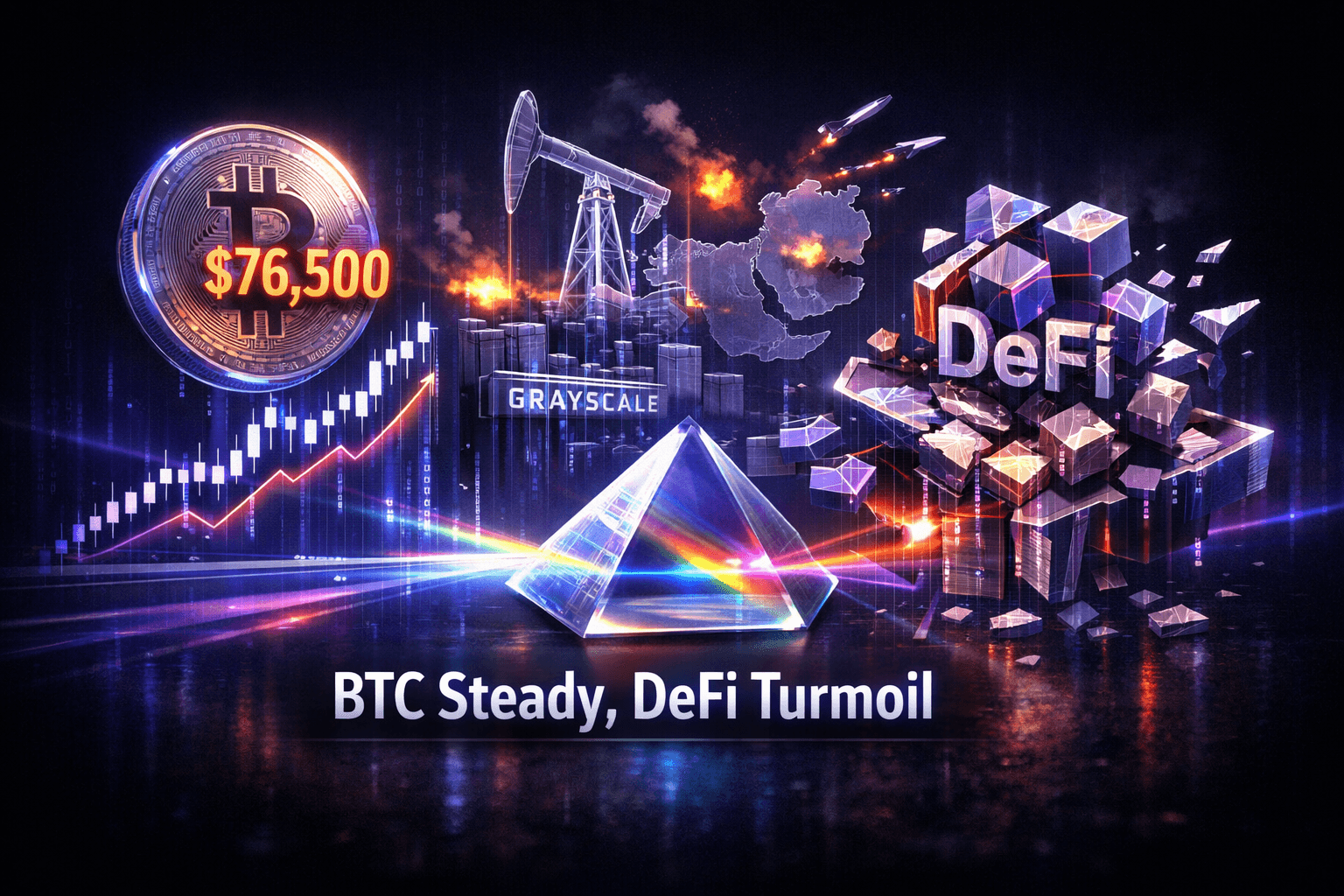
Bitcoin closed the day holding above $76,500, steadying after a weekend dip toward $75,000 as tensions in the Strait of Hormuz and oil market volatility kept traders cautious. At the same time, a major DeFi exploit and shifting custody arrangements among big funds highlighted persistent operational and security risks in the sector.
Why this matters to you is simple. Macro shocks are again nudging crypto prices, while structural changes in custody, mining capacity, and stablecoin-backed finance are reshaping where capital flows and where risk concentrates.
Market Highlights
Quick facts and headline moves to note from today.
- Bitcoin, $BTC, traded back above $76,500 after slipping toward $75,000 on the weekend, according to Bitcoin Magazine.
- DeFi sector losses topped roughly $600 million in recent weeks after the Kelp DAO exploit, contributing to total value locked falling to a one-year low, The Block reports.
- Grayscale amended its Hyperliquid ETF filing, dropping Coinbase, $COIN, as custodian and naming Anchorage as a custodian alternative, per The Block.
- Alcoa, $AA, is nearing a sale of its Massena East smelter to NYDIG for bitcoin mining conversion, signaling more industrial re-use of energy assets.
- Tether, $USDT, took an 8.2% stake in bitcoin mining finance platform Antalpha, expanding its footprint in crypto infrastructure.
Key Developments
Bitcoin Holds, Macro Risks Keep Traders Cautious
Geopolitical friction around Iran and prediction-market bets that Strait of Hormuz disruptions will persist sent oil prices higher and pushed some safe-haven flows into bitcoin, helping $BTC remain above $76,500. Cointelegraph technical commentary notes that $80,000 remains a key overhead resistance for bulls.
This interplay between oil and bitcoin raises a question for you, will macro-driven bids sustain further upside or merely keep bitcoin range bound until headlines calm?
DeFi Exploit Drags TVL to One-Year Low
A Kelp DAO exploit, with knock-on disputes involving Aave, $AAVE, and LayerZero, has contributed to over $600 million in losses across DeFi in recent weeks, according to The Block. The incident has sent total value locked to its lowest level in a year.
For investors this underscores that security and counterparty risk are still central. Data suggests liquidity is migrating away from yield-bearing DeFi pools while governance and recovery processes remain contested.
Custody Shifts and Institutional Moves
Grayscale amended a Hyperliquid ETF filing to drop Coinbase as custodian and name Anchorage, marking a notable custody reshuffle among large institutional product sponsors. The change follows Grayscale previously using Anchorage as a secondary custodian for some trust holdings.
Meanwhile Tether expanded its strategic investments, acquiring an 8.2% stake in Antalpha and continuing to broaden its non-stablecoin portfolio. These moves indicate larger players are reallocating resources across custody, mining finance, and infrastructure, a development that could change where institutional liquidity concentrates.
What to Watch
Look ahead to the catalysts and risks that could move markets tomorrow and into next week.
- Macro and geopolitical headlines, especially any escalation or calming around the Strait of Hormuz, will remain the primary near-term driver for oil and correlated risk assets including bitcoin.
- DeFi ecosystem responses to the Kelp DAO exploit, including recovery plans, audits, and any legal action, will determine whether liquidity returns to protocols or continues to migrate away.
- Regulatory and policy developments tied to the SEC under chair Paul Atkins are worth monitoring, because passage of a market structure bill would materially clarify agency authority over crypto and could affect custody models and product approvals.
- Industrial adoption signals, such as the potential $AA sale to NYDIG for mining, and further investments by stablecoin issuers into infrastructure, could influence mining capacity and funding availability.
- Technical levels matter, $80,000 remains cited as stiff resistance for $BTC, so watch volume and cross-asset flows for conviction on a breakout or renewed consolidation.
Bottom Line
- Bitcoin's price resilience above $76,500 shows macro risk can support crypto demand, but $80,000 is a key hurdle to clear before bulls regain broader control.
- DeFi suffered meaningful losses this month, and TVL is at a one-year low, highlighting persistent security and liquidity risks in permissionless finance.
- Institutional custody changes and strategic investments from players like Grayscale and Tether indicate continued maturation in infrastructure and capital allocation.
- Industrial recycling of energy assets for mining, illustrated by the Alcoa to NYDIG talks, points to continued growth in specialized bitcoin mining capacity.
- Analysts note the market is sending mixed signals, so a selective approach and attention to custody, security, and macro catalysts is warranted.
FAQ
Q: How important is the $80,000 level for bitcoin? A: Technical analysts say $80,000 is a major overhead resistance, and a decisive break with volume would likely shift momentum, while rejection could keep prices in a range.
Q: What does the Kelp DAO exploit mean for DeFi safety? A: The exploit and subsequent disputes show vulnerabilities in protocol design and integration, and data suggests users are temporarily withdrawing liquidity until remediation and audits occur.
Q: Will custody changes at Grayscale and Tether's stake moves affect market access? A: Changes in custody relationships and strategic investments indicate institutional product mechanics are evolving, which could influence confidence and operational risk for some market participants, but effects will unfold over time.