The Big Picture
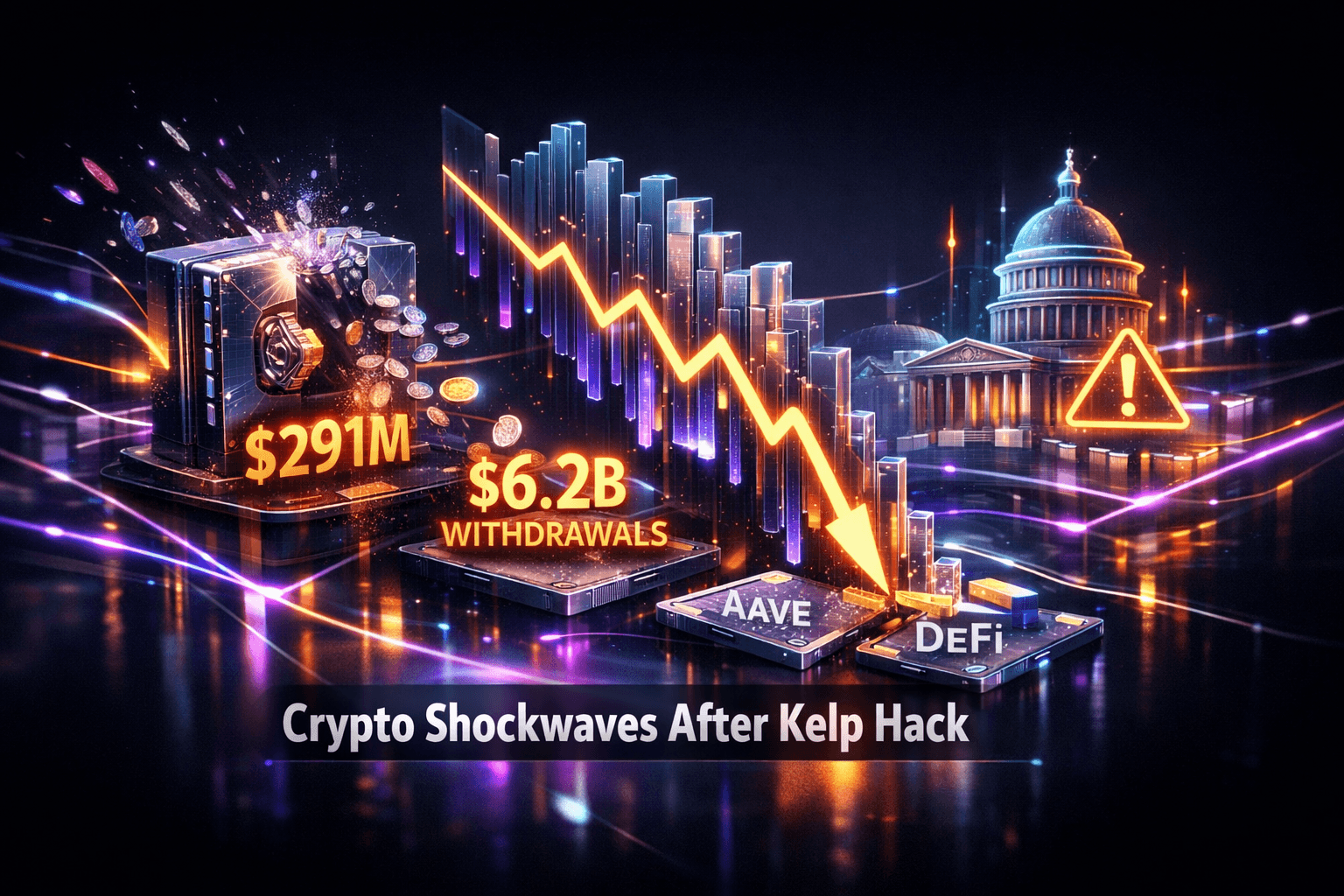
The biggest development in crypto overnight was a large cross-chain exploit tied to Kelp DAO infrastructure that drained roughly $291 million and sparked a liquidity crunch on Aave, prompting about $6.2 billion in withdrawal attempts. That attack spread fear through DeFi and put contagion risks back at the center of the conversation for developers, traders and policymakers.
Why this matters to you is simple. When core liquidity pools and front-end services get hit, access to capital can freeze and volatility jumps. With U.S. equity markets closed for the weekend, crypto markets kept trading and these headlines are already shaping sentiment heading into Monday.
Market Highlights
Quick facts and moves to know as you assess risk and positioning.
- Kelp DAO exploit: attackers siphoned about $291 million, according to reporting by Decrypt and CoinDesk.
- Aave ($AAVE) liquidity crunch: reporting indicates roughly $6.2 billion in attempted withdrawals amid strained liquidity on Aave lending markets.
- DeFi contagion: CoinDesk and Cointelegraph coverage characterizes this as one of the largest hacks of the year, with developers warning of cross-chain contagion and structural risk.
- Front-end and DNS risk: EasyDNS admitted responsibility for a social engineering hijack affecting eth.limo, highlighting DNS vulnerabilities at the application layer.
- Broader context: analysts note that the 2024 BTC cycle has underperformed past halvings, suggesting longer standing volatility changes, while AI traffic to retailers jumped 393 percent in Q1, showing tech tailwinds elsewhere.
Key Developments
Kelp DAO exploit and Aave liquidity squeeze
Reports say attackers drained $291 million from Kelp DAO-linked infrastructure which then fed into a wave of withdrawals on Aave, producing about $6.2 billion in attempted exits. Developers and protocol teams scrambled to manage liquidity and to limit contagion across lending pools.
For you that means higher short-term volatility and counterparty risk in non-isolated lending markets. Analysts quoted in Cointelegraph warned that preserving capital efficiency may require trade offs with isolation mechanisms going forward.
DeFi contagion debate and non-isolated lending
Coverage framed the exploit as a test case for non-isolated lending models. Some protocol founders argued the loss could have been contained with more isolation, while others warned that isolation reduces capital efficiency and yields.
This debate will influence protocol upgrades and design priorities. If you use aggregated lending or cross-margin products, expect renewed focus on liquidation mechanics and reserve sizing in the near term.
Front-ends, DNS risk and the broader security picture
EasyDNS publicly accepted responsibility after a social engineering hijack of eth.limo, the first such breach in 28 years for the provider. That incident joins several recent frontend compromises and makes clear that decentralization at the base layer does not remove operational risks at the application layer.
Developers and custodians will push for better DNS hygiene, multi-sig standards and user education. You should assume the attack surface includes custodial services and domain infrastructure, not just smart contract code.
What to Watch
Here are the catalysts and risk factors that should guide your monitoring over the next 24 to 72 hours.
- Protocol responses: track announcements from Aave governance and major lending pools for emergency measures, liquidity injections or parameter changes.
- On-chain flow and stablecoin movement: watch large stablecoin transfers and contract interactions that signal where liquidity is moving.
- Consensus Policy Summit: policy discussions start this week and may include regulatory responses to systemic DeFi risks. What regulatory changes might be proposed, and how will developers react?
- Front-end security fixes: monitor EasyDNS remediation steps and any advisories from major wallets and dapps.
- Macro and BTC cycle commentary: analysts like Galaxy’s Alex Thorn say recent Bitcoin cycles have shown declining volatility. That may temper expectations, but data suggests cycles can shift. How you interpret that will affect risk tolerance.
Bottom Line
- Major hack and withdrawal panic have created immediate stress for DeFi liquidity and renewed contagion fears.
- Non-isolated lending models are under scrutiny, and protocol upgrades or governance actions could change yield dynamics.
- Application layer security, including DNS and front-end controls, is now as important as smart contract audits.
- Policy discussions at the upcoming Consensus summit could accelerate regulatory attention on systemic risk in DeFi.
- At the end of the day, these events increase short-term uncertainty for crypto markets and highlight the need for careful risk assessment.
FAQ Section
Q: How big was the Kelp DAO exploit and what else was affected? A: Reporting shows roughly $291 million was drained and it prompted around $6.2 billion in attempted withdrawals on Aave and related liquidity pools, creating acute stress across lending markets.
Q: Will this change how DeFi lending is built? A: Data suggests renewed interest in isolation and reserve mechanisms, but trade offs with capital efficiency mean design changes will be debated and rolled out over time.
Q: Should I expect regulators to react after the hack? A: Policy attention is already rising with Consensus’ policy summit on the calendar. Regulators are likely to cite contagion risks when discussing oversight and operational standards.