The Big Picture
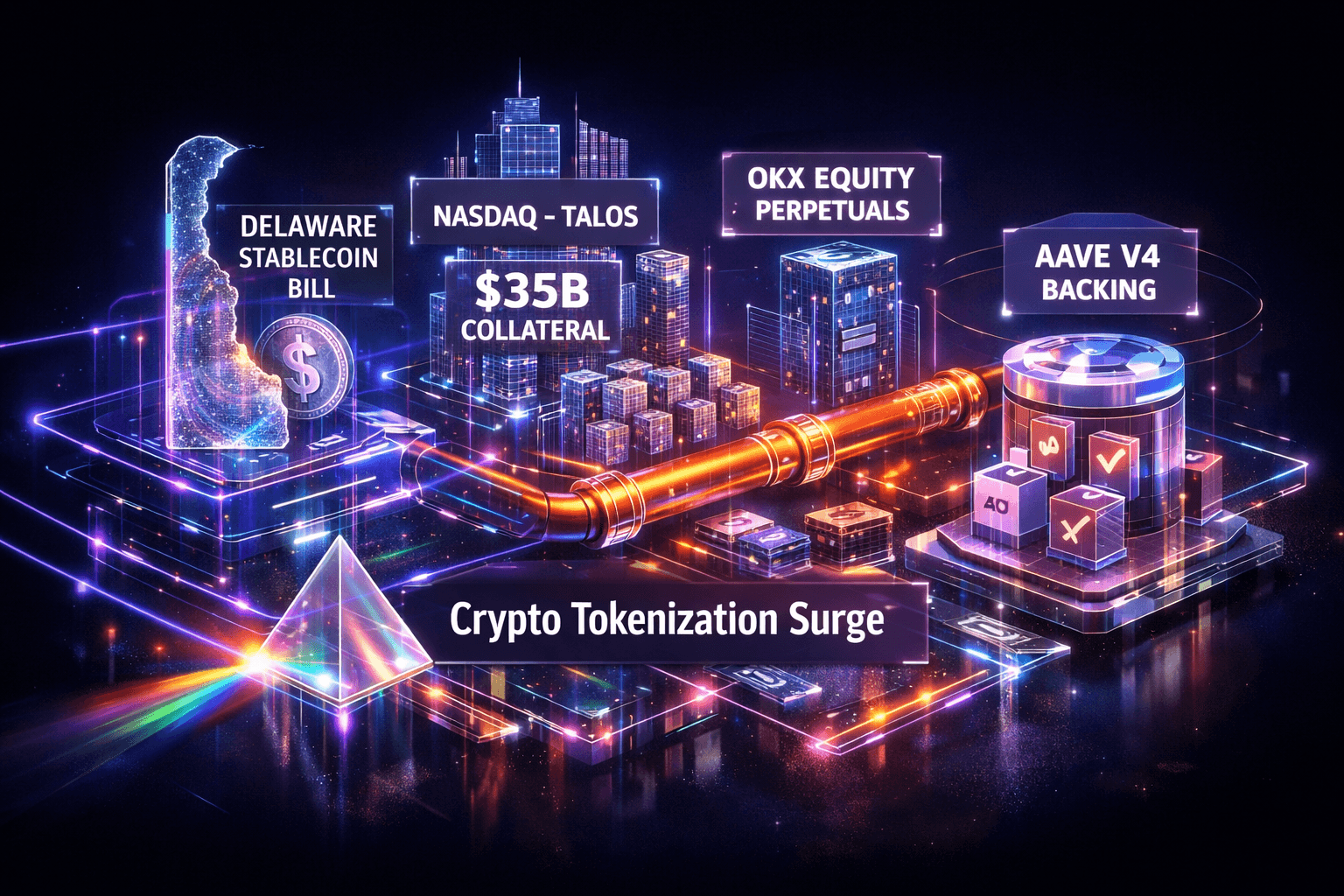
Crypto markets woke to a wave of infrastructure and product moves that underline accelerating institutionalization and new use cases. Delaware lawmakers introduced bills to license stablecoin issuers and let state banks manage digital assets, while market infrastructure players and exchanges rolled out solutions aimed at clearing collateral jams and expanding tradable products.
These developments matter because they address long standing frictions you may have heard about, from regulatory uncertainty to trapped collateral and limited institutional rails. Momentum around tokenization and onchain governance now looks set to drive liquidity and product innovation through the spring.
Market Highlights
Quick facts and overnight price action to note for your watchlist.
- Delaware lawmakers filed bills to license stablecoin issuers and permit state banks to custody and manage digital assets, a move toward clearer state-level regulatory frameworks.
- Hyperliquid reported HIP-3 open interest rose 25% in one week to $1.74 billion, with top pairs tied to tokenized real world assets like crude oil and silver.
- Nasdaq is integrating collateral and surveillance systems into Talos’s trading stack to tackle a roughly $35 billion trapped collateral problem.
- OKX launched 24/7 equity perpetual swaps with 5x leverage on the Mag Seven and additional contracts covering crypto-related stocks including $COIN and $HOOD.
- Aave DAO’s snapshot backed the V4 mainnet plan in a near-unanimous vote, moving toward a binding onchain decision.
- Balancer Labs will shut down as a corporate entity after a $110 million exploit, while the DAO pursues restructuring and a BAL buyback to provide exits.
- Macro moves: oil jumped about 4% on reports Gulf allies may join the Iran conflict, and crypto markets recovered with gains for $BTC, $ETH and $SOL.
Key Developments
State-level stablecoin licensing in Delaware
Delaware lawmakers filed two bills to license stablecoin issuers and allow state banks to manage digital assets. For you that means a potential increase in regulated onramps and custodial options, especially if other states follow suit. Clearer state rules often lower friction for traditional financial institutions thinking about crypto services.
Nasdaq and Talos target trapped collateral
Nasdaq is wiring collateral and surveillance into Talos’s institutional trading stack to fix a $35 billion trapped collateral problem tied to tokenization and margin processes. Can better plumbing unlock meaningful institutional flows? If so, tokenized assets and institutional desks could see easier capital efficiency and faster settlement.
Exchange product expansion and onchain upgrades
OKX rolled out round the clock equity perpetuals for the Mag Seven with 5x leverage and plans to expand into tokenized assets later this year. That lets crypto holders use $BTC and other holdings as collateral to access synthetic stock exposure. Meanwhile, Aave DAO moved to formalize V4 with a near-unanimous governance snapshot backing, signaling active development and onchain coordination.
These moves show both centralized exchanges and decentralized protocols are pushing new entry points and functionality. You should note the difference in risk profiles though; exchange margin products bring leverage and counterparty exposure, while protocol upgrades like $AAVE V4 change onchain mechanics and governance risks.
What to Watch
Here are the catalysts and risks that could move markets over the next days and weeks.
- Regulatory follow-through: Will Delaware’s bills pass and will other states adopt similar frameworks? Regulatory clarity could lower business risk and increase institutional participation.
- Collateral solutions rollout: Watch announcements from Nasdaq and Talos for pilot timelines and participant lists. Successful pilots could ease the $35 billion collateral drag and boost tokenization volumes.
- Product adoption and risk: Track OKX’s liquidity and margin utilization on the new equity perps, and watch whether those products pull volume from traditional venues. Remember leveraged products magnify gains and losses.
- Protocol governance: Monitor the binding onchain vote for Aave V4 and DAO execution plans. Governance outcomes will affect $AAVE holders and DeFi counterparties.
- Security repair and DAO restructures: Follow Balancer’s restructuring plan, fee changes, and the BAL buyback details so you understand potential dilution or exit mechanics for token holders.
- Macro and geopolitical pressure: Treasury yields, swap spreads, and energy market moves could influence crypto flows. You should watch U.S. rates and oil headlines for correlation risks.
Bottom Line
- Institutional and product developments dominate today, with state-level stablecoin licensing and Nasdaq-Talos plumbing aimed at unlocking capital efficiency.
- Exchange-led product expansion, exemplified by OKX’s equity perpetuals with 5x leverage, broadens access but raises margin and counterparty considerations.
- DeFi governance remains active, as Aave moves toward a binding V4 vote while Balancer’s corporate shutdown follows a $110 million exploit and a DAO-led restructuring plan.
- Hyperliquid’s 25% weekly open interest gain to $1.74 billion highlights rising demand for tokenized RWA pairs, a sign of growing market complexity.
- Geopolitical and macro risks persist, so clearer skies ahead for infrastructure do not remove near-term correlation to rates and oil shocks.
FAQ Section
Q: What does Delaware licensing for stablecoins mean for the market? A: It signals state level regulatory progress that could create safer onramps and more institutional custody options, which may boost business activity if adopted broadly.
Q: How serious is the $35 billion collateral problem Nasdaq and Talos are addressing? A: Very. Trapped collateral reduces capital efficiency for tokenized assets, and fixes could increase liquidity and reduce margin congestion for institutional desks.
Q: Should I be worried about the Balancer exploit and DAO changes? A: Security events remain material. Balancer’s move to shut down its corporate arm and pursue DAO restructuring aims to limit legal risk and offer holders an orderly path, but you should monitor implementation and any tokenomics changes closely.