The Big Picture
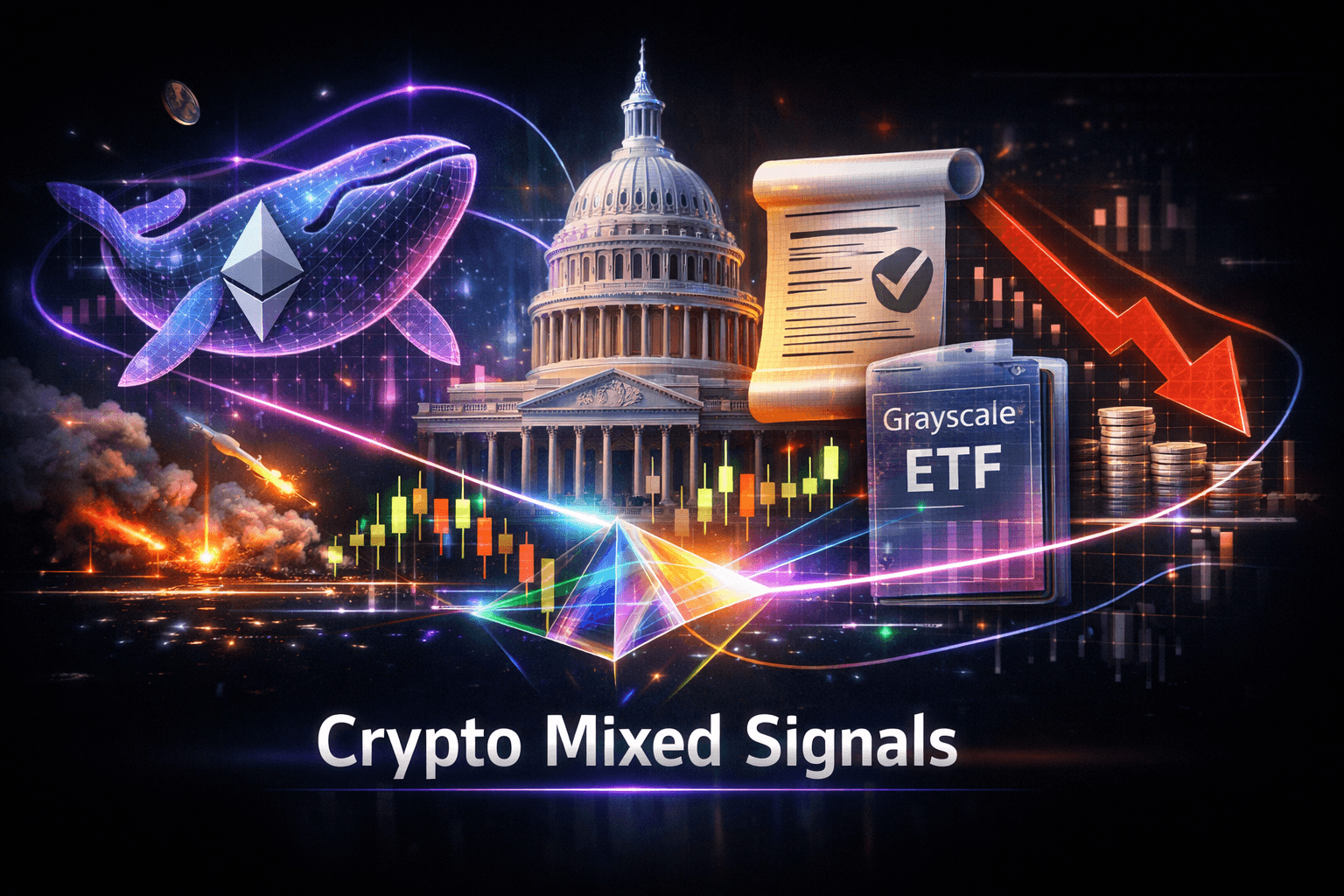
Cryptocurrency headlines this weekend are sending mixed signals, and you should be paying attention if you hold digital assets. On one hand, a high-profile ETH accumulation and fresh ETF filing show institutional interest and product innovation. On the other hand, geopolitical tensions and risk-off flows are pressuring Bitcoin and prompting traders to pay for downside protection.
These stories matter because they point to a tug of war between demand drivers and macro or political risk, and that tug will shape volatility into next week as Congress advances crypto legislation and markets reopen after the weekend.
Market Highlights
Here are the quick facts you need heading into the long weekend.
- Ethereum accumulation: Early Ethereum whale thomasg.eth bought about $19.5 million in $ETH this week, a notable single-party accumulation that analysts flag as a bullish signal for on-chain demand.
- Bitcoin flows and sentiment: Cointelegraph reports BTC weakness as the US and Israel-Iran war enters its fourth week, with ETF and equity outflows rising as traders cut risk.
- Regulatory and product moves: Grayscale filed for a HYPE ETF tracking Hyperliquid, which would trade on Nasdaq under the proposed ticker $GHYP if approved.
- Legislative progress: Negotiators announced an "agreement in principle" on stablecoin yield treatment in a sweeping crypto bill, a development that could affect how yields are regulated nationwide.
- Other notable items: Nevada issued a temporary ban on Kalshi markets for at least 14 days, and prosecutors revealed an $8 million AI-driven streaming royalties fraud case that highlights new tech-related risks.
Key Developments
Whale Buys and Institutional Product Interest
An early Ethereum adopter, known on-chain as thomasg.eth, reportedly added $19.5 million of $ETH this week. That move, paired with Grayscale's HYPE ETF filing to track onchain perps on Hyperliquid, shows demand from both deep-pocketed holders and traditional asset managers for crypto exposure.
What does this mean for you, the retail investor? It suggests institutional product development and on-chain accumulation are supporting the market's structural growth, even as price action remains uneven.
Geopolitical Risk Drains Risk Appetite
Bitcoin weakness deepened as the conflict involving the US, Israel and Iran stretched into week four. Media reports cite rising ETF and equity outflows as traders pare risk. VanEck added that volatility has come down over the last month, but market participants are still paying a premium for downside protection.
So how should you interpret that? Stabilizing volatility does not mean comfort; it can mean investors are buying insurance. That dynamic tends to cap upside until geopolitical clarity returns.
Regulation Advances, But State-Level Friction Persists
Lawmakers said they reached an "agreement in principle" on stablecoin yield provisions in a broader crypto bill, a meaningful step toward clearer federal rules. At the same time, Nevada temporarily banned Kalshi's prediction markets for at least 14 days, showing state-level regulatory actions can still surprise markets.
Those two threads are connected. Federal clarity could smooth state conflicts over time but, for now, you should expect a patchwork of actions that can affect firms operating across state lines.
What to Watch
As you plan for next week, focus on catalysts that will move sentiment and flows.
- Congressional progress on the crypto bill, including final language on stablecoin yields. Any vote or public timeline will be market-moving because it shapes custody and yield frameworks.
- Regulatory responses to the Grayscale HYPE ETF filing and other product registrations. Watch SEC commentary and Nasdaq steps on $GHYP.
- Geopolitical headlines tied to the US and Israel-Iran war. Headlines are driving risk-off flows in BTC and cross-asset selling, so monitor developments closely.
- Options and derivatives activity including demand for put protection. VanEck notes traders are paying up for downside protection, which can signal limited appetite for speculative longs.
- Legal and fraud risk tied to AI, including the $8 million fraudulent streaming case, and ongoing security research such as the BlockSec vs EVMBench debate about AI auditing.
Who stands to gain or lose in the near term? Winners may include firms offering regulated yield or institutional-grade exposure, while smaller venues and prediction markets could face regulatory headwinds.
Bottom Line
- Mixed signals dominate: institutional filings and large on-chain buys suggest structural demand, but geopolitical tensions and outflows are keeping risk premiums elevated.
- Regulatory progress at the federal level is promising, yet state bans and political noise can still trigger market shocks.
- Options market behavior indicates traders are buying downside protection, so volatility may remain one-sided until clarity emerges.
- New technology risks are real, as highlighted by an $8 million AI-driven fraud case and debates over AI's role in security audits.
- Stay selective and monitor legislative, regulatory and geopolitical headlines closely, because they are likely to drive flows and price action into next week.
FAQ Section
Q: Is the Ethereum whale buying a sign of a sustained rally? A: Large on-chain purchases indicate accumulation and can support sentiment, but they do not guarantee a sustained rally given current macro and geopolitical headwinds.
Q: How will the "agreement in principle" on stablecoin yield affect yield products? A: The agreement signals progress toward federal rules that could clarify how stablecoin yields are treated, which may encourage product development, though final text and implementation will determine the impact.
Q: Should I be worried about the Nevada Kalshi ban and political headlines? A: State-level actions and political noise can create short-term volatility and operational risk for specific platforms, so you should watch for broader regulatory responses and legal developments.