The Big Picture
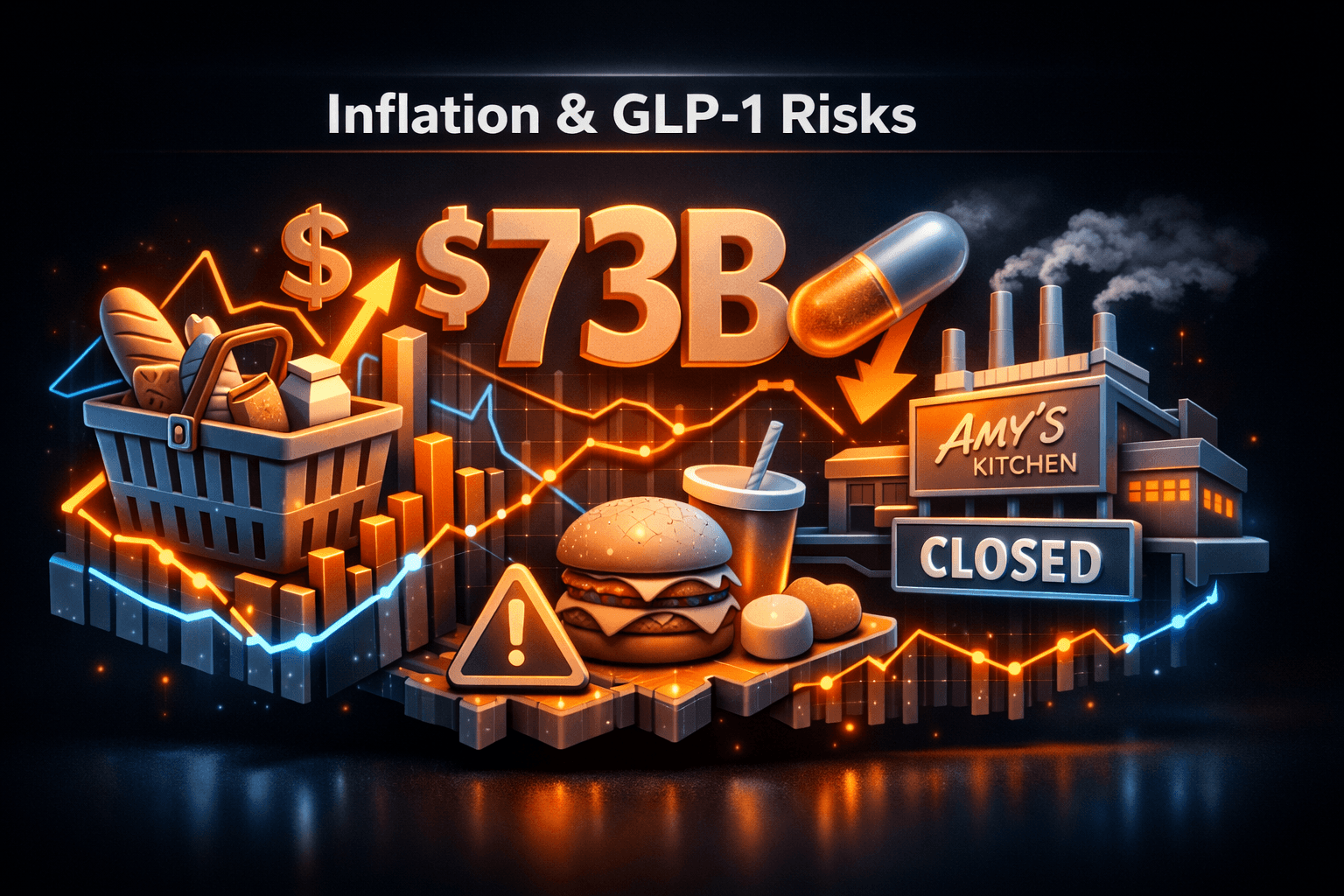
Today the sector tightened as macro and structural risks gained the spotlight. A Brand Finance report saying GLP-1 weight-loss drugs put about $73 billion in global food value at risk landed as grocery inflation signals and a manufacturing shutdown added fresh pressure.
That combination matters because it targets the profit pools of major snack and convenience brands and raises input and logistics costs across the store shelf. You should expect investors to focus on margin resilience and demand durability heading into the last quarter.
Market Highlights
Key moves and takeaways from today’s headlines and company actions.
- Brand Finance estimates GLP-1 exposure at roughly $73 billion in global food value, calling out major snack brands including $PEP, $K, and $HSY as among the most exposed.
- Amy’s Kitchen announced plans to close a California frozen-food plant, eliminating about 260 jobs as it streamlines manufacturing amid category headwinds.
- Grocery industry leaders at an FMI briefing warned that rising fuel costs could push grocery inflation higher, a trend that may squeeze retailer and supplier margins.
- $AMZN asked Meta to remove Amazon from the Muse AI agent shopping experience after learning the agent would access its shop without prior notice, highlighting platform control tensions.
- $GPS rolled out a multiyear “fashiontainment” tie-up with boy band Just Your Type, signaling bigger experiential marketing bets.
- Aldi will add its first ready-made meals line, expanding the discount grocer’s private-label reach into single-serve and family-size prepared items.
- On Holding $ONON says a recent soccer entry can help it nearly double sales by 2029, targeting high-teens growth over the next three years, though analysts remain skeptical.
- Trane Technologies $TT unveiled expanded AI maintenance and replacement tools for building owners, a move that could lower operating cost for retail real estate and facilities teams.
Key Developments
GLP-1 Drugs and Snack Brands
Brand Finance put $73 billion of global food value at risk from GLP-1 drugs, naming names like $PEP, Kellogg $K, and $HSY as highly exposed. This is not just a headline number, it’s a structural revenue risk that could reshape category priorities and promotional strategies across the snacking and confectionery aisles.
How should companies respond, and how should you read results in the coming quarters? Analysts note brands will need to sharpen product segmentation and innovate around lower-calorie or functional offerings to defend sales.
Rising Grocery Inflation and Supply Pressure
Industry experts at an FMI briefing flagged rising fuel costs as the next inflation pressure point that could force price increases. Retailers and suppliers have been absorbing costs so far, but that buffer is thinning and margin compression appears likely if fuel trends continue upward.
That dynamic ties directly to Amy’s Kitchen’s decision to shutter a California plant and cut roughly 260 roles as it streamlines operations. The closure is a concrete sign of tightening economics in frozen and organic food manufacturing.
Platform Control, Marketing Bets and New Products
Platform friction returned today when $AMZN asked Meta to remove it from Meta’s Muse AI agent experience after Amazon said it wasn’t given advance notice. This underscores rising tensions over agentic shopping and access to inventory and pricing data on third-party AI platforms.
On the brighter side, Gap $GPS is investing in multiyear experiential content with a boy band to drive engagement, and Aldi is launching ready-made meals to broaden private-label reach. Small DTC players like La Joya Jewelry say they can absorb rising fulfillment costs because of higher average order values, but channel mix and marketplace fees will remain an area you should watch.
What to Watch
Look to upcoming catalysts and risk signals that will shape sentiment in the near term. You should track earnings and guidance from major food and grocery retailers, and watch fuel price trends for margin implications.
Will snack-brand sales trends show sustained weakness as GLP-1 adoption grows, or will product innovation stabilize volumes? Expect volatility around quarterly results and analyst revisions as more data arrives.
Other actionable items include monitoring $AMZN platform positioning with AI agents, updates on manufacturing rationalization at Amy’s Kitchen, and execution of experiential campaigns at $GPS. Keep an eye on $TT deployments of AI tools at retail properties as those may influence operating costs over time.
Bottom Line
- Structural risks dominated today, with GLP-1 exposure and rising grocery inflation posing medium-term pressure on food and retail margins.
- Company-level moves are mixed: Aldi’s ready-meals and $GPS’s experiential push offer growth angles, but manufacturing cuts at Amy’s signal cost stress.
- Platform control battles like $AMZN versus Meta add uncertainty around distribution and agentic shopping, a new operating risk to monitor.
- Facility-level AI from $TT could reduce operating drag for store owners over time, but won’t offset near-term margin pressures for many brands.
- Analysts note you should expect selective weakness and increased focus on SKU-level performance as companies adapt product mixes and pricing strategies.
FAQ Section
Q: How big is the GLP-1 risk for food brands? A: Brand Finance estimates about $73 billion in global food value is exposed, with major snack and confectionery brands among the most vulnerable.
Q: What does rising grocery inflation mean for margins? A: Rising fuel and input costs usually force price increases or margin compression; retailers and suppliers will be tested on how much they absorb versus pass to consumers.
Q: Should I expect more plant closures like Amy’s Kitchen? A: Data suggests companies will continue to rationalize manufacturing and logistics where unit economics weaken, so additional closures or network changes are possible.