The Big Picture
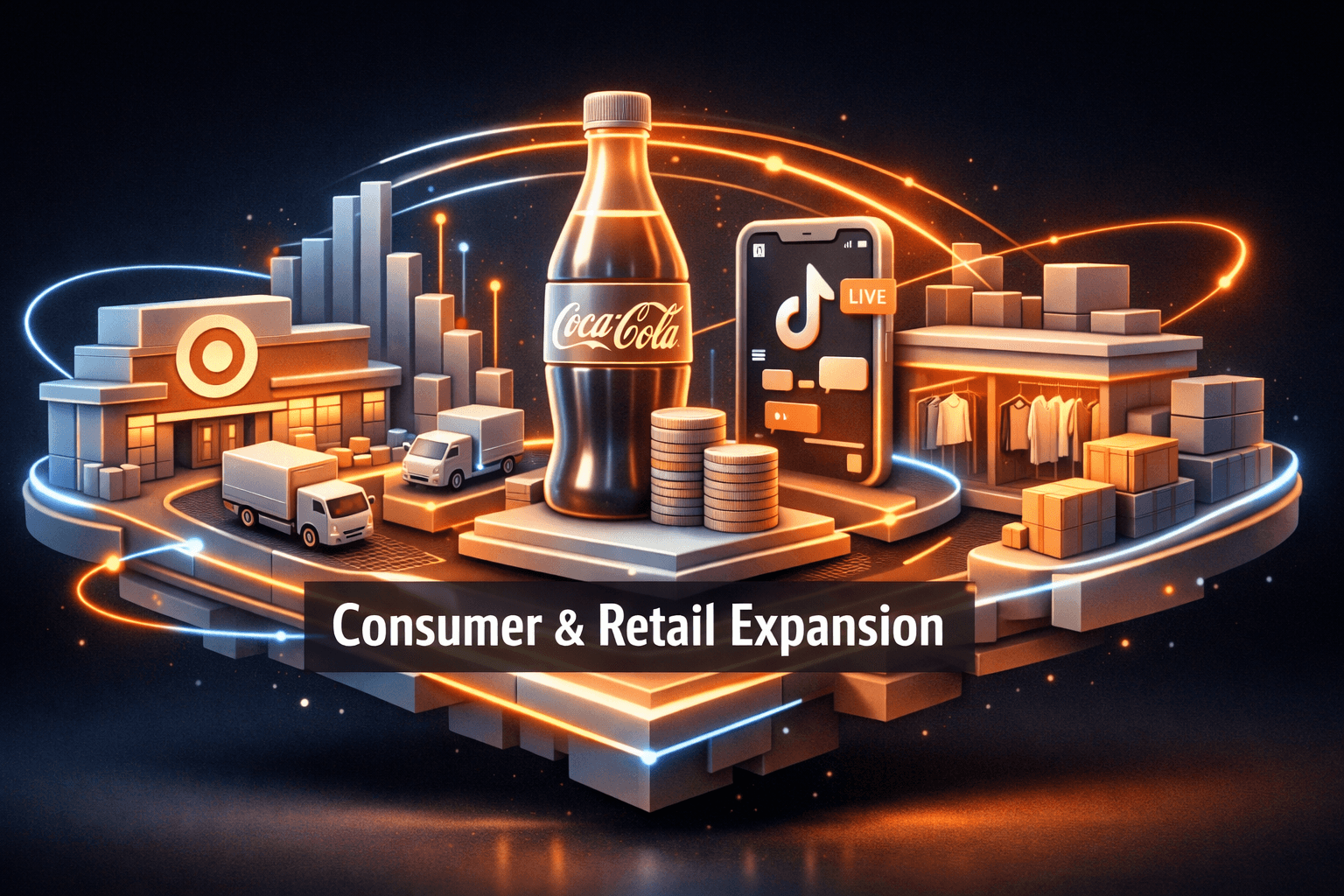
Retailers and consumer brands are redeploying capital into physical presence and supply capabilities while leaning on new digital channels for discovery. You’ll see this in store openings at $TGT, Unilever-backed brand rollouts into mass retail, and heavy manufacturing commitments from $KO.
This matters because it signals a coordinated shift in strategy: brands are trying to regain control of acquisition economics as AI reshapes digital ad markets, and they’re backing that shift with real-world investment. What does that mean for you as a retail investor? Expect more spending on stores, logistics, and experiential formats, and a faster evolution of commerce channels such as livestreaming.
Market Highlights
Quick facts and figures from overnight and recent developments:
- The Laundress, now owned by Unilever, is launching into Target, marking its largest brick-and-mortar expansion to date. Parent company is listed as $UL.
- TikTok Shop U.S. reports 94% of luxury resale revenue comes from livestreams year to date, underscoring live commerce as a dominant format.
- $KO plans to invest $10 billion in U.S. manufacturing by 2030 to expand production and distribution.
- $WSO will acquire The Granite Group, adding 82 locations to its plumbing and HVAC network, pending regulatory approvals.
- $TGT will open eight new stores in October as part of a plan to add more than 300 locations by 2035.
- Illinois announced $26 million in grants for grocers, including $4.5 million to help reopen recently closed stores.
Key Developments
Brands refocus on physical retail as AI disrupts digital customer acquisition
Fashion and beauty firms are moving budgets back into stores, events, and human service after AI upended digital targeting and increased cost uncertainty. That trend helps explain why digitally native and legacy brands are investing in real-world touchpoints, and why you may see more experiential marketing and pop-ups in the months ahead.
Analysts note this is a structural reaction to rising digital acquisition costs, and it could lift same-store sales and brand loyalty if execution matches intent.
The Laundress joins $TGT and other national chains
Unilever-owned The Laundress is making its largest retail push by entering $TGT, moving from DTC into mass retail. For you, that’s an indicator of how consumer goods owners are using retailer partnerships to broaden reach and reduce reliance on paid digital channels.
Entry into a major mass retailer tends to boost distribution and trial, but brands must balance pricing and margin pressures in the process.
Big spending on supply chains and M&A
$KO’s pledge to spend $10 billion on U.S. manufacturing by 2030 is one of the largest recent commitments to domestic capacity, and it’s likely to affect suppliers and logistics networks. That kind of capex is aimed at shortening lead times and improving freshness for beverage SKUs.
$WSO’s acquisition of The Granite Group adds 82 locations and accelerates its diversification into plumbing distribution. The deal will close after regulatory sign-off, and it amplifies industry consolidation trends in building-supply distribution.
Livestreams and new commerce formats reshape demand
TikTok Shop’s disclosure that 94% of U.S. luxury resale revenue is coming from livestreams underlines how live commerce is becoming the conversion engine for higher-ticket categories. Are livestreams the new storefront for luxury and resale? The data suggests they might be.
At the same time, dueling October deal events from $AMZN and $TGT are set to test promotional elasticities before the holiday season, and brands will need to choose channels and discounting strategies carefully.
What to Watch
Here are the near-term catalysts and risks you should monitor today and in the coming weeks.
- October deal days from $AMZN and $TGT: track promotional depth, category performance, and any guidance about holiday inventory.
- Regulatory approval timeline for $WSO’s acquisition of The Granite Group, and any terms disclosure that could change deal economics.
- $KO’s project rollouts and capex phasing through 2030, including where capacity is added and expected ROI.
- Retail foot-traffic and same-store sales data, which will show whether investments in stores and service are translating to higher conversion. You’ll want to see whether brands reporting moves back into physical retail also post improved retention metrics.
- Livestream metrics and platform monetization: watch gross merchandise value and take-rates for TikTok Shop and competing formats, especially in luxury resale.
- Local and state incentives like Illinois’s $26M grant program, which can influence grocer economics in specific markets.
Bottom Line
- Retailers and CPG firms are shifting capital toward physical expansion and supply-chain resilience, signaling confidence in in-person commerce and distribution plays.
- Livestream commerce is moving from novelty to core channel for certain categories, particularly luxury resale, and you should track platform metrics closely.
- Large capex commitments such as $KO’s $10B plan and M&A like $WSO’s acquisition suggest near-term wins for suppliers and logistics partners, but expect longer payback timelines.
- Promotional tests from $AMZN and $TGT in October will be critical data points for holiday planning and pricing strategy.
- Keep an eye on execution: store openings, assortment placement, and conversion rates will determine whether these investments deliver improved returns.
FAQ Section
Q: How will livestream sales affect traditional retailers? A: Livestreams are adding a high-conversion channel for discovery and impulse purchases, particularly in fashion and luxury resale, and many retailers are experimenting with integrations to capture that demand.
Q: Does $KO’s $10B U.S. investment mean higher costs for beverage players? A: The $10B is aimed at expanding capacity and distribution, which may raise near-term capital intensity but could lower logistics and stockout costs over time.
Q: What are the biggest risks from this sector shift back to stores? A: Execution risk tops the list, including labor, inventory management, and rising construction or lease costs. You should also watch digital acquisition trends as AI continues to change ad economics.