The Big Picture
Retailers are spending and reorganizing to capture customers ahead of the holiday season, and those moves are showing up as concrete investments you can track. Overnight and in pre-market activity we saw expansion at scale from Shein, pay and benefits investments from $AMZN tied to Whole Foods, and private-label traction at $KR that underscores the value focus shoppers still have.
These developments matter because they point to a sector shifting from cost control to targeted growth. If you follow retail names, you can see inventory, labor and marketing strategies starting to flow into operations and store experiences, which could support sales and margins into year end.
Market Highlights
Quick facts and notable price moves from today and overnight coverage.
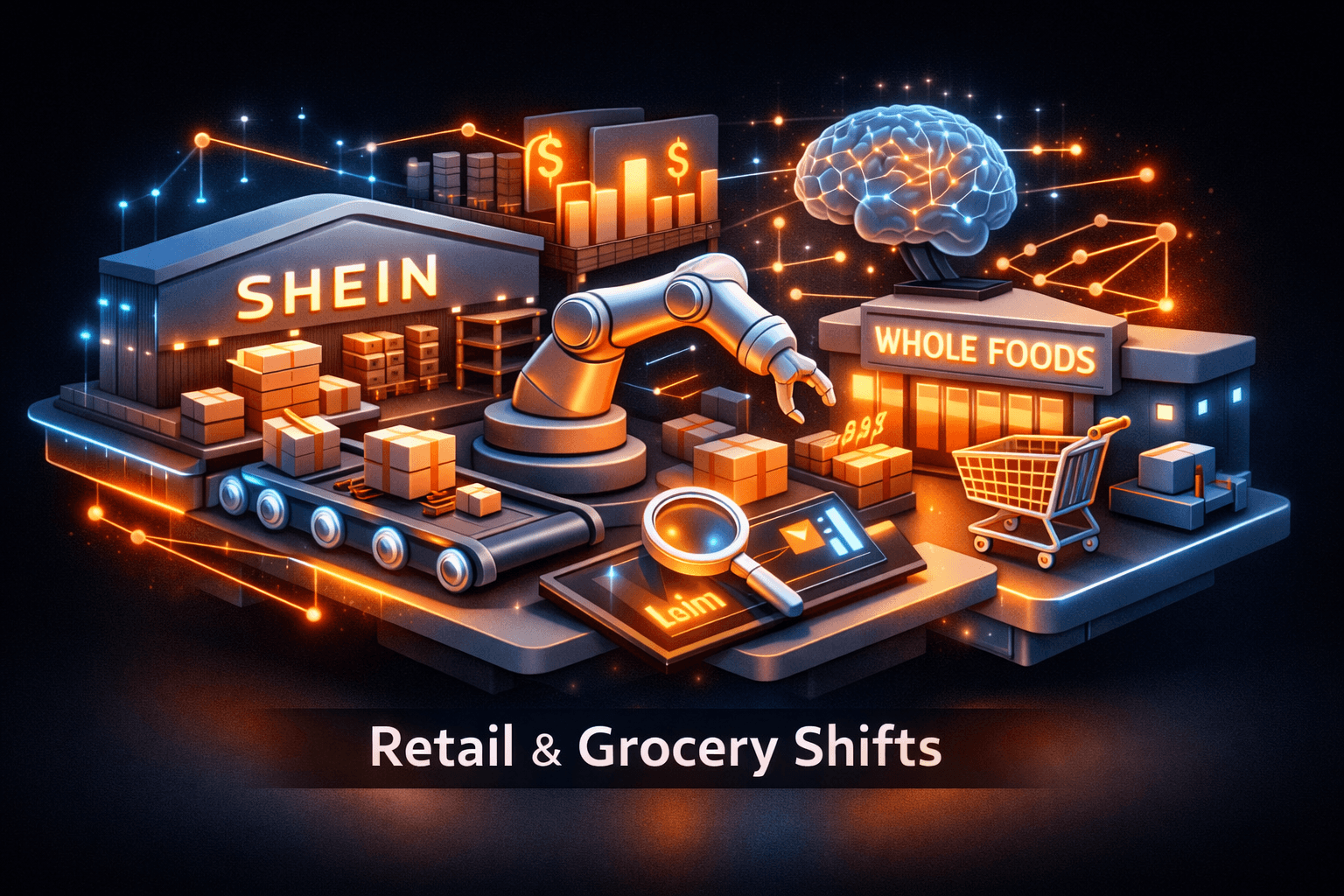
- Shein expands U.S. footprint with a 737,000 square foot automated warehouse in Lebanon, Indiana. The facility opens less than two weeks after Shein's Hong Kong IPO was completed.
- $AMZN says it will invest more than $230 million in pay and benefits for Whole Foods store employees, signaling a greater focus on frontline labor costs and retention.
- $KR reports private label growth outpaced national brands in Q2, reinforcing a value-first shopper trend that helped margins and basket economics.
- $CRI is rolling out its first major brand refresh since 2000 to appeal to Gen Z and millennial parents, aiming to modernize its marketing and product storytelling.
- $KHC is addressing sales losses at Oscar Mayer, saying a resealability packaging issue caused most of the problem. The company is taking corrective steps.
- $BBY is launching its holiday gifting center earlier than ever, tying in shop-in-shop experiences with Google and Meta to drive in-store traffic.
- $HAIN is selling its international business for $323 million as it continues to simplify its portfolio after earlier divestitures.
Key Developments
Shein builds U.S. automation scale
The launch of a 737,000 square foot distribution center in Indiana signals Shein's intention to shorten delivery windows and reduce friction for U.S. customers. That facility is heavily automated, which should lower per-unit distribution costs over time and support faster inventory turns.
For investors, the shift from pure marketplace to logistics-driven commerce matters. Faster fulfillment tends to lift conversion and repeat purchase rates, and it puts pressure on incumbents to match speed or compete on price and service.
Amazon boosts frontline pay at Whole Foods
$AMZN's commitment of over $230 million to benefits and pay for Whole Foods store employees is a meaningful spending decision. Improved pay and benefits can cut turnover and lift service levels in stores, but it also raises operating costs you will want to watch against comps and margin commentary.
It's a move that puts people and operations at the center of Amazon's grocery integration strategy. Will higher store-level costs pressure near-term profits, or will better retention and service drive more sales? Analysts will be parsing those offsets in upcoming updates.
Grocers and brands play to value and trust
$KR's private label growth outpacing national brands shows shoppers still prioritize savings when they shop. Dairy and private-label categories are being positioned as growth drivers, with retailers leaning into these assortments to protect margins.
Brand-level troubles cropped up at $KHC where packaging resealability hit Oscar Mayer sales, a fixable operational issue. Meanwhile $HAIN is simplifying through a $323 million sale of its international unit, a move that trims complexity and frees cash for portfolio priorities.
What to Watch
Here are the catalysts and risk areas you'll want to monitor through the rest of September and into the holiday season.
- Earnings and guidance: Watch Q3 commentary from $KR, $AMZN, $BBY, $KHC and $CRI for holiday merchandising plans, labor cost assumptions, and inventory posture.
- Labor and margin impact: Track how $AMZN's Whole Foods investment affects margins and same-store sales. You'll want to see whether better retention translates into higher basket size.
- Fulfillment and speed: Monitor Shein's delivery KPIs and any competitive response from platform and logistics partners. Faster fulfillment could lift conversion rates for direct-to-consumer players.
- Consumer behavior signals: Mastercard data shows teens increasingly trust AI recommendations more than friends or parents. Will AI-driven discovery change marketing ROI and customer acquisition costs? It's a key question for retailers investing in personalization.
- Operational fixes: Keep an eye on $KHC's remediation timeline for Oscar Mayer packaging issues and any follow-through on product recalls or rework costs.
Bottom Line
- Retailers are investing in operations and talent, not just promotions, which may support more sustainable sales gains into the holidays.
- Shein's logistics expansion and $AMZN's Whole Foods spend both point to higher near-term operating outlays with potential upside in sales and retention.
- Private labels remain a powerful lever for grocers like $KR to drive value and margin, data suggests.
- Brand refreshes such as $CRI's show incumbents are courting younger parents, which could pay off if marketing resonates.
- Be selective and monitor upcoming earnings and operational KPIs, because execution will determine who turns investments into profit. A shot in the arm for growth still needs disciplined follow-through.
FAQ Section
Q: How will Shein's U.S. warehouse affect competition? A: Faster, more automated U.S. fulfillment should lower Shein's delivery times and costs, increasing pressure on fast-fashion rivals and encouraging incumbents to boost logistics or emphasize differentiation.
Q: Does $AMZN's $230 million investment mean higher prices at Whole Foods? A: The investment targets pay and benefits for store employees, which raises operating costs. Whether prices rise will depend on how much of those costs retailers absorb versus passing them to shoppers.
Q: Should I expect private labels to keep growing at grocers? A: Data from $KR shows private labels outpacing national brands in Q2, indicating sustained shopper focus on value. Store economics and category execution will determine how broadly that trend continues.