The Big Picture
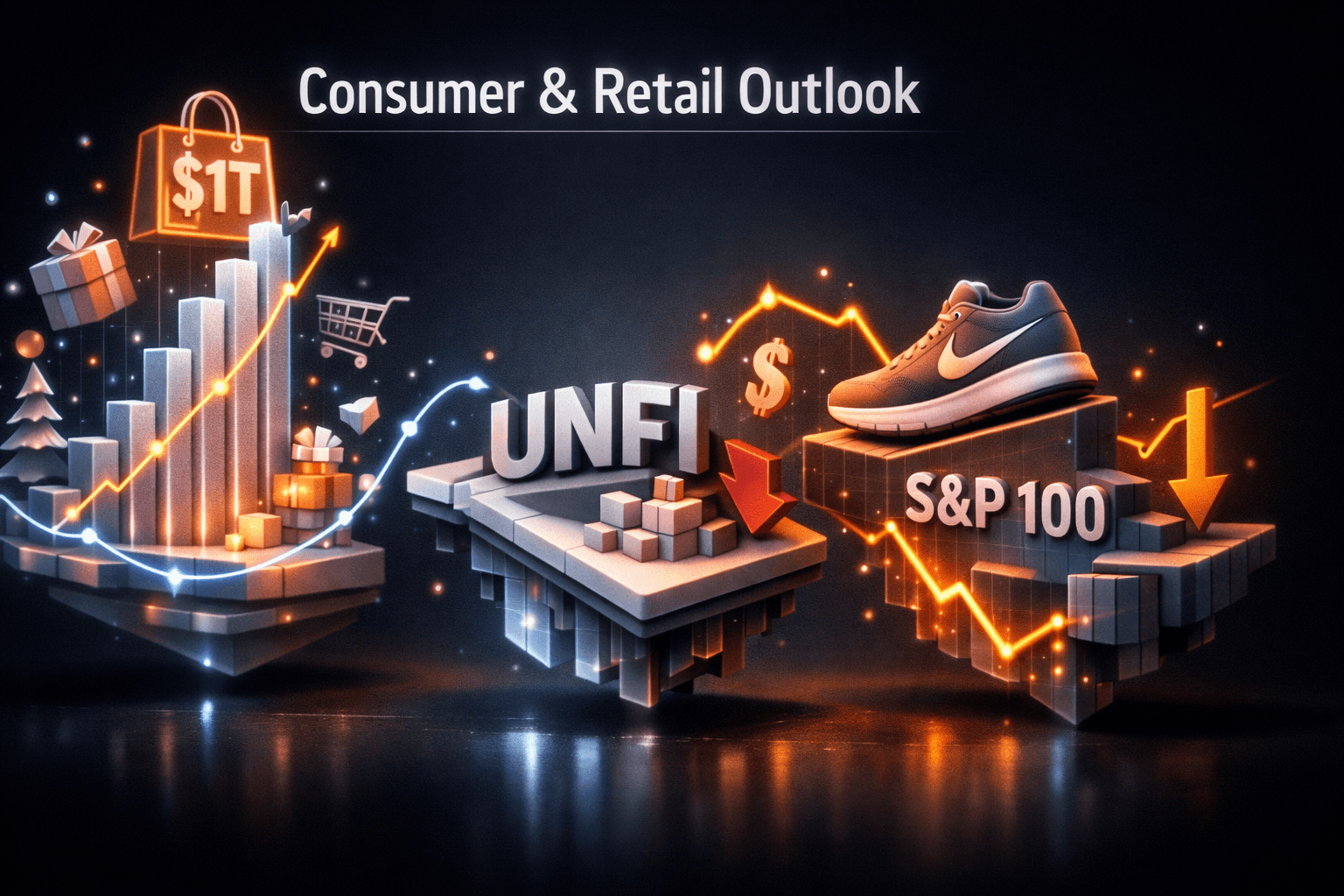
The consumer and retail patch opens today with mixed signals: Bain projects holiday spending will top $1 trillion, but individual companies are showing varied momentum. That macro spending headline matters because it frames demand expectations for apparel, grocery, and retail media as the season approaches.
You’ll see both clear growth plays and pockets of weakness in today’s headlines. Some brands are leaning into live moments and new product launches to gain share, while a few distributors and legacy names face operational or index-related setbacks.
Market Highlights
Quick facts and price actions to note as the market trades today.
- Bain forecasts holiday spending to top $1 trillion, with inflation accounting for much of the increase, a dynamic that can lift nominal sales but pressure margins.
- United Natural Foods Inc $UNFI reported a roughly 1% net sales decline in its fiscal fourth quarter, with management citing optimization actions and short-term project work after last year’s cyber attack.
- Nike $NKE and Simon Property Group $SPG will be removed from the S&P 100 effective Sept. 21, a largely symbolic move for the mall owner but a fresh reminder of headwinds for the apparel giant.
- Brands and retailers are doubling down on discovery and audience reach: Lands’ End is targeting college football game days, and Ace Hardware is promoting national brand-building via its retail media network.
- Global CPG leader Nestle9, via Gerber, launched Gerberlyte, a kids hydration beverage aimed at parents seeking no-artificial-ingredient options.
Key Developments
Holiday spending climbs, but inflation skews the story
Bain & Company’s forecast that holiday spending will exceed $1 trillion is top-line bullish for nominal retail sales. That said, much of the increase is driven by inflation rather than unit growth, so you should watch how margin and mix dynamics play out for companies that rely on discretionary purchases.
UNFI’s quarter shows operational strain, pockets of resilience
United Natural Foods reported a net sales decline of about 1% in the latest quarter as it lapped last year’s cyber attack and executed planned optimization steps. Grocery Dive and Digital Commerce 360 note that natural products sales rose even as the conventional segment weakened, and management expects to be back on a growth trajectory in fiscal 2027.
That split matters for suppliers and brokers you follow, since it suggests category-level shifts are in play even when overall top lines look flat.
Brand plays and marketplace strategies: Lands’ End, Temu, Ace, Nestle9
Lands’ End is making a visible marketing push around college football game days to broaden awareness, an example of brands targeting live cultural moments for discovery. At the same time, an Anaheim merch maker reports that Temu, part of PDD Holdings’ ecosystem, helped it find growth while protecting IP across the marketplace stages.
Ace Hardware spotlighted retail media as a channel for national brand building at its Upfront event, and Nestle9 introduced Gerberlyte, a kids hydration drink developed in response to parental demand for simpler ingredient lists. Taken together, these items show brands and retailers experimenting with channels and products to capture seasonal demand. Which approaches will scale and which will be one-offs? That question will help sort winners from the rest.
What to Watch
Keep an eye on the following catalysts and risks as the market digests today's news and heads into the fall season.
- Holiday retail and inflation data, including updated consumer sentiment and weekly spending trends, since the $1 trillion forecast is headline-grabbing but sensitive to price and volume swings.
- UNFI’s fiscal 2027 guidance and commentary on margin recovery and inventory after its optimization work. You should watch category mix trends, since natural is rising while conventional lags.
- S&P 100 index changes effective Sept. 21: the removal of $NKE and $SPG can affect passive flows and short-term liquidity for those names.
- USDA public comment period on SNAP waiver policy after a court ruling vacated purchasing restrictions in five states, a policy area that could influence grocery sales in affected regions. How will retailers and states respond?
- Retail media outcomes and partner metrics from Ace’s new offerings and other retailers’ ad networks; ad revenue can offset weak product margins if audience targeting scales.
Bottom Line
- Holiday spending forecasts are supportive of higher nominal sales, yet inflation means revenue gains won’t automatically translate into profit gains.
- UNFI’s slight sales decline highlights operational headwinds, though natural product strength signals where demand is shifting.
- Marketing and product innovation remain active: Lands’ End’s college-football push and Nestle9’s Gerberlyte show brands chasing discovery and trusted positioning.
- Index moves for $NKE and $SPG are mostly symbolic, but they can affect trading dynamics in the near term.
- Policy developments around SNAP and marketplace IP protections are wildcards to monitor as you evaluate exposure to grocery and mass channels.
FAQ Section
Q: How should I interpret the $1 trillion holiday spending forecast? A: The forecast indicates strong nominal demand, but much of the gain is from inflation, so compare volume indicators and margin outlooks to understand real demand.
Q: Does UNFI’s sales dip mean the grocery sector is weakening? A: UNFI reported about a 1% net sales decline tied to optimization work and post-cyberattack effects. Some categories, like natural products, showed growth, so the impact is mixed rather than uniform.
Q: What does Nike leaving the S&P 100 mean for its stock? A: The removal, effective Sept. 21, is largely symbolic and related to index composition. It can affect passive fund flows and trading behavior in the short term, but it doesn’t change Nike’s underlying business fundamentals.