The Big Picture
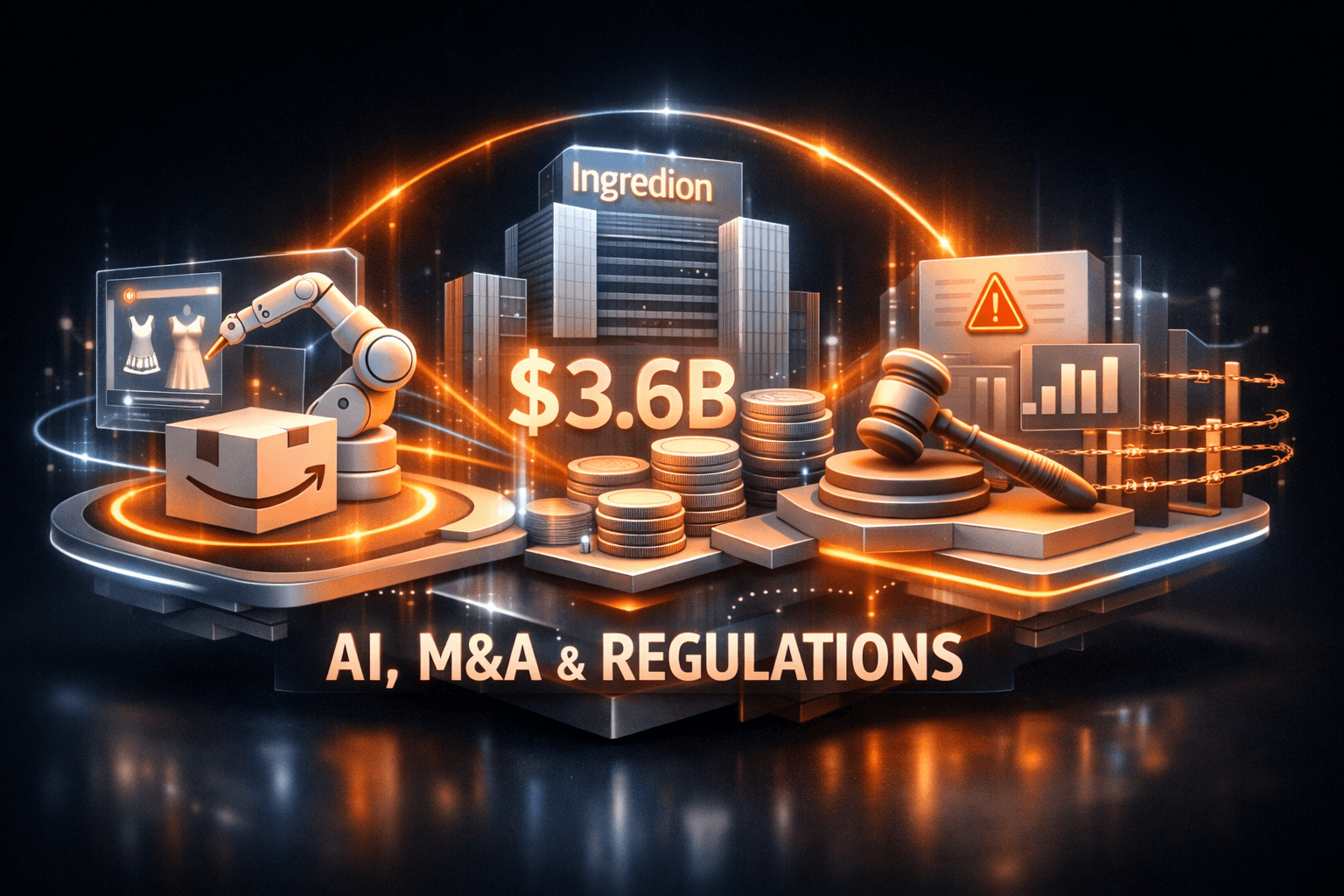
The Consumer & Retail sector served up a day of mixed signals, with technology and consolidation headlines on one side and regulatory and supply-chain headaches on the other. You saw big strategic moves today, including a $3.6 billion food-ingredients deal and new AI shopping features, while states moved to curb dynamic pricing and an earlier Prime Day forced planning changes.
Why does this matter to you? These developments affect costs, customer acquisition and pricing tools across the industry, and they could shape who gains share as consumer behavior and regulations evolve.
Market Highlights
Quick facts and numbers to scan before you dig into the details.
- Petco $WOOF posted fiscal Q1 net sales of $1.5 billion, up 0.2%, with comparable sales up 0.7% for the quarter ended May 2, 2026.
- Ingredion $INGR agreed to acquire Tate & Lyle for $3.6 billion, creating a combined business approaching $10 billion in annual revenue.
- Saks Global won court approval for a bankruptcy exit plan that cuts debt by about 75% and secures $500 million in new financing, while targeting $9 billion in GMV by 2030.
- Amazon $AMZN launched an AI image generator inside its app to help narrow search queries and surface similar products for shoppers.
- Connecticut enacted a ban on using personally identifiable data to set individualized prices, following Maryland; a related bill awaits the New York governor's action.
- Best Buy $BBY will pilot Meta Lab shop-in-shops at 50 locations this summer. Walmart $WMT added restaurant delivery with Subway via Express Delivery.
Key Developments
Amazon rolls AI into search, Best Buy leans into AR/VR
Amazon's new AI image generator lets users describe products and get AI-created images to refine search results. At the same time Best Buy $BBY is installing Meta Lab shop-in-shops at 50 locations so shoppers can test AI glasses and VR headsets. Data suggests retailers are investing in immersive tech to shorten the path from discovery to purchase.
What does that mean for you as an investor? These moves reinforce the importance of digital experience as a competitive moat. Are companies that can't match these capabilities going to lose share? It's a question analysts note as they reassess retail tech spend and store formats.
Big M&A in ingredients: Ingredion buys Tate & Lyle
Ingredion $INGR agreed to acquire Tate & Lyle for $3.6 billion, creating a near-$10 billion revenue platform focused on clean-label and lower-sugar ingredients. The deal widens product portfolios and gives both companies more leverage with consumer packaged goods customers.
For you, this is a consolidation play in a defensive corner of food supply chains. The transaction could drive synergies and broader customer reach, but integration execution will matter for margin outcomes and the combined company's growth profile.
Regulation and restructuring: Dynamic pricing rules, Saks exit
Connecticut followed Maryland by banning the use of personally identifiable information to set dynamic prices for consumers. New York may act next. Regulators are putting guardrails around targeted pricing, which could limit revenue optimization tools for grocery and online retailers.
Meanwhile Saks Global cleared a bankruptcy exit that slashes debt by around 75% and brings $500 million in new financing. The retailer now has a narrower runway to win back shoppers and rebuild sales momentum, and customer return rates will be critical to meeting its $9 billion GMV goal by 2030.
What to Watch
Focus on upcoming catalysts and risks that could move stocks in the near term.
- Prime Day timing: An earlier Prime Day on June 23-26 forced brands to accelerate orders and forecasts, creating short-term supply-chain strain. Expect inventory and freight flow updates this week.
- Regulatory trend: Watch New York's action on dynamic pricing and any federal guidance. If more states move quickly, retailers will need to adjust pricing engines and analytics models.
- Earnings and reports: Look for company commentary from grocers and specialty retailers on omnichannel sales, same-store trends, and tech investments. Petco $WOOF's modest comps suggest some categories remain resilient.
- M&A integration: Monitor Ingredion $INGR's integration plan and margin targets. Execution will determine whether the deal accelerates growth or creates short-term cost pressure.
- Customer return metrics: For Saks Global, weekly traffic and spend-per-visit will be key early signals on its recovery path. Who returns, and how often, will shape the restructuring's success.
Bottom Line
- Mixed signals dominate today: innovation and consolidation are balanced by regulatory limits and supply-chain adjustment.
- AI and experiential retail are accelerating, with $AMZN and $BBY pushing digital and in-store tech to shorten shopper journeys.
- Regulators are tightening on personalized pricing, a risk for retailers that rely on individualized promotions and dynamic algorithms.
- Ingredion's $3.6 billion acquisition reshapes the ingredients space, but integration will determine real value creation.
- Keep an eye on Prime Day timing and weekly traffic data, because near-term inventory and customer behavior shifts could affect earnings narratives.
FAQ Section
Q: How will state bans on dynamic pricing affect retailers? A: Retailers may need to redesign pricing engines to avoid using personally identifiable data, which could limit individualized offers and require broader segmentation or contextual pricing approaches.
Q: Should I expect big margin changes from the Ingredion-Tate & Lyle deal? A: Analysts note the deal aims for revenue scale and product breadth, but margin improvements will depend on integration, cost synergies, and product mix shifts over the next several quarters.
Q: Will an earlier Prime Day hurt holiday inventory for brands? A: The earlier event pulled orders forward and created short-term strain, data suggests; brands that misread demand or fail to secure freight may face stockouts or uneven inventory positions going into Q3.
Analysts note these items to inform your view, and data suggests selective exposure to resilient categories and companies with clear execution plans will matter. This summary is for informational purposes only and not personalized investment advice.