The Big Picture
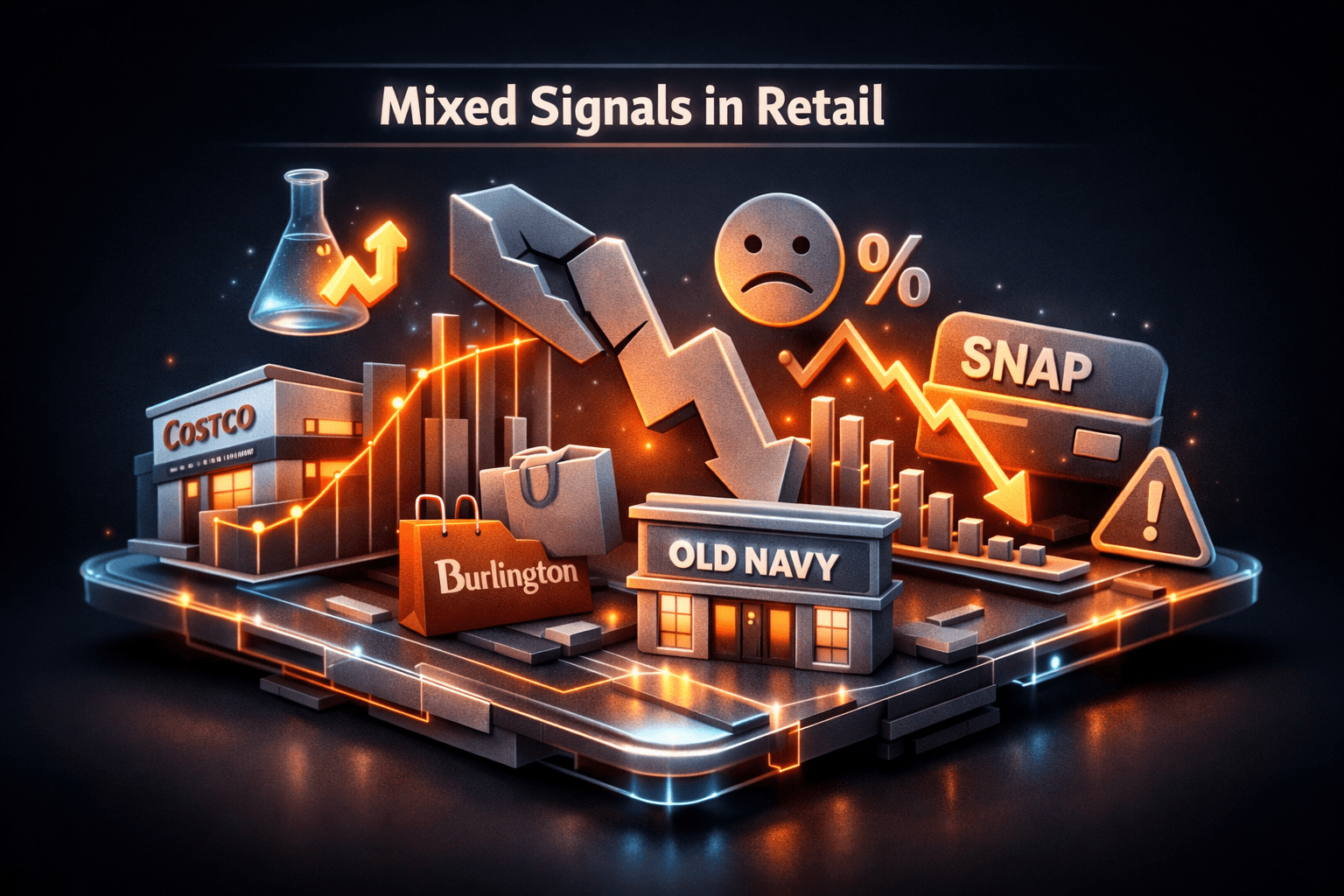
Today the Consumer & Retail sector sent mixed messages, with bright spots in company-level execution running up against clear macro and policy headwinds. Costco reported record gas sales and flagged tariff refunds, while off-price expansion and strategic transactions kept the headlines upbeat.
At the same time you saw evidence that household strain remains real. Consumer sentiment hit fresh lows and policy moves around SNAP waivers create category-level risk for sugary and impulse items. What does this mean for you as a retail investor? It means selectivity matters more than ever as retailers try to navigate both demand shifts and margin pressure.
Market Highlights
Quick facts and where the action landed today.
- $COST: Costco executives told investors the chain saw record gas sales in Q3 and noted potential tariff refunds, highlighting fuel costs as a member concern.
- $GPS: Gap Inc. grappled with a fashion miss at Old Navy that leadership attributed to internal execution problems rather than lack of customer interest.
- $BURL and $MAT: Off-price Burlington is planning more than 100 new stores this year, and Mattel expanded its Brick Shop line with new sets to diversify product appeal.
- $IFF: International Flavors & Fragrances agreed to sell its food ingredients business for $4.3 billion in a move to sharpen focus and improve profitability.
- Macro and policy: Consumer sentiment dropped to a new low and SNAP waivers are projected to reduce sales in soda, candy and energy drinks, creating headwinds for certain categories.
Key Developments
Costco's gas surge and tariff refunds
$COST reported record gas sales for Q3, and management emphasized how fuel prices remain top of mind for members. Executives also signaled expected tariff refunds that could be margin-accretive when realized.
For you that suggests Costco is still finding ways to leverage its membership model for non-traditional revenue streams, and tariff relief could provide a near-term boost to gross margins if refunds materialize.
Old Navy miss raises questions for Gap Inc
Gap Inc. $GPS acknowledged an Old Navy fashion misstep that executives say came down to execution rather than demand. The company is addressing internal issues but faces growing competition in the value segment from off-price and fast-fashion chains.
That loss of momentum at a key banner raises a caution flag, especially as shoppers tighten budgets and longer term inflation expectations drift higher. You should watch whether management can translate fixes into sustained sales recovery.
Macro pressure, policy risk and strategic moves
Consumer sentiment fell to a new low today, with cost of living rising as the first-order worry. Analysts note that sustained higher inflation expectations would increase the odds of further Fed tightening, which could pressure discretionary spending.
Separately, Numerator warns that state SNAP waiver restrictions could cut up to 830 million dollars in sales for soda, candy and energy drinks by year end, signaling category risk for grocers and suppliers. Against that backdrop companies like $IFF are reshaping portfolios, selling the food ingredients unit for 4.3 billion dollars to focus on higher-growth areas.
What to Watch
Focus your attention on near-term catalysts and risk factors that will likely shape performance into the summer.
- Earnings and guidance from value and off-price chains, especially any follow-up from $GPS and $BURL updates on store productivity and inventory turns.
- Consumer sentiment metrics and inflation data, since a sustained uptick in long-term inflation expectations could affect rates and discretionary spending.
- Policy developments on SNAP waivers and state restrictions, which could materially alter category sales for suppliers and grocers.
- Product innovation and private-label moves, like natural color ingredient demand as $TGT and $WMT push cleaner labels, and new refrigerated snacks from legacy brands. Can retailers convert product innovation into sustained sales?
- Corporate portfolio actions, for example execution on $IFF's sale proceeds and how those funds are deployed to grow higher-margin businesses.
Bottom Line
- Sector reading is mixed, so adopt a selective approach rather than broad assumptions about consumer health.
- Retailers with strong membership or value propositions, and those that can manage costs, look better positioned to weather slower discretionary spending.
- Policy and category-specific risks, notably SNAP waiver impacts, could create concentrated downside for beverage and impulse categories.
- Watch execution at banners like Old Navy and rollout metrics at fast-expanding off-price players to gauge inventory and margin trends.
- Strategic portfolio moves such as $IFF's sale may free capital for growth, but you should monitor how proceeds are used and whether they translate to higher profit growth.
FAQ Section
Q: How will falling consumer sentiment affect retail earnings? A: Lower sentiment can signal softer discretionary spending which may pressure same-store sales and margin mix for apparel and nonessential categories.
Q: Are SNAP waiver restrictions a widespread risk? A: State-level SNAP policy changes are uneven, but Numerator expects significant impacts in affected states and categories, meaning some retailers and brands will feel more pressure than others.
Q: What role do strategic sales and portfolio moves play for companies like IFF? A: Divestitures can sharpen focus and improve profitability, but the market will be looking for clear capital allocation plans and execution on reinvestment or debt reduction.