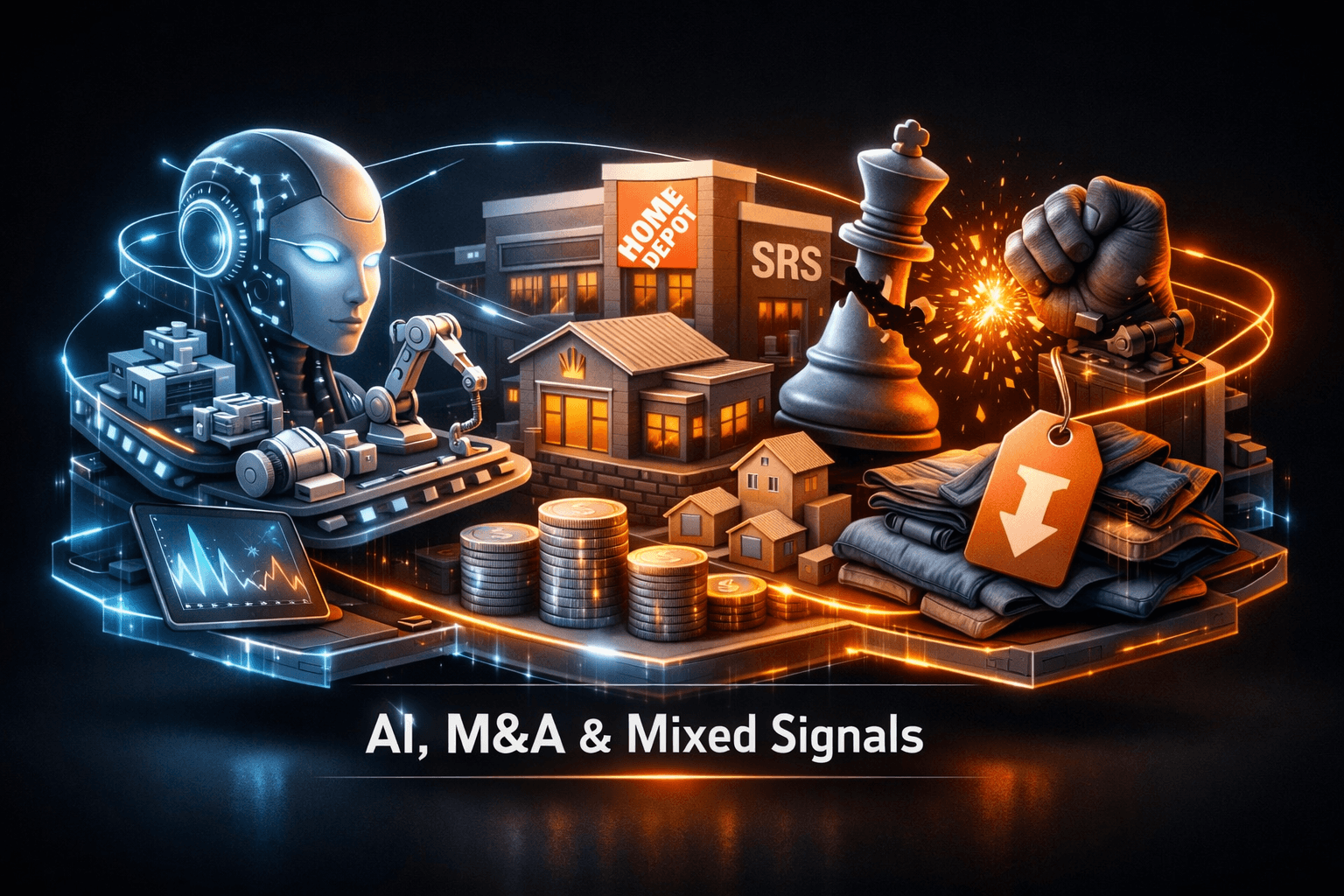
The Big Picture
AI and consolidation dominated the Consumer & Retail narrative on May 15, as companies from Parts Town to Albertsons rolled out technology to speed operations, while $HD’s SRS completed another distributor buy to bulk up Pro services. At the same time investors were reminded that structural headwinds remain, with resale stealing share from department stores and activists targeting boardrooms at $TGT.
Why should you care? Technology and deal activity can lift margins and growth for some companies, while governance and shifting consumer habits create execution risk for others. Today's headlines give you concrete signals to monitor as summer demand and promotional calendars ramp up.
Market Highlights
Quick reads on the biggest developments investors will be watching.
- Parts Town expands its AI PartPredictor to cover 120 brands and more than 18,000 equipment models, aiming to speed parts identification for technicians and dispatchers.
- $HD: SRS Distribution closed its acquisition of Mingledorff’s LLC, extending SRS’ footprint in HVAC distribution to better serve Pro customers.
- $TGT: Activist shareholders are pushing to oust former CEO Brian Cornell and director Christine Leahy from the board, arguing their presence could slow a turnaround.
- Resale growth continues to pressure department stores, according to Bank of America research, though off-price chains appear less exposed for now.
- $BBBY and The Container Store open their first co-branded location in Fort Worth, marking a step in Bed Bath & Beyond’s integration strategy following its acquisition announcement.
- $PEP rolled out a reformulated Muscle Milk with higher protein and no artificial colors, sweeteners or flavors, aiming for share in the crowded protein drink market.
- $AMZN is refocusing grocery around a Prime-first model, prioritizing membership benefits over broad physical expansion.
- $ACI is deploying a Google Cloud-based computer vision tool, Intelligent Quality Control, to help assess fresh produce at distribution centers.
- Canmakers such as $BALL, $CCK and $ARD report tight capacity and higher input costs as brands prepare summer promotions tied to global events and national celebrations.
Key Developments
AI and supply-chain tech pick up steam
Parts Town’s PartPredictor update and $ACI’s roll-out of an Intelligent Quality Control tool show the same theme, technology that removes manual friction and improves speed to sale. Faster parts identification and automated produce inspection can lower labor hours and shrink waste, data points analysts note that may help margins over time.
For you that means watching adoption and rollout speed. Technology is only as valuable as its scale, so monitor execution and measurable outcomes such as reduced returns, faster fulfillment or lower spoilage rates.
Consolidation and store experiments continue
$HD’s SRS completing the Mingledorff’s acquisition is another sign of vertical consolidation in pro-facing distribution, a strategic move to lock in Pro customers and capture higher-margin installation flows. Meanwhile $BBBY’s first co-branded store with The Container Store opens Saturday in Fort Worth, offering a real-world test of cross-brand merchandising synergies after the acquisition announcement.
These deals are pieces of the puzzle for longer-term customer retention and category expansion, but you'll want to track integration costs and any near-term disruption to same-store metrics.
Demand shifts and governance risks temper optimism
Bank of America’s analysis showing department stores losing share to the resale channel highlights a structural challenge. Off-price retailers appear insulated for now, but the secondhand market is growing faster than many legacy chains expected.
At the same time activists pushing to remove former $TGT leaders from the board inject governance uncertainty. Proxy fights can distract management and affect strategic timelines. How will you weigh operational progress against potential leadership turnover?
What to Watch
- Proxy calendar and votes at $TGT, including any management responses or board changes that could reshape strategy and capital allocation.
- Rollout metrics for Parts Town’s PartPredictor and $ACI’s computer vision tool, specifically adoption rates and savings in cycle time or spoilage.
- Integration milestones for SRS’s Mingledorff’s deal and the $BBBY/Container Store co-branded store performance, same-store sales, and customer feedback.
- Capacity and input-cost updates from canmakers $BALL, $CCK and $ARD ahead of peak summer promotions, and any signs price increases are passed through to brands and consumers.
- $AMZN’s grocery strategy shifts, particularly changes to Prime benefits or promotional cadence that could affect grocers and food brands competing for membership-driven spend.
- Broader macro indicators, including inflation measures and consumer spending data, which will influence promotional intensity and margin pressure into the summer.
Bottom Line
- Technology and AI deployments are showing up as tangible cost and speed initiatives, which analysts note could support margins if adoption scales.
- Deal activity and co-brand experiments signal firms are still pursuing growth through M&A and new formats, but integration risk remains a near-term watch item.
- Resale's rise and activist governance at major retailers create offsetting risks to the upbeat tech and M&A story, so a selective approach makes sense.
- Keep an eye on capacity and input cost reports from packaging and canmakers, since these feed directly into COGS for beverage and food brands this summer.
- For your watchlist, prioritize measurable execution indicators such as adoption rates, same-store sales trends, and proxy developments rather than headlines alone.
FAQ Section
Q: How will Parts Town’s AI update affect parts distributors and service margins? A: The update expands coverage to 120 brands and over 18,000 models, which should reduce search time and returns; analysts say cost savings are possible but will depend on uptake and integration with ordering systems.
Q: Does the $HD SRS acquisition materially change Home Depot’s Pro strategy? A: It adds distribution depth and local reach for Pro customers, supporting installation and product flow; results will hinge on integration execution and how quickly SRS leverages scale.
Q: Should I be worried about resale stealing share from department stores? A: Resale is growing and pressuring legacy apparel channels, but off-price and value retailers face less near-term disruption; the longer-term trend favors nimble models that capture used-goods demand.