The Big Picture
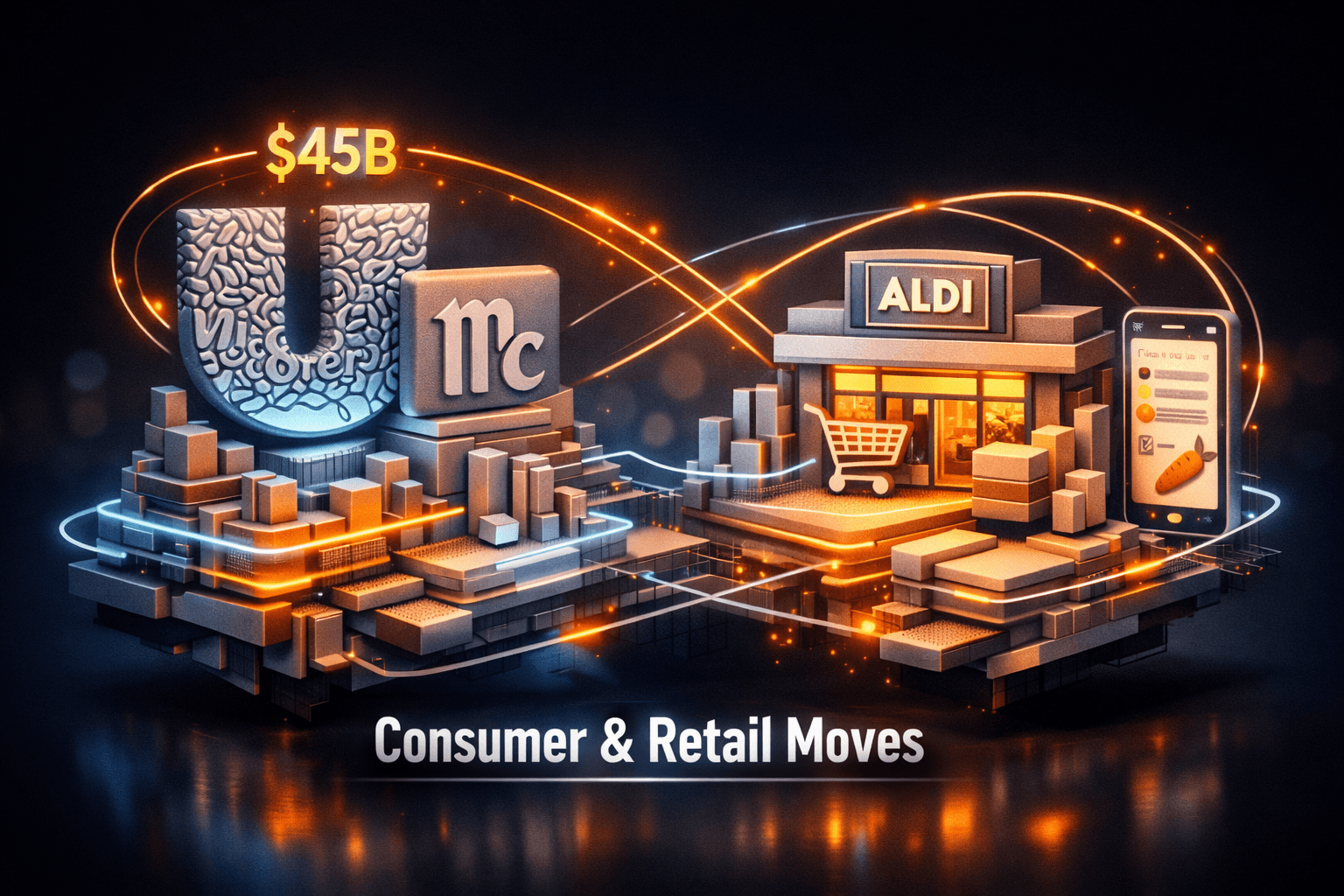
Today’s biggest development is the proposed $45 billion combination of Unilever’s food business with McCormick, a deal that reshapes the global spices and condiments landscape and will ripple across grocery shelves and supplier relationships. That strategic consolidation comes alongside a flurry of tech partnerships and licensing deals aimed at boosting e-commerce and in-store convenience, suggesting the sector is investing in scale and capability.
For investors, the theme is clear, you’re seeing scale and digital infrastructure move to the front of the line. Will cost synergies and faster digital rollout translate into margin gains? That’s the question markets will parse in the days ahead.
Market Highlights
Quick facts and overnight items to start your trading day.
- Unilever and McCormick announced a proposed $45 billion combination of Unilever’s food business with $MKC, creating a global spice and condiments giant. The move centers flagship brands such as Hellmann's and Frank's RedHot.
- Aldi U.S. launched a new website and app powered by Instacart’s Storefront Pro, outsourcing e-commerce and fulfillment to $CART's white-label platform to scale online grocery sales quickly.
- Allbirds, the once high-flying DTC shoe maker, agreed to be sold for $39 million after steep sales declines and store closures, a sign of consolidation and market retrenchment in footwear; the board unanimously approved the transaction, which includes an intellectual property sale.
- Food and CPG moves include $GIS launching Trix and Lucky Charms with natural colors this summer as part of a broader removal of synthetic dyes, a consumer-focused product shift investors will want to track.
Key Developments
Unilever and McCormick, a transformational tie-up
The proposed $45 billion deal to combine Unilever’s food business with $MKC creates a large-scale CPG player focused on condiments and spices. Analysts note the deal is designed to capture scale efficiencies, extend global distribution and consolidate complementary brand portfolios.
For you that means watch for regulatory reviews and integration guidance. Synergy projections and cost-savings targets will determine whether this deal is accretive or signals tougher near-term execution risk.
Aldi taps Instacart to accelerate e-commerce
Aldi U.S. rolled out a new website and mobile app powered by Instacart’s Storefront Pro, shifting the technical and fulfillment burden to $CART’s white-label solution. The partnership lets Aldi move faster on online assortment and delivery without building a large in-house logistics stack.
This is a practical example of grocers outsourcing to win speed to market. If you follow grocery stocks, pay attention to how quickly Aldi scales digital orders and whether same-store sales mix shifts toward higher-margin online formats.
Retail tech, licensing and M&A reshape consumer offerings
Agentic commerce vendor Firmly launched Firmly Connect, a no-code platform to help retailers sell via emerging AI channels, and multiple merchants have signed on. ProVendorConnect introduced a B2B marketplace for property managers, standardizing procurement for services and contractors.
Licensing deals and PE activity are also notable. New Balance licensed HandsFree Labs technology to bring slip-in sneakers to market by next year. Advent International agreed to acquire a majority stake in body care brand Salt & Stone with current senior management staying on. These moves show both strategic investors and brands are prioritizing distribution and product innovation to capture demand.
What to Watch
Here are the catalysts and risks that could move consumer and retail names today and in the coming weeks.
- Regulatory and integration milestones for the Unilever-McCormick deal, including any antitrust scrutiny and the timeline for realizing synergies.
- Execution metrics for Aldi’s Instacart rollout, such as online order volume, fulfillment costs and regional expansion plans, which will indicate whether the partnership lifts digital penetration without eroding margins.
- Allbirds’ sale process and any related IP or restructuring disclosures, which could signal how investors should think about the viability of former DTC growth stories that struggled to reach profitability.
- Product and ingredient shifts at big food names, notably $GIS’s move to natural colors this summer, which may affect marketing spend, labeling costs and retailer shelf placement.
- Adoption pace for new retail technologies such as Firmly Connect and B2B marketplaces, which could change customer acquisition economics and lower onboarding friction for omnichannel moves.
Bottom Line
- Scale and consolidation are the dominant themes, exemplified by the $45 billion Unilever-McCormick tie-up and private equity activity in niche brands.
- Retailers are outsourcing digital heavy lifting, with Aldi choosing $CART’s Storefront Pro to accelerate online sales rather than build costly infrastructure.
- Product innovation and ingredient reformulations, like $GIS’s natural-color cereals, are consumer-facing moves that could support premiumization and loyalty.
- The Allbirds sale at $39 million is a cautionary tale for DTC brands that grew fast without durable profitability; it underscores the premium on sustainable unit economics.
- Watch integration execution and regulatory developments closely, because they’ll shape near-term volatility and longer-term value creation.
FAQ Section
Q: How will the Unilever-McCormick deal affect grocery pricing and shelf space? A: The combination creates a larger negotiating profile with retailers, which analysts say could influence promotions and private-label strategy, though changes will depend on integration outcomes and retailer response.
Q: Does Aldi’s Instacart partnership mean other grocers will outsource e-commerce? A: Many grocers are weighing speed to market versus control, so you’ll likely see a mix of partnerships and in-house builds; the Aldi move highlights outsourcing as a fast path to scale.
Q: What does the Allbirds sale tell you about DTC fashion brands? A: It suggests that rapid customer acquisition without sustainable margins or consistent retail distribution can lead to distress, and that brand equity alone may not protect market value.