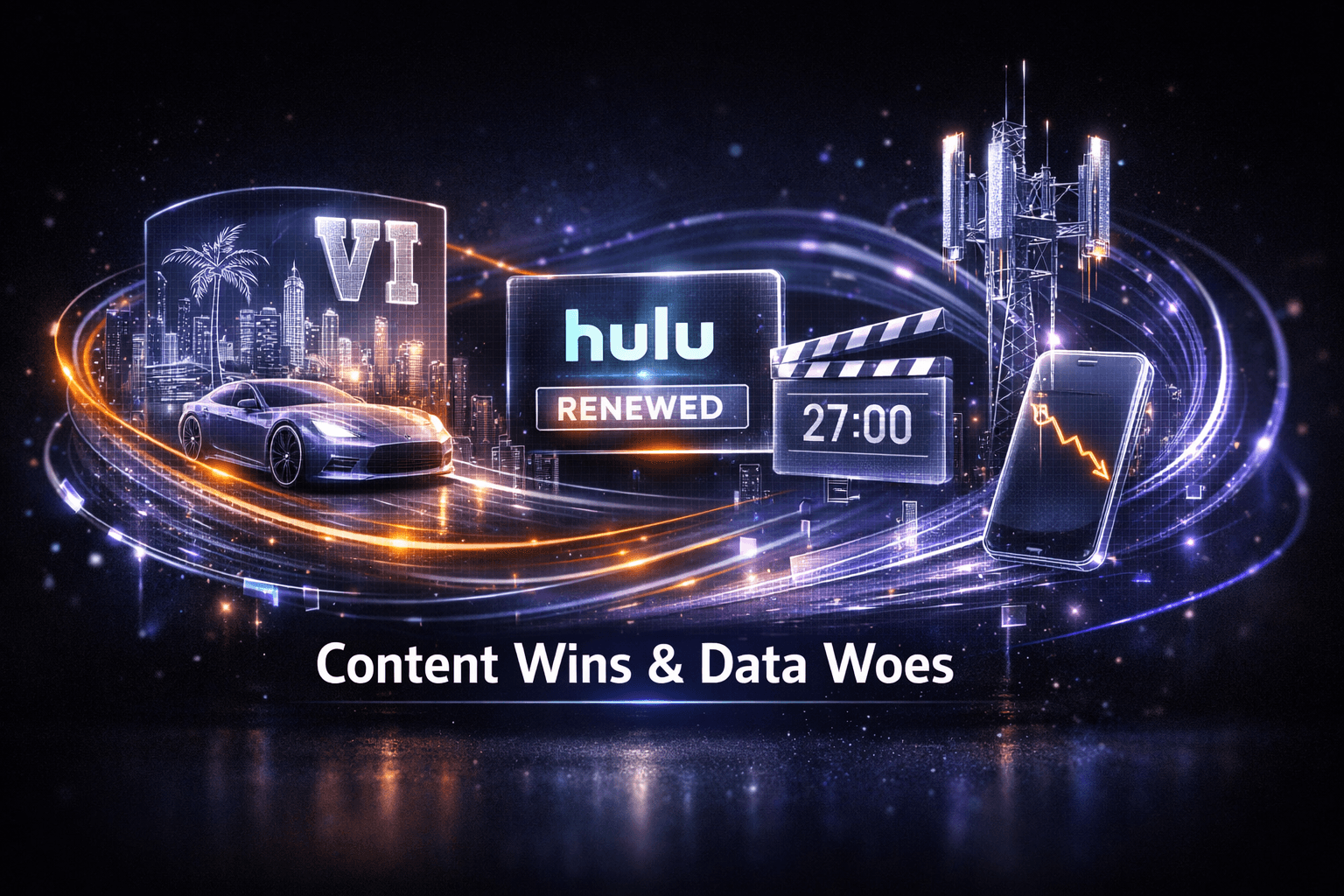
The Big Picture
Content drove headlines today as major franchises and streamers rolled out high-impact programming and promotions, while telecom and device data reminded markets that infrastructure and hardware face real limits. You saw blockbuster marketing moves and fandom events that can lift engagement, but you also got fresh evidence that network performance and smartphone demand remain uneven.
Why does this matter to you as an investor? Media companies are still monetizing tentpole IP and live promotion, yet telco metrics and regional device weakness could cap upside for platform owners and hardware suppliers. That makes selective exposure and scrutiny of next catalysts essential.
Market Highlights
Quick facts and takeaways from today’s top stories.
- Netflix Netflix (NFLX) dropped a 27-minute extended look at Grand Theft Auto VI on Netflix, a high-profile cross-promo tied to the game's November release, and the clip went live at 3 p.m. ET.
- Hulu, part of the broader streaming ecosystem led by Disney The Walt Disney (DIS), scored a programming win as the thriller "Furious" was renewed for Season 2 after steady week-over-week viewership since its July 27 premiere.
- Paramount-related fan activity around "Star Trek" will ramp into Sept. 8, the franchise’s 60th anniversary, with global screenings and a Vulcan salute world-record attempt that should boost engagement for legacy IP and licensing partners, including Paramount Global (PARA).
- Theme-park content and experiential marketing continued, as Universal (Comcast Comcast (CMCSA)) and Barker/Universal promoted a new Halloween Horror Nights activation tied to the "Obsession" IP, aimed at driving foot traffic and ancillary revenue.
- On the infrastructure side, Ookla reported a rural-urban performance gap in 5G fixed wireless access, with T-Mobile US (TMUS) cited as leading in speed. China Broadnet missed its 5G subscriptions target and flagged a challenging path to profitability. Separately, Omdia said Southeast Asia smartphone shipments fell 23% in 2Q26 to the lowest level since 2014.
Key Developments
Netflix and Gaming Cross-Promotion Amplifies Engagement
Netflix’s $NFLX timed a wide-release 27-minute GTA 6 featurette to drive buzz ahead of the game’s November launch. This kind of cross-media rollout can boost subscriber engagement and generate promotional halo effects for both gaming and streaming partners, at least in the short term.
For you, that raises the question: can content tie-ins meaningfully convert to longer-term subscriber gains or just produce episodic spikes? Analysts will be watching engagement metrics and any downstream ad or merchandising lift.
Streaming Content Momentum: "Furious" Renewal and Franchise Events
Hulu’s renewal of "Furious" for Season 2 confirms the title’s breakout status and strengthens the streamer’s content pipeline heading into the fall cycle. Disney $DIS benefits from programming depth even as it balances broader corporate priorities.
Meanwhile, Paramount’s global "Star Trek" anniversary activations aim to monetize nostalgia and fandom through screenings and partnerships. Those initiatives tend to produce steady licensing and merchandise revenue for years, not just a single quarter.
Telecom and Device Weaknesses Temper the Upside
Ookla’s 5G FWA study showed better urban performance than rural, and named $TMUS as the speed leader. That urban-rural divide matters for fixed wireless monetization and for investors who follow capex-to-service returns.
China Broadnet underdelivering on 5G subscription goals highlights the difficulty smaller operators face competing at scale, and Omdia’s 23% drop in Southeast Asia smartphone shipments signals weak demand in price-sensitive markets. Together these items suggest headwinds for network equipment vendors and low-cost device makers.
What to Watch
As you consider positioning, keep an eye on near-term catalysts and risks across content and networks.
- Streaming: Monitor viewership metrics and churn/ARPUs for $NFLX and Hulu-related reporting from $DIS. Quarterly subscriber and engagement updates will tell you whether promo events deliver durable results.
- Gaming: Watch Rockstar and partner monetization timelines ahead of GTA 6's November launch. Any surprise delays or consumer reaction to leaked content could move sentiment quickly.
- Telecom: Look for follow-up Ookla data and carrier filings that break down urban versus rural FWA performance. Capex plans and any updated guidance from $TMUS or other carriers will be important.
- Device demand: Expect more regional shipment updates from Omdia and other research houses. If the sub-100 dollar segment remains weak, suppliers and component makers could see margin pressure.
- Events and experiential revenue: Track box office, park attendance, and licensing announcements tied to Halloween Horror Nights and "Star Trek" activations to gauge monetization beyond streaming.
Bottom Line
- Content and event marketing are driving engagement, with Netflix’s GTA 6 preview and Hulu’s renewal providing tangible show-and-tell wins for media players.
- Telecom performance gaps and missed 5G targets in some markets are a reminder that infrastructure and subscriber economics still present risks to monetization.
- Southeast Asia smartphone weakness, a 23% decline in 2Q26, points to regional demand challenges that could pressure low-cost device makers and supply chains.
- Your approach should be selective, focusing on companies that can monetize tentpole IP and manage network economics effectively.
- Analysts note today’s news mixes short-term engagement gains with longer-term structural risks for hardware and networks, so momentum indicates opportunity but not uniform upside.
FAQ
Q: How will Netflix’s 27-minute GTA 6 preview affect subscriber trends? A: The preview is likely to boost short-term engagement and PR, but sustainable subscriber gains will depend on longer-term retention and conversion metrics reported in upcoming quarters.
Q: Should I worry about the 23% drop in Southeast Asia smartphone shipments? A: The decline highlights weakness in low-cost segments and could pressure component suppliers and smaller brands, but premium device makers may be less exposed if the slump remains concentrated in sub-100 dollar phones.
Q: Do telecom performance gaps mean 5G FWA won’t scale profitably? A: Not necessarily, but the rural-urban performance gap and missed targets by some operators show that execution, spectrum strategy, and targeted capex will drive which carriers can make fixed wireless access profitable.