The Big Picture
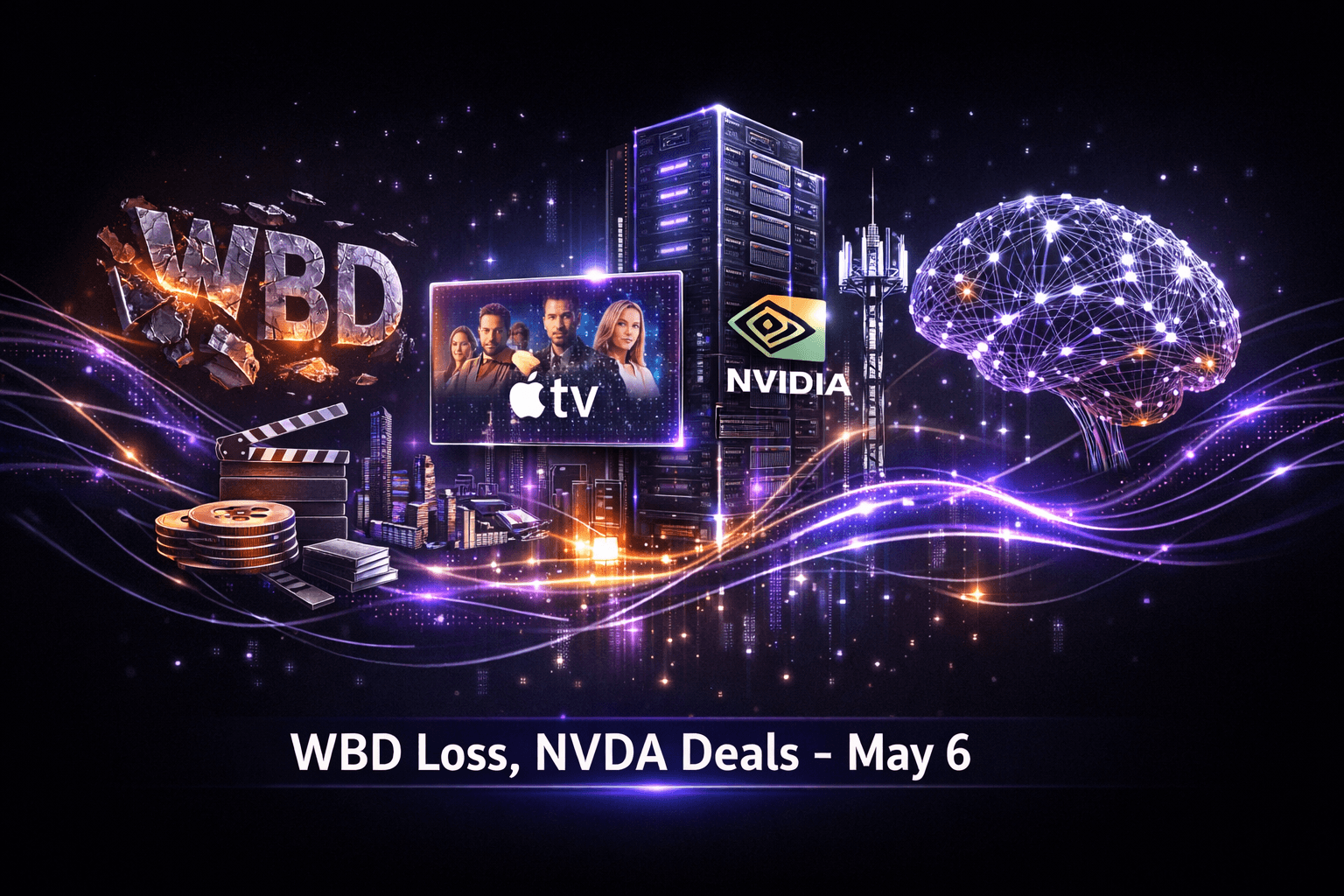
Today’s big story was Warner Bros. Discovery reporting a multibillion dollar March-quarter loss that grabbed headlines across the media landscape. That charge, largely tied to a breakup fee and an item involving Paramount, overshadowed operational gains in streaming and studios.
At the same time you saw a string of strategic moves that matter for the sector’s medium-term outlook. Nvidia and Corning announced capacity expansion tied to AI demand, Apple TV greenlit new scripted content, and telecoms pushed deeper into AI and security. What does this mix mean for your media exposure? It signals a market with clear risks but also selective catalysts.
Market Highlights
Headlines drove trading narratives across big media names and infrastructure plays. Below are quick facts to keep you oriented.
- Warner Bros. Discovery, $WBD, posted a large March-quarter loss, driven largely by a breakup fee related to Netflix separation and a Paramount item reported in multiple outlets.
- Industry reaction focused on balance sheet and M&A implications after $WBD’s disclosure. Analysts note the headline loss does not fully reflect operating momentum in streaming and studios.
- Nvidia, $NVDA, and Corning, $GLW, announced a partnership to expand US optical connectivity and fiber capacity to meet AI-driven demand, a strategic infrastructure move for networks and data centers.
- Apple’s entertainment arm, $AAPL via Apple TV, greenlit the spy thriller Disavowed starring James Marsden, highlighting continued content investment by streaming platforms.
- Universal Music Group, $UMG, filed a new brief in an appeals court dispute with Salt-N-Pepa over masters, underscoring ongoing rights litigation risk in the music industry.
Key Developments
WBD’s Q1 Loss and the Paramount Item
Reports showed Warner Bros. Discovery taking a roughly $2.9 billion loss in the March quarter, a figure multiple outlets tied to a breakup fee and a settlement item involving Paramount. The coverage emphasized that streaming and studios delivered operational lifts even as one-off charges weighed on earnings.
For investors, that means you should separate headline accounting items from core margins. Analysts note the large charge creates near-term volatility but does not erase progress in content monetization and distribution strategies.
Infrastructure and AI Demand: Nvidia and Corning
In partnership with $NVDA, Corning said it will expand US optical connectivity manufacturing by tenfold and grow US fiber production capacity by more than 50 percent. The move is explicitly aimed at meeting AI-driven demand for bandwidth and low-latency links.
That’s a reminder that communications and media trends now tie closely to broader tech capex cycles. Which firms benefit from that tailwind? Network equipment makers, fiber producers and cloud providers will be ones to watch as demand for connectivity scales.
Content, Rights and Regulation: Apple TV and UMG Lawsuit
$AAPL’s Apple TV greenlighting of Disavowed starring James Marsden reinforces ongoing content spend across streamers, as platforms chase exclusive franchises and talent to retain subscribers. Content bets remain central to distribution economics.
Meanwhile $UMG’s latest filing in the Salt-N-Pepa case highlights recurring legal exposure around masters and copyrights. The outcome could have broader implications for catalog valuations and label economics, so you’ll want to track appeals closely.
What to Watch
Tomorrow and beyond, focus on several catalysts that could reshape near-term sentiment. You’ll want to keep an eye on follow-up filings and earnings commentary from major media companies that could clarify one-off charges versus operating trends.
- Corporate updates: Watch for investor calls and analyst notes from $WBD, $PARA and major studios for management commentary on the accounting items and M&A timelines.
- Infrastructure pipeline: Monitor capital spending announcements from fiber and optical suppliers, and any vendor commentary from $NVDA and $GLW about timing and customer commitments.
- Legal developments: Track the Universal Music and Salt-N-Pepa appeals timeline, since a reversal or affirmation could affect rights valuation across the industry.
- Telecom execution: Follow Indosat’s AI integration progress and any telecoms discussing post-quantum security upgrades, which could affect capex cycles and vendor demand.
- Macroe and regulation: Pay attention to broader ad markets and subscription trends, plus any regulatory or antitrust signals around large media combinations.
Bottom Line
- The sector delivered mixed signals today, with a headline loss at $WBD counterbalanced by infrastructure and content moves elsewhere.
- One-off accounting charges created volatility, but operating indicators in streaming and studios remain relevant to long term cash flow expectations.
- AI-driven investment in network and fiber capacity, led by $NVDA and $GLW, is a structural positive for communications infrastructure demand.
- Legal and rights disputes, like the $UMG case, continue to pose downside risk for catalog valuations and label economics.
- Be selective, watch upcoming company calls and legal milestones, and think through exposure to both content owners and infrastructure suppliers.
FAQ Section
Q: How should I interpret $WBD’s large reported loss? A: Analysts note much of the loss is tied to a breakup fee and specific transaction items; you should separate those one-offs from ongoing streaming and studio performance when assessing fundamentals.
Q: Will the Nvidia and Corning investment change the telecom equipment landscape quickly? A: The $NVDA and $GLW capacity expansion signals stronger future demand for optical and fiber, but buildouts and supply chain scaling take time, so benefits will be gradual rather than immediate.
Q: Does the Universal Music appeals filing threaten music company valuations? A: Rights litigation creates headline risk and could influence catalog pricing if precedent shifts, but outcomes vary and analysts will factor rulings into long term royalty expectations.