The Big Picture
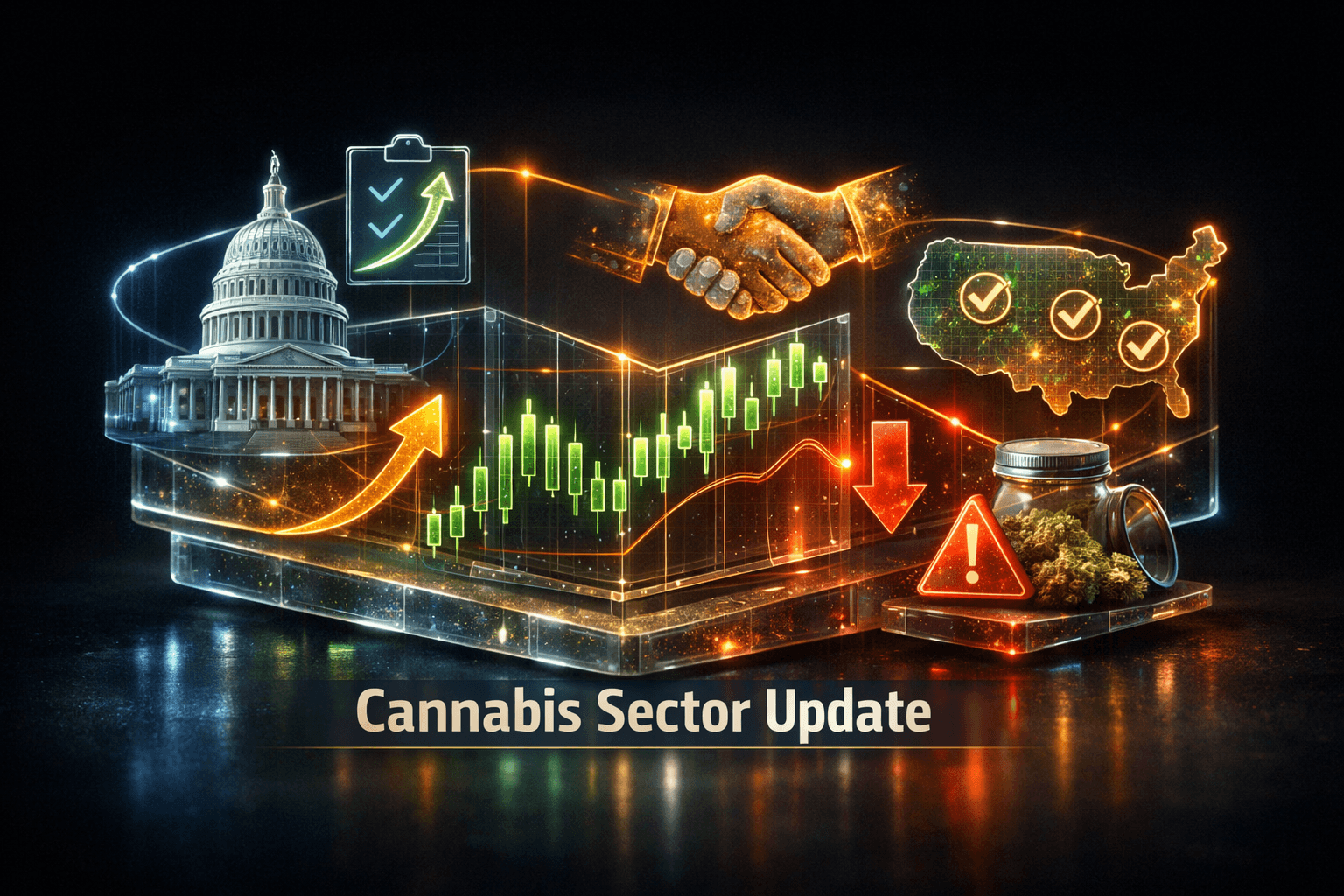
Today’s cannabis headlines delivered a split picture for investors, with policy momentum and a small but notable acquisition offset by regulatory friction and a product recall. You saw proof that legalization and rescheduling debates are reshaping markets even as implementation questions and quality-control issues create near-term volatility.
Why does this matter to you? Because political tailwinds and M&A activity can support growth, while operational and regulatory risks can affect revenue, margins and reputation for licensed operators and retailers.
Market Highlights
Key facts and quick takes from today’s reporting.
- TerrAscend acquisition: Multi-state operator TerrAscend closed a cash and debt deal for $9 million to buy five New Jersey retail locations, according to MJBizDaily.
- Price disparity: Cannabis prices vary widely by state, with an eighth costing about $15 in Washington and $52 in Kentucky, highlighting fragmented supply chains and license-capacity effects.
- Regulatory moves: Polling shows strong voter support for medical cannabis in North Carolina at 75 percent, while adult-use support is just over 50 percent, suggesting possible ballot or legislative traction.
- Quality alert: Missouri regulators issued a recall after random testing found aspergillus mold in a branded pre-roll product, underlining testing and compliance risk.
- Federal uncertainty: California officials say the DEA has provided little guidance on federal rescheduling implementation, leaving states to fill major gaps themselves.
Also keep an eye on sector trackers and liquid names like $MSOS, $TCNNF, $GTBIF, $CURLF and $TLRY as you follow market reactions and news flows.
Key Developments
Policy and Public Opinion
State-level politics moved in a generally constructive direction. An Elon University poll found 75 percent support for medical cannabis reforms in North Carolina and just over 50 percent support for adult-use legalization, signaling growing public acceptance.
At the same time, Alabama's health officials withdrew their objection to federal medical cannabis rescheduling, which reduces one state-level obstacle and may smooth some regulatory frictions.
M&A and Retail Activity
TerrAscend’s $9 million purchase of five New Jersey retail locations shows MSOs are still pursuing bolt-on retail deals in regulated states. The transaction is a concrete example of market consolidation at a modest scale, and it gives TerrAscend more retail footprint in a major Northeast market.
Deals like this typically aim to add revenue and distribution points quickly, but you should remember that integration and local market dynamics determine whether a small buy turns into meaningful growth.
Compliance, Safety and Implementation Gaps
Product safety matters. Missouri’s recall of Juicy J’s cherry limeade infused pre-rolls after aspergillus detection highlights how random testing can trigger immediate supply chain disruption and reputational damage for licensees and brands.
At the federal level, California regulators say the DEA has not provided practical implementation guidance after rescheduling, creating uncertainty for states updating rules. That gap could slow cross-state coordination, enforcement clarity and banking or research changes many businesses need.
What to Watch
Looking ahead, there are several catalysts and risks that could move names in the sector and affect your positions.
- Upcoming ballots and legislative windows, especially in North Carolina, where public support could translate into action. Will lawmakers or voters move this cycle?
- Federal implementation guidance, or lack of it, from the DEA and other agencies. Analysts note states want clarity on licensing, testing, banking and research rules after rescheduling.
- Quality-control headlines and recalls. You should watch state testing reports and brand-level disclosures because more recalls could pressure small cannabis retailers and branded product margins.
- M&A cadence and pricing. Expect more modest bolt-ons like TerrAscend’s deal, rather than big-ticket rollups, until regulatory clarity improves.
- Price normalization and interstate implications. The difference between $15 and $52 eighths in different states shows the cost of isolated markets. Will producers and retailers find ways to lower unit costs while complying with local rules?
Track sentiment and volume in major sector vehicles such as $MSOS, $TCNNF, $GTBIF, $CURLF and $TLRY to see how broader investor appetite is evolving. Are you watching the right names for exposure to policy wins or are you more concerned about operational risks?
Bottom Line
- Neutral overall today, with policy progress and M&A offset by regulatory uncertainty and a product recall.
- State-level support and administrative moves matter, but federal implementation gaps from the DEA could slow practical reforms.
- Quality-control failures remain a real operational and reputational risk for retailers and brands.
- Small-scale acquisitions will continue as MSOs expand footprint, but integration and local rules will determine success.
- Stay selective and watch upcoming ballots, regulatory guidance, and testing results to gauge risk versus opportunity.
FAQ Section
Q: How will state polling in places like North Carolina affect cannabis companies? A: Polling shows public support that can create legislative or ballot momentum, which could expand markets and create new retail opportunities for licensed operators.
Q: Should you worry about DEA inaction on rescheduling rules? A: Yes, implementation gaps increase uncertainty on licensing, banking and interstate rules, and analysts note that businesses may face delayed federal coordination until guidance is issued.
Q: How significant is a product recall for a cannabis business? A: Recalls can disrupt supply, trigger enforcement reviews and harm brand trust, so regulators and companies typically respond quickly and investors monitor follow-up testing and corrective actions.