The Big Picture
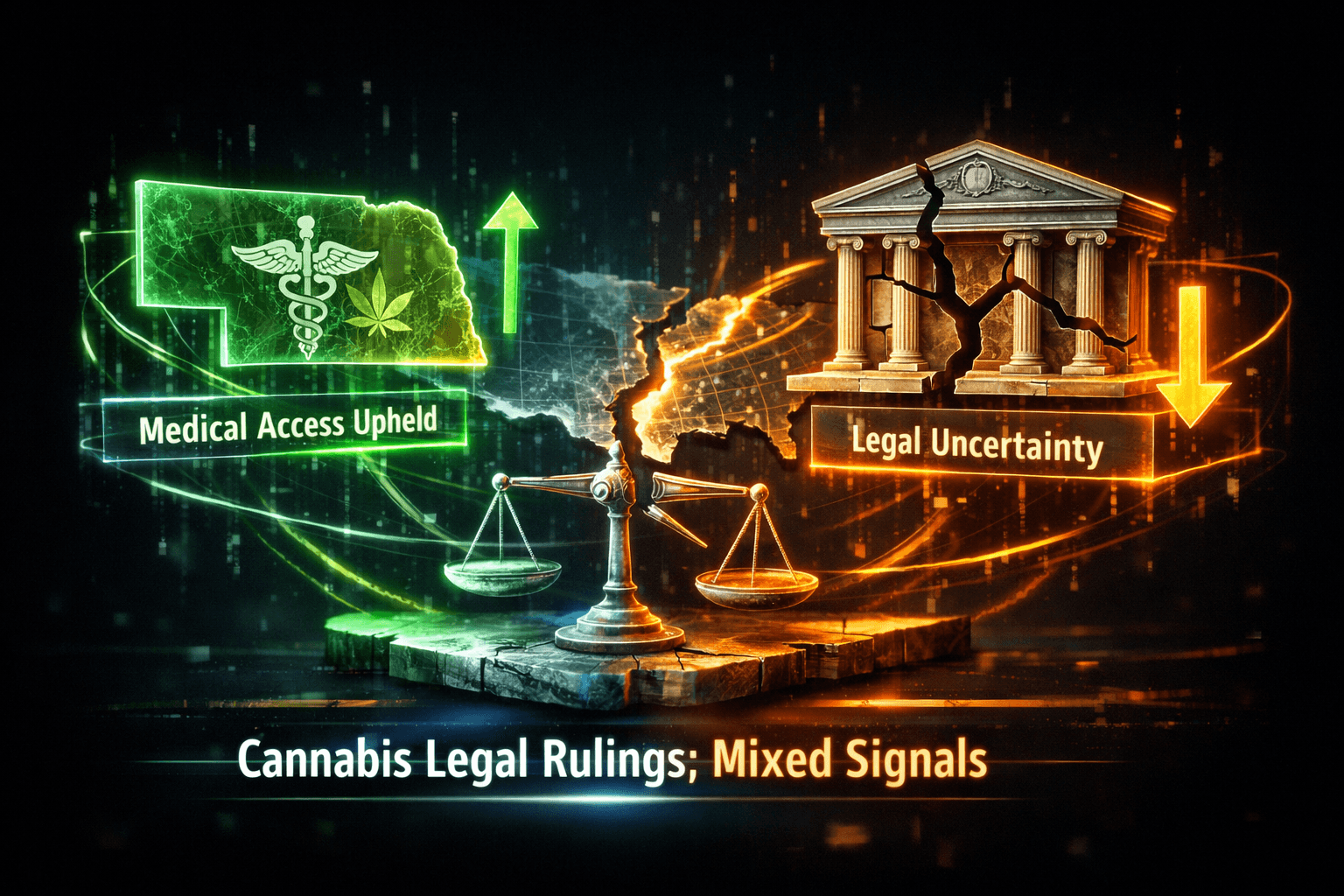
Today’s top cannabis headlines underline a mixed legal and regulatory environment that’s still shaping valuations and contract certainty in the sector. You should note that state-level wins for legalization coexist with federal court rulings that can erase large commercial judgments, and even local enforcement actions can affect public perception.
That combination means you’ll want to track legal developments closely, because they can change deal economics and counterparty risk quickly. What does this mean for the broader market? It’s a reminder that legal clarity is still the biggest non-market driver for cannabis stocks.
Market Highlights
Overnight and pre-market news was dominated by court rulings and a regulatory settlement rather than earnings or operational announcements. Trading patterns may reflect the legal mix, with attention focused on multi-state operators and companies with large contract exposures.
- Curaleaf subsidiaries were named in the Sixth Circuit case that reversed a $38.1 million judgment versus a Michigan cultivator; watch $CURLF for related headlines.
- No major overnight price shocks were reported in the news wire, but sector names may see volatility as markets digest legal risk. Keep an eye on the sector ETF $MSOS for direction.
- Other frequently watched tickers in the space include $TCNNF, $GTBIF, $CURLF, $TLRY, which investors often use to gauge sentiment across the cannabis complex.
Key Developments
Vermont Lt. Gov. Fined for Unlicensed Cultivation
Vermont Lt. Gov. John Rodgers agreed to pay a $2,500 fine to settle a regulators’ violation for growing roughly 200 cannabis plants at an unlicensed site, cutting an initial $5,000 penalty in half. The settlement is a reputational story rather than an industrywide operational issue, but it underscores enforcement reach at the state level.
For public companies and their investors, it’s a reminder that compliance lapses, even by public officials, can draw attention to licensing practices and local regulations. You should expect local regulators to use such cases to reinforce permitting standards.
Nebraska Supreme Court Upholds Medical Cannabis Laws
The Nebraska Supreme Court unanimously rejected a challenge seeking to overturn the state’s medical cannabis laws. Chief Justice Jeffrey Funke found the challenger lacked standing, effectively preserving patient access and the existing regulatory framework in that state.
This is a clear, pro-market outcome at the state level. For investors, state-court stability often translates into steadier demand forecasts for medical programs and fewer short-term policy shocks in affected markets.
Sixth Circuit Reverses $38.1M Judgment, Citing Federal Law
The Sixth Circuit in Cincinnati reversed a $38.1 million breach-of-contract judgment that a Michigan cultivator had won against Curaleaf subsidiaries, ruling that federal prohibition barred enforcement of the agreement. The decision highlights a persistent legal risk for commercial contracts tied to cannabis activities.
This ruling has direct implications for multi-state operators and their counterparties, because it suggests federal-law defenses can nullify large state-court awards. If you hold names with complex contract portfolios or legacy deals, legal exposure may be material to valuations.
What to Watch
Expect heightened attention to court calendars, state regulator actions, and any signals from federal agencies. You’ll want to follow how companies disclose legal contingencies in filings and listen for management commentary on contract risk in calls.
- Case appeals and cert petitions, especially any attempt to bring the Sixth Circuit decision to the Supreme Court, could be market-moving.
- State-level regulatory enforcement actions and licensing audits, like the Vermont case, often prompt companies to re-check compliance controls. Watch $MSOS and $TCNNF for ETF-level flows that may reflect shifting sentiment.
- Curaleaf’s legal exposure is a specific tracer for the judgment reversal; follow $CURLF statements and related filings closely.
- Macro and policy calendar: look for hearings, DOJ or DOJ-adjacent guidance, and any legislative movement on federal reform. Are federal courts going to keep undercutting state market contracts? That question matters for your risk models.
- Operational catalysts: earnings and quarterly filings from major MSOs and lab/processor partners will reveal contract risk reserves and legal provisions. Which companies are provisioning for contingent liabilities?
Bottom Line
- The sector shows mixed signals: state-court support for medical programs versus federal court rulings that can eliminate large awards.
- Legal and compliance risk remains a primary driver of company valuations and volatility, so monitor filings and disclosures closely.
- $MSOS, $TCNNF, $GTBIF, $CURLF, and $TLRY are tickers to watch for headline sensitivity and ETF/stock flows.
- Expect short-term volatility around legal filings, appeals, and state regulator actions, and consider legal outcomes when you model downside scenarios.
- This update is informational only; analysts note that legal clarity, not operational growth alone, will shape sector re-rating over time.
FAQ Section
Q: How does the Sixth Circuit decision affect cannabis company contracts? A: The court found federal law can bar enforcement of certain cannabis-related contracts, which increases legal risk for deals tied to federally illegal activity and may lead companies to disclose higher contingencies.
Q: Does the Nebraska ruling mean fewer legal threats to medical programs nationwide? A: The decision is favorable for Nebraska patients and operators, but it does not change federal preemption risk elsewhere; state-level stability can still improve local demand forecasts.
Q: Should you worry about regulatory fines like the Vermont case? A: Small fines for unlicensed activity mainly signal enforcement attention. You should watch company compliance practices and disclosures, because repeated or larger enforcement actions can affect operations and reputation.