The Big Picture
The most impactful development this morning is a possible U.S. Supreme Court review of cannabis licensing disputes, a move that could reshape how states and courts resolve competitive licensing fights and influence valuations across the sector. That legal uncertainty collides with signs of policy momentum, including a federal-leaning House member publicly backing nationwide legalization and state-level enforcement data showing high compliance.
For you as an investor, that mix matters because legal clarity and consistent enforcement tend to reduce regulatory risk, which is often a key driver of multiples in the cannabis space. Will the Supreme Court act, and how quickly will Congress or state regulators follow with clearer guidance?
Market Highlights
Quick facts and figures to start your trading day.
- Supreme Court signal: Marijuana Moment reports the high court could take up licensing disputes, which may create precedent for how challenges to state licensing rules are decided.
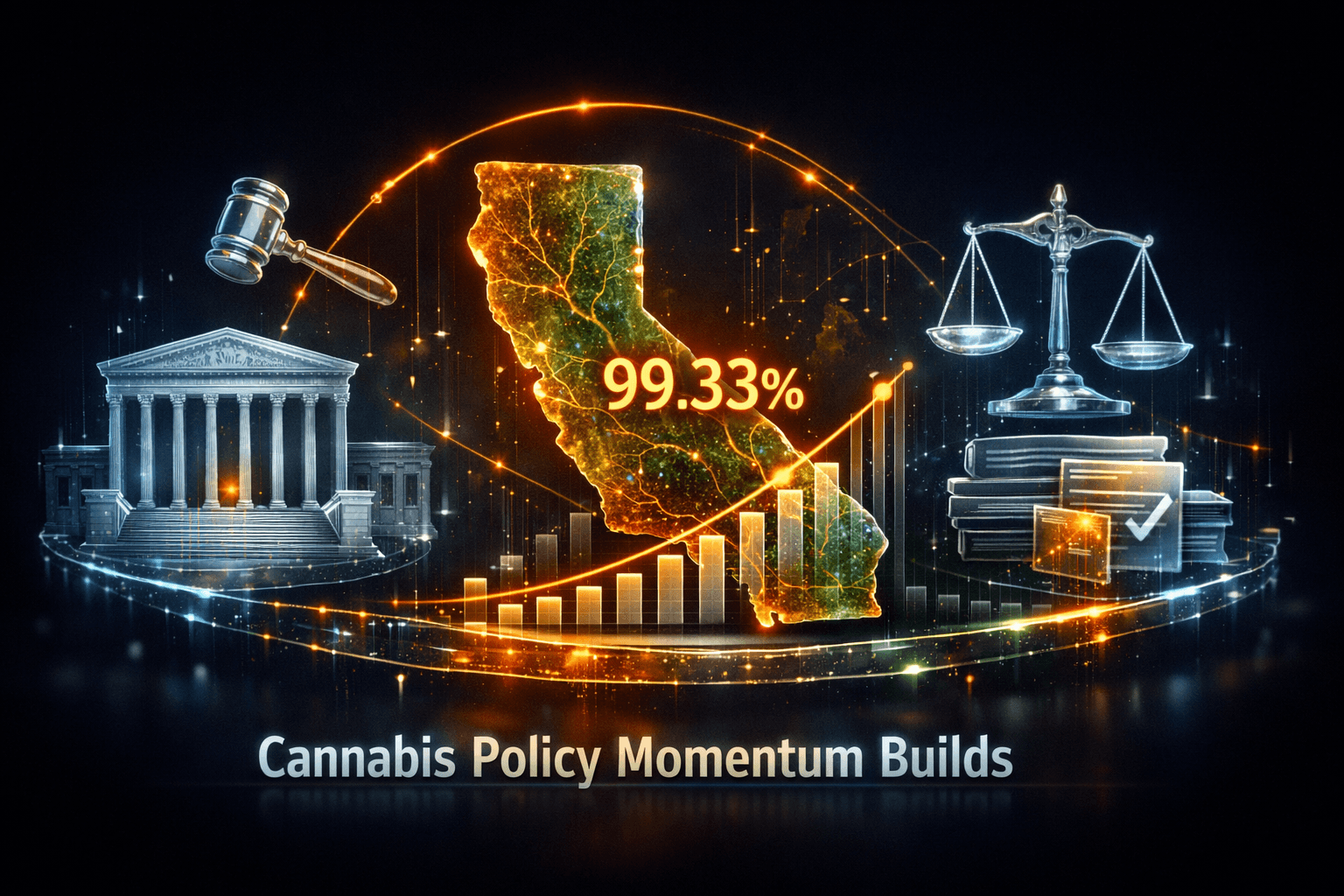
- California enforcement: The state’s Alcoholic Beverage Control reported 99.33% compliance across 23,667 site visits, with 158 violations recorded and 7,403 products removed from shelves, according to Ganjapreneur.
- Law enforcement trends: Northwest Indiana saw cannabis arrests fall from 1,272 in Q1 2021 to 734 by Q4 2025, reflecting cross-border effects from neighboring states that legalized adult use.
- Federal politics: A New Hampshire House member said during a primary debate she would back federal legalization, signaling continued political momentum toward nationwide reform.
Key Developments
Supreme Court may shape licensing disputes
The prospect of a Supreme Court review elevates licensing fights from state administrative battles to federal judicial scrutiny. If the Court accepts a case, lower-court splits could be resolved in a way that affects how states design application processes and handle competitive awards.
For operators and investors, that could mean changes to the durability of licenses, contest timelines, and legal expense assumptions. You should watch for case filings and any fast-tracked briefing schedules.
California shows near-full compliance on hemp and kratom sales
Updated enforcement figures from California indicate 99.33% compliance among investigated Alcoholic Beverage Control licensees, with 7,403 products removed after 23,667 inspections. That’s a strong regulatory signal, and it suggests licensed retail channels are largely aligning with state rules.
Higher compliance reduces regulatory uncertainty and may limit opportunistic litigation, but product removals show regulators are vigilant. Expect continued scrutiny of product labeling and supply chain documentation, which can affect margins for producers and distributors.
Political and social trends continue to move in favor of reform
At the federal level, a New Hampshire representative said she’d support legalization, and public commentaries, including an opinion piece on India’s historical policy, highlight growing global normalization of cannabis. Meanwhile, localized drops in arrests in parts of Indiana point to real-world effects when neighboring states legalize.
These signals together form a bellwether for investors, suggesting regulatory risk is gradually diminishing in many markets even though legal complexity remains.
What to Watch
Focus your attention on legal, political, and compliance catalysts that could move stocks and sentiment today.
- Supreme Court docket activity, filings, and any announced grants of certiorari, which would accelerate legal clarity timelines.
- Congressional calendar and committee moves on federal legalization measures, plus any statements from influential lawmakers or committee chairs.
- State enforcement actions and product recalls, especially in large markets like California where compliance metrics matter for supply and distribution.
- Regulatory guidance on hemp-derived products, since removals in California indicate ongoing enforcement against products that don’t meet state standards.
Stocks to watch in the sector include AdvisorShares Pure US Cannabis ETF (MSOS), Trulieve Cannabis (TCNNF), Green Thumb Industries (GTBIF), Curaleaf Holdings (CURLF), and Tilray Brands (TLRY), each sensitive to policy headlines and state-level outcomes. Analysts note that ETFs like $MSOS can reflect broader sentiment shifts, while single-name exposures such as $TLRY and $TCNNF react more to operational or licensing news. How will you position for legal clarity versus regulatory risk?
Risk factors to monitor include licensing reversals, product safety recalls, and shifts in enforcement priorities that could raise compliance costs. Keep an eye on litigation expense disclosures in filings, and watch press releases for product pullbacks that could affect revenue timing.
Bottom Line
- Potential Supreme Court involvement is the headline risk and opportunity, because a decision to hear a case could set national precedent on licensing disputes.
- California’s 99.33% compliance rate is a positive sign for regulated retail channels and could lower perceived operational risk for listed companies doing business there.
- Political endorsements for federal legalization and falling regional arrests reinforce momentum toward reform, which tends to compress policy risk premium over time.
- Watch $MSOS, $TCNNF, $GTBIF, $CURLF, and $TLRY for sensitivity to legal and regulatory updates, and read filings for litigation and compliance expenses.
- Data suggests momentum is building, but legal and enforcement uncertainty remain. Proceed cautiously and monitor catalysts closely.
FAQ
Q: Could the Supreme Court decision change state licensing outcomes? A: Yes, if the Court takes a case it could set precedent that changes how states structure and defend licensing programs, affecting appeals and award durability.
Q: Does California’s high compliance rate mean enforcement risk is over? A: No, high compliance reduces some enforcement risk, but the scale of product removals shows regulators still act, so suppliers and retailers must maintain strong compliance controls.
Q: Which catalysts will move cannabis stocks most in the near term? A: Legal rulings, federal legislative activity, state enforcement actions, and major recalls are the top near-term catalysts that typically move sector prices and sentiment.