The Big Picture
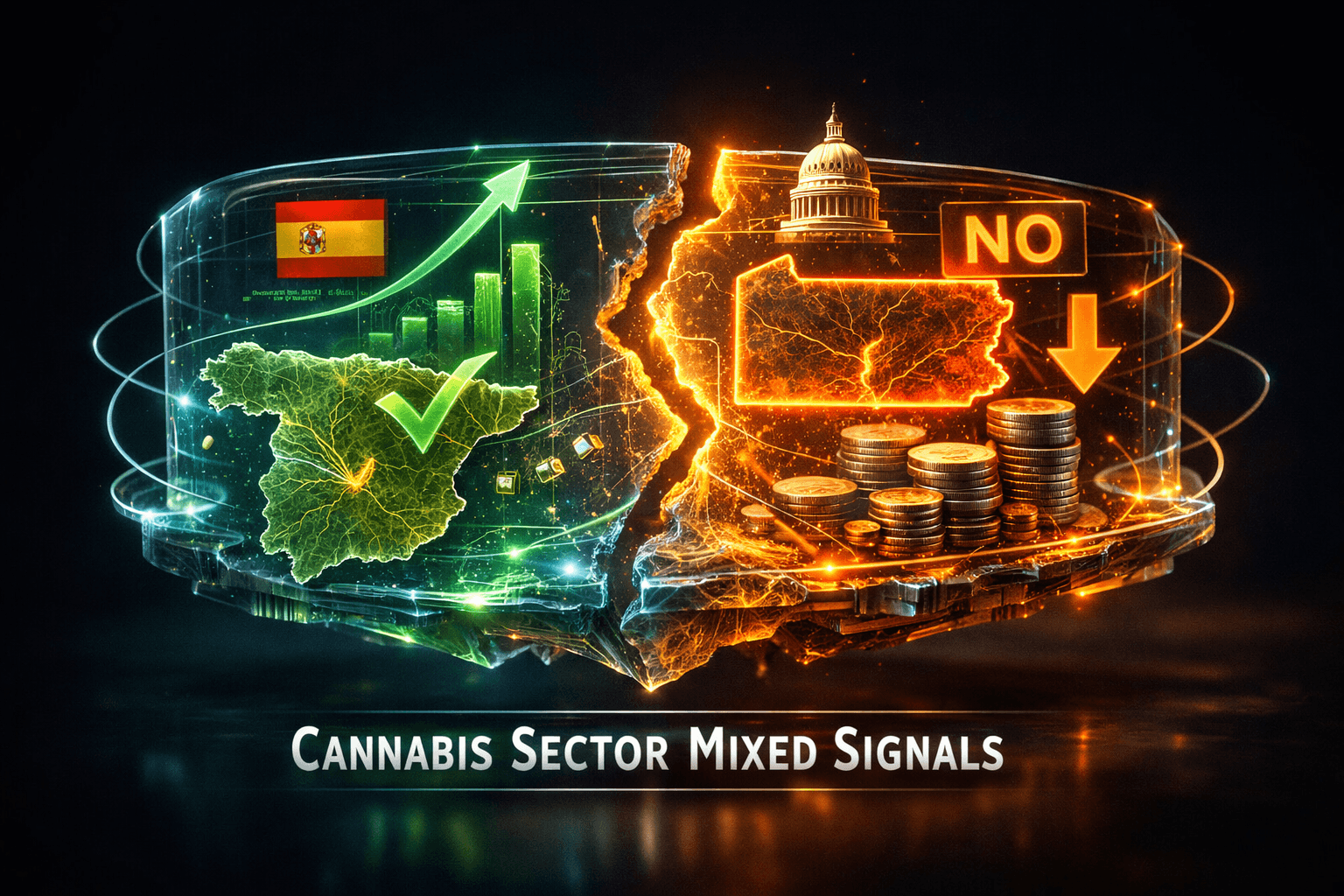
Today the cannabis sector delivered mixed signals, with a notable corporate regulatory win overseas and uneven political progress at home. Curaleaf's move to register cannabis preparations in Spain marked a tangible expansion in Europe, while several U.S. state-level policy outcomes left the pathway to broader adult-use markets uncertain.
Why does this matter to you as an investor? International regulatory approvals and federal guidance on adjacent psychedelics can create new addressable markets, but state-level setbacks and divergent state responses to federal reforms mean volatility and uneven opportunity ahead.
Market Highlights
Quick facts and headlines to track from today's news flow.
- Curaleaf Holdings $CURLF: First company to register cannabis preparations in Spain, enabling hospital pharmacies to compound prescribed formulas for patients, a regulatory milestone in the EU market.
- Pennsylvania: Adult-use marijuana legalization was left out of the state budget deal approved over the weekend, delaying potential retail expansion and tax revenue changes.
- FDA and psychedelics: The Food and Drug Administration finalized guidance on conducting psychedelic research and scheduled a public hearing in September, an event that could influence clinical pathways for psychedelic therapies.
- State policy divergence: Wyoming officials said the state will not reschedule cannabis under state law despite federal reclassification to Schedule III, underscoring patchwork implementation across states.
- Political momentum and bills: A new Pennsylvania bill would award medical marijuana licenses to small, diverse, and disadvantaged businesses, while a Kansas gubernatorial candidate publicly backed broad cannabis reforms.
Key Developments
Curaleaf registers cannabis preparations in Spain
Curaleaf $CURLF announced registration of cannabis preparations that hospital pharmacies can use to compound prescriptions for healthcare professionals. This makes Curaleaf the first company to secure that pathway in Spain, a step that could accelerate clinical and hospital-level distribution in the market.
For investors you should note this expands Curaleaf's regulatory moat in Europe and signals the growing institutional acceptance of medical cannabis in Spanish healthcare settings.
Pennsylvania stumbles, but medical access gains focus
Adult-use legalization was excluded from Pennsylvania's recent budget deal, effectively pausing plans for commercialization and related tax revenue. At the same time, lawmakers filed a bill to prioritize medical licenses for small and diverse businesses under the existing medical program.
What this means is the near-term path to large-scale retail expansion in Pennsylvania looks stalled, but regulatory attention is shifting to medical program reform that could redistribute opportunity within the market.
Federal and state policy create a patchwork of outcomes
The FDA finalized guidance to help researchers navigate the unique challenges of psychedelic clinical trials and will host a public hearing in September. This is meaningful for the broader cannabinoid and psychedelics ecosystem because it clarifies regulatory expectations around human-subject research.
Contrast that with Wyoming's decision not to reschedule cannabis at the state level despite federal reclassification. You're seeing fragmentation: federal shifts don't automatically translate to uniform state action.
What to Watch
Where you should focus next and what could move markets tomorrow and beyond.
- Curaleaf $CURLF follow-up: Watch for commercial or hospital partnership announcements in Spain and wider Europe, and any regulatory filings that outline timing for product rollout.
- State legislative calendars: Pennsylvania lawmakers could revive adult-use debates later in the year, while the new bill prioritizing small medical licensees could create late-cycle volatility in local operators.
- Federal signals and hearings: The FDA's September hearing on psychedelics may influence R&D funding, trial timelines, and investor interest in adjacent life-science companies.
- Broader sector ETFs and names to track: $MSOS, $TCNNF, $GTBIF, $CURLF, $TLRY are key tickers investors monitor for sector flows and sentiment shifts.
- Implementation risk: Monitor state agencies for guidance on federal reclassification impacts, especially in states like Wyoming where officials have signaled no immediate change.
Which event will move you the most, regulatory clarity or state-level politics? Keep an eye on local legislative calendars, because that's where a lot of near-term upside or downside will originate.
Bottom Line
- Curaleaf's Spanish registration is a concrete international regulatory win that expands medical distribution channels for the company.
- Pennsylvania's exclusion of adult-use legalization from the budget is a near-term headwind for sector upside in a large northeastern state.
- Federal guidance on psychedelics and a scheduled FDA hearing add clarity for clinical development, offering potential long-term R&D tailwinds for adjacent therapeutic markets.
- State-level divergence, illustrated by Wyoming's refusal to reschedule, means federal reforms will produce uneven outcomes and ongoing policy risk.
- This summary is informational only, analysts note you should monitor legislative calendars and regulatory filings for actionable signals, and this is not personalized investment advice.
FAQ Section
Q: Will Curaleaf's Spain registration immediately boost its revenues? A: Registration enables hospital compounding and patient access, but commercial rollout and revenue impact will depend on partnerships and product availability timing.
Q: Does Pennsylvania's budget decision mean legalization is dead for 2026? A: The budget exclusion delays adult-use commercialization, but legislators may resume debates or introduce new measures later in the legislative session.
Q: How should you interpret federal psychedelic guidance for cannabis investments? A: FDA guidance clarifies clinical trial expectations for psychedelics which may increase investor interest in therapeutic research, but direct effects on cannabis companies will vary by business model and R&D exposure.