The Big Picture
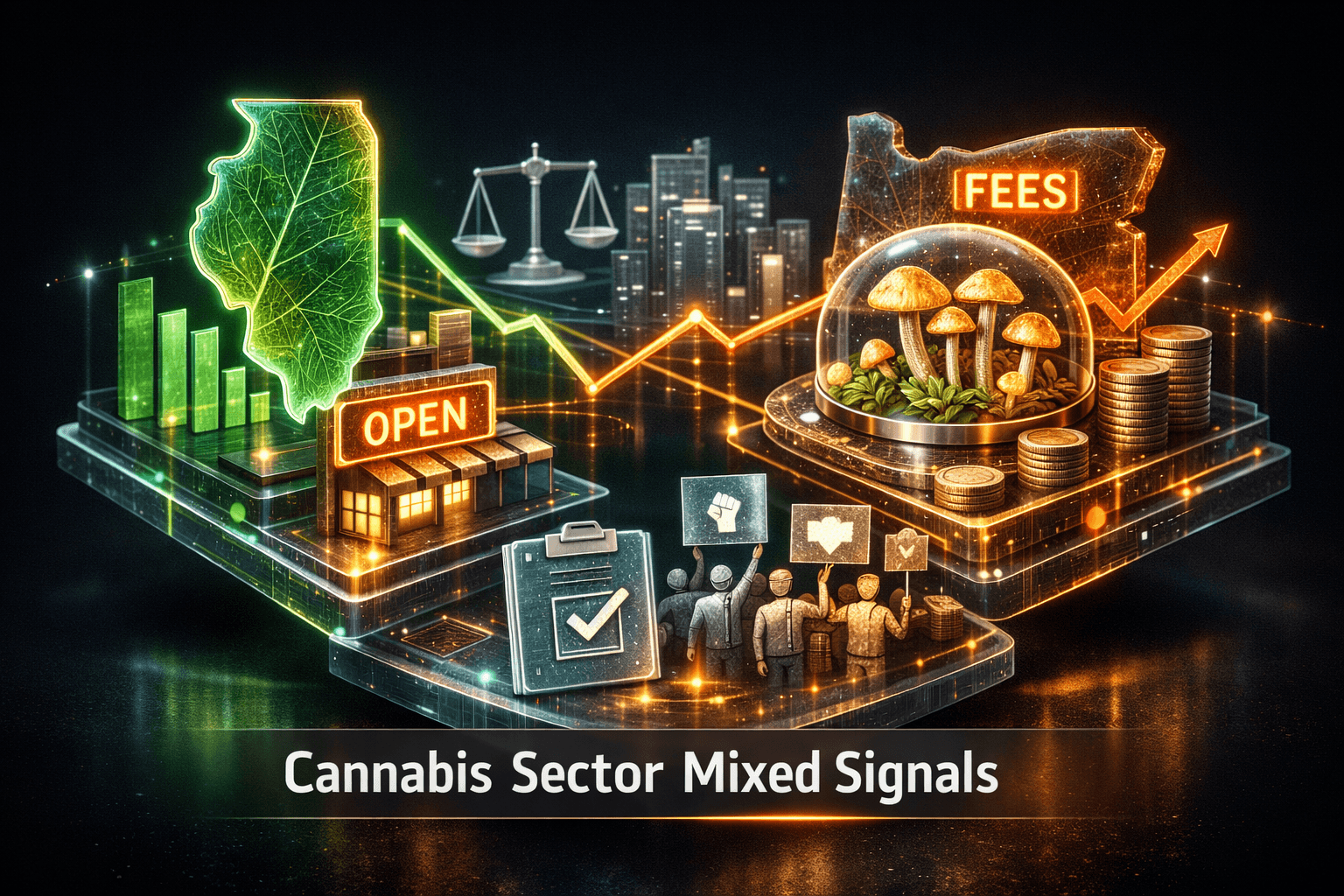
Illinois issued guidance that doubles adult possession limits, greenlights drive-thru and curbside sales at dispensaries, and extends store hours, signaling meaningful expansion of consumer access in a large state market. At the same time you saw pushback on costs and standards elsewhere, with Oregon proposing steep fee hikes for psilocybin businesses and union wins in Missouri that could raise labor costs.
This mix of deregulation, professionalization, and potential cost pressures matters because it points to both upside for retail sales and new operating headwinds. How these forces balance will help determine near-term margin pressure and capital allocation decisions for operators and investors like you.
Market Highlights
- Illinois regulatory update: State guidance doubles legal possession limits and permits drive-thru and curbside pickup for dispensaries, plus longer operating hours. This could increase foot traffic and convenience sales for in-state operators.
- Oregon fee proposal: Regulators are seeking steep fee hikes for psilocybin businesses, prompting warnings that smaller operators could be forced out of the market.
- Labor and standards: Missouri cannabis workers ratified what union leaders say is the state’s first cannabis collective bargaining agreement, securing higher pay and paid vacation; the National Institute of Standards and Technology released a 31-page report on scales used to weigh marijuana products.
- Culture and education: A High Times feature traced the evolution of the joint tip from simple paper to luxury design, while Roanoke College launched a three-year online bachelor’s degree in cannabis studies.
- Sector tickers to watch today include $MSOS, $TCNNF, $GTBIF, $CURLF, and $TLRY as investors parse regulatory shifts and cost signals across states.
Key Developments
Illinois expands retail access and convenience
Illinois officials published implementation guidance allowing dispensaries to add drive-thrus, offer curbside pickup, and extend hours, while the law doubles possession limits for adults. For operators this could translate into higher same-store traffic and a need to invest in new store layouts and point-of-sale workflows, changes you should watch as operators update capital plans.
Oregon’s proposed fee hikes put pressure on psilocybin firms
State regulators in Oregon proposed major fee increases for the psilocybin industry, drawing warnings that the measures could force a contraction. While this targets psilocybin rather than cannabis directly, it underscores a broader trend of state regulators reassessing fee structures and industry funding models, which could spill over into cannabis rulemakings.
Standards, labor wins, and education shape the sector’s backbone
The NIST 31-page report on weighing scales offers detailed technical guidance that states can adopt to reduce compliance risk and measurement disputes at retail. Alongside that, Missouri workers ratified a first-in-state union contract for cannabis employees, pushing for higher pay and paid vacation. Roanoke College’s new three-year cannabis degree and consumer culture pieces like the joint tip story point to continued professionalization and mainstreaming of cannabis jobs and products.
What to Watch
Look for rulemaking details and business guidance as Illinois operators begin to implement drive-thrus and extended hours. Those operational changes could affect store-level revenue and staffing plans, so monitor state agency filings and license amendment timelines.
Will higher fees in Oregon prompt a legal or legislative response, or will companies accept consolidation? You should track public comment periods and agency meeting dates there to gauge likely outcomes and timing.
Keep an eye on labor developments and cost trends. Union contracts and wage gains in pockets like Missouri can increase operating expenses elsewhere as employees press for parity. Also watch whether states adopt the NIST recommendations for scales, because uniform measurement standards can reduce shrink and compliance disputes.
For market signals, follow $MSOS, $TCNNF, $GTBIF, $CURLF, and $TLRY as proxies for broader sentiment and company-specific risk. You may want to watch upcoming earnings, state ballot or legislative calendars, and any federal guidance that could affect banking and taxation in the months ahead.
Bottom Line
- Illinois’ reforms expand retail access and convenience, potentially lifting in-state volumes while creating short-term implementation costs for operators.
- Oregon’s proposed fee hikes pose a contraction risk for psilocybin firms and highlight regulatory cost risk that can affect adjacent markets.
- Standardization efforts like the NIST scales report and new educational programs point to continued professionalization of the industry, which can support credibility but may raise compliance costs.
- Labor wins in Missouri underscore rising worker power and potential margin pressure; analysts note labor costs are an increasingly important variable for operator models.
- Overall, you should take a selective approach as the sector balances access-driven growth against regulatory and cost headwinds.
FAQ Section
Q: How will Illinois’ changes affect dispensary sales? A: Expanded possession limits and drive-thru options increase convenience and could boost retail volumes, though operators will face implementation costs and new compliance steps.
Q: Should investors worry about Oregon’s psilocybin fee hikes impacting cannabis stocks? A: The proposal targets psilocybin but signals wider regulatory reconsideration of fee models, which could influence state-level cannabis policy and investor risk assessments.
Q: What does the NIST report mean for cannabis businesses? A: The 31-page report offers technical guidance on scales that can reduce disputes and improve consistency across state markets if regulators adopt the recommendations.