The Big Picture
State-level policy shifts over the holiday weekend are creating fresh uncertainty for the cannabis and hemp sector, and that matters for your portfolio positioning. Virginia lawmakers included market changes in a final budget that many hemp farmers say will favor larger players and push out small operators.
US markets were closed Sunday. Remember that the last trading day was Thursday, July 2, and the next session is Monday, July 6. You should view these stories as policy risk events rather than immediate market moves, but they can shape investor sentiment and company outlooks going into next week.
Market Highlights
Policy headlines dominated weekend reading, while key sector names remain in focus heading into Monday.
- $MSOS, the broad cannabis ETF, and major operators such as $TLRY and $CURLF were widely watched heading into the long weekend, as investors reassessed state-level regulatory risk.
- $TCNNF and $GTBIF remain closely monitored by retail investors for regional exposure, with traders likely to price in tighter state rules when markets reopen on July 6.
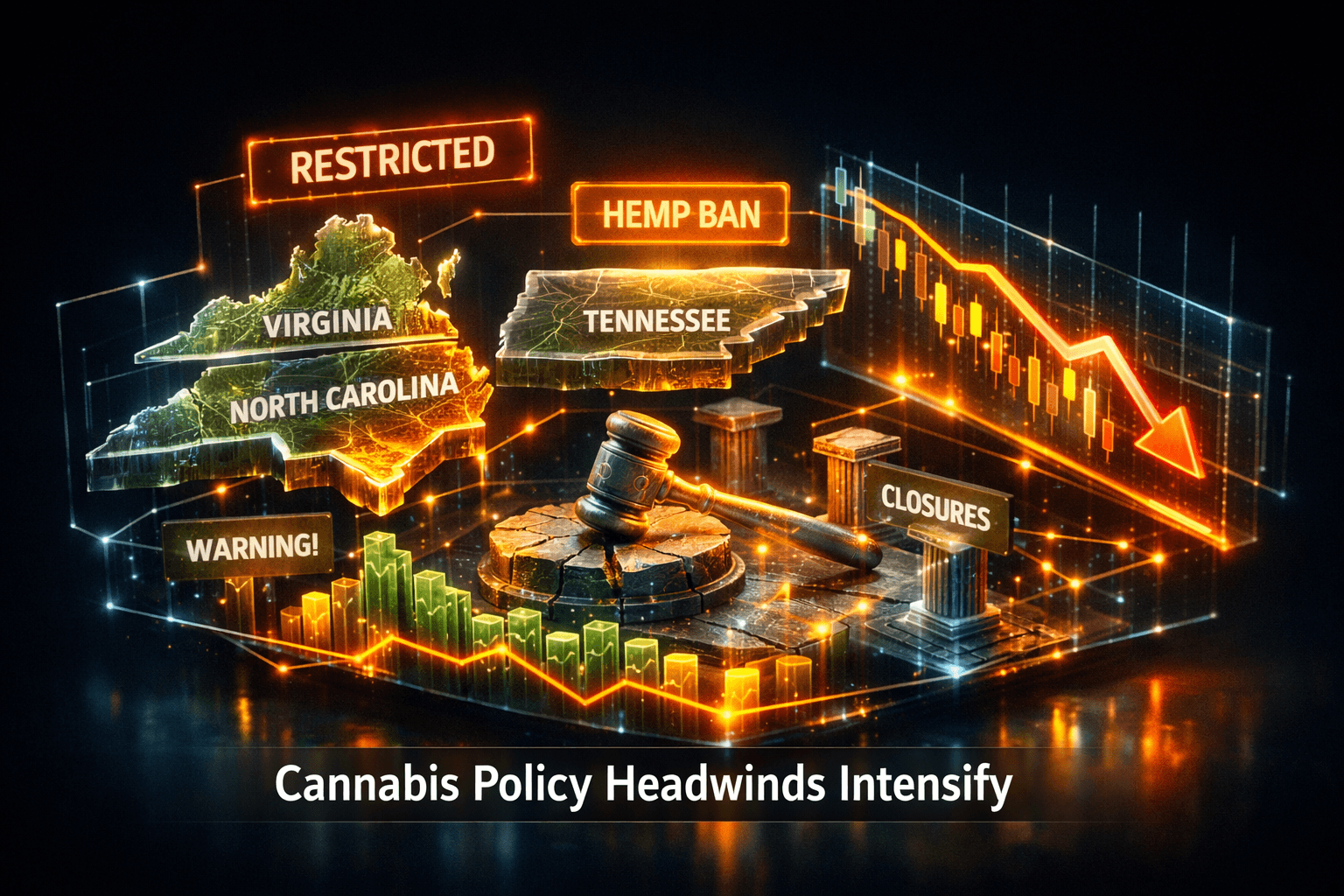
- No US equities trading occurred Sunday; expect volatility early in the week as markets digest the legislative developments in Virginia, Tennessee, and North Carolina.
Key Developments
Virginia: Farmers Fear Market Tilt Toward Big Capital
Virginia’s final budget includes provisions that change how the legal cannabis market will be implemented next summer. Hemp farmers and small businesses say the language effectively favors larger, better-capitalized firms and could push independent growers out of the market.
For you that means monitoring permit rules, licensing quotas, and wholesale pathways. If larger multis start gaining advantage, pricing and margin pressure could follow for smaller producers who can’t scale quickly.
Tennessee: Hemp Product Ban Takes Effect as Legalization Push Rises
Tennessee’s ban on popular hemp products took effect midweek and prompted renewed legalization efforts by state Democrats. Lawmakers say the ban was meant to curb unregulated products, but critics warn it drives consumers to the illicit market.
That dynamic raises regulatory and compliance risks for companies selling across state lines. Will patchwork bans push demand into illicit channels, or accelerate calls for statewide legalization and clearer rules? Either outcome creates transitional risk you’ll want to watch.
North Carolina: Senate Votes to Restrict Hemp THC and Kratom
On their last day before a recess, North Carolina senators passed a bill that would ban many hemp THC products and restrict kratom. The move signals continued conservative sentiment in some state capitals toward novel cannabinoid products.
Companies with product lines that include delta-8 and related compounds could see shelf access and revenue cutbacks in the state. Expect retailers and manufacturers to reassess state-by-state product strategies and supply chains.
What to Watch
State rules and enforcement will remain the primary driver of sector headlines next week. You should focus on a few concrete developments that will shape near-term risk and opportunity.
- Legislative updates and implementation guidance in Virginia, including licensing timelines for the market launching next summer.
- Any legal or regulatory challenges to Tennessee’s hemp product ban and whether Democratic legalization bills gain traction.
- Follow North Carolina’s final enrollment and any amendments to the hemp THC restrictions when the House reconciles with the Senate.
- Watch $MSOS for ETF flow signals, and monitor $TLRY, $CURLF, $GTBIF, and $TCNNF for company-specific responses to state restrictions.
- Quarterly earnings and balance-sheet disclosures from major operators will matter if policy-driven revenue risks grow, so check upcoming earnings calendars when markets reopen.
Need a heads up on how this could affect liquidity in the sector? Expect selective volatility and regional dispersion of pricing as states move at different paces.
Bottom Line
- Regulatory headwinds in multiple states create near-term uncertainty for hemp and cannabis producers and retailers.
- Small growers and local brands in Virginia and North Carolina face the greatest operational risk, while larger operators may gain relative scale advantages.
- Patchwork bans like Tennessee’s can push consumers to unregulated markets and complicate compliance across state lines.
- Monitor $MSOS, $TLRY, $CURLF, $GTBIF, and $TCNNF for sector sentiment and company-level exposure to state policy shifts.
- Expect volatility when US markets reopen on Monday, July 6, as investors price in these legislative developments.
FAQ Section
Q: How will Virginia’s budget changes affect hemp farmers? A: The changes could concentrate market access with larger firms by altering licensing and market structure, creating competitive pressure on small growers and processors.
Q: Will Tennessee’s ban reduce overall cannabis consumption? A: Data suggests bans shift consumption rather than eliminate it, which can expand unregulated sales and complicate public health oversight.
Q: What should you watch next week? A: Track legislative guidance and any legal challenges, plus earnings and ETF flows for $MSOS and the named operators as markets reopen on July 6.