The Big Picture
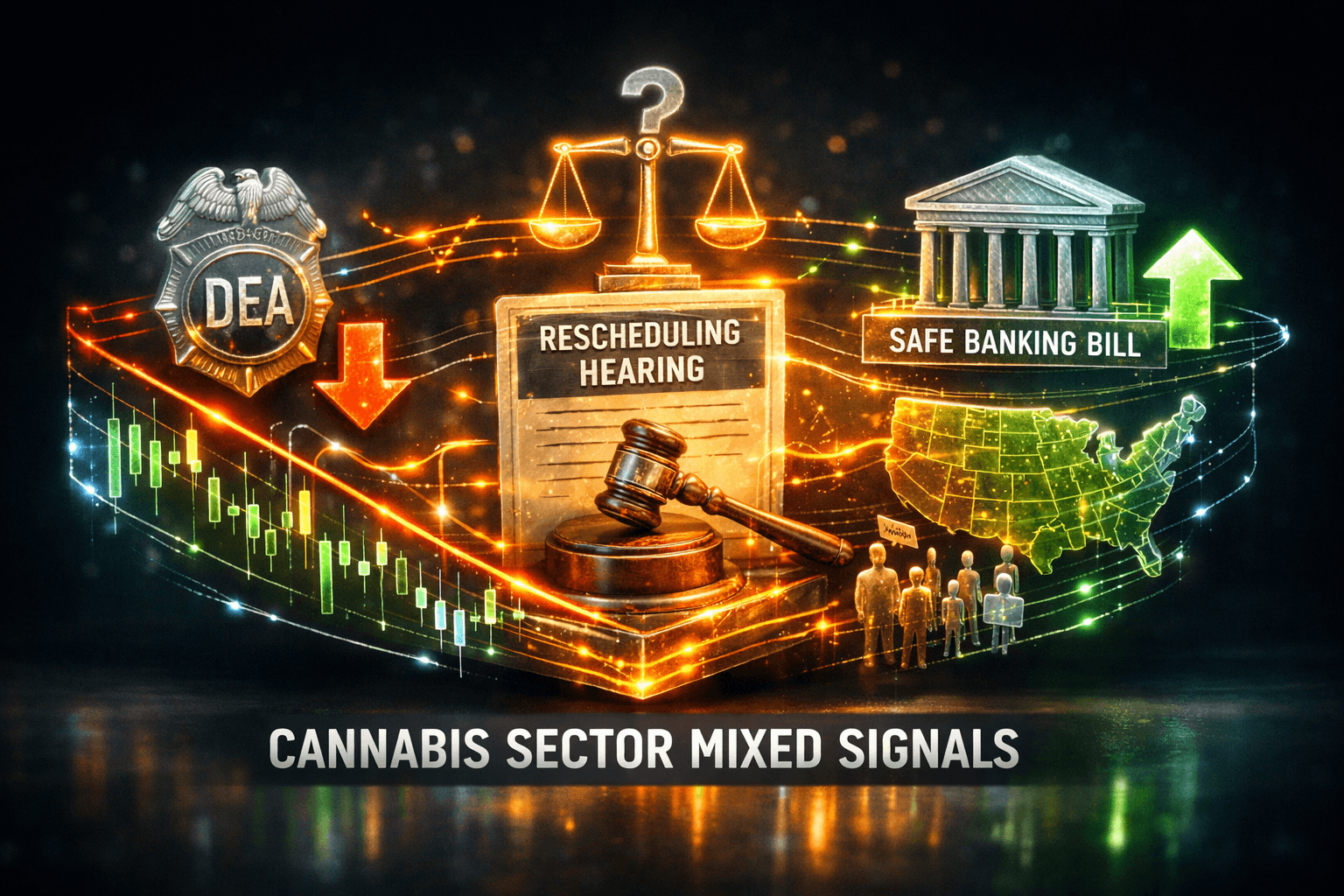
The cannabis sector closed the day with mixed signals that leave investors with both reasons for concern and reasons to stay engaged. The DEA doubled down on treating synthetic hexahydrocannabinol, or HHC, as a federally banned compound, and a controversial, closed-door DEA hearing set for June 29 raised fresh questions about the federal rescheduling process.
Offsetting that regulatory strain, lawmakers filed a bipartisan SAFE banking bill to protect banks that serve cannabis businesses, and activists in Massachusetts launched a campaign to block a legalization rollback. If you follow this space, you can see why volatility is likely to continue into next week.
Market Highlights
Market reactions were mixed as traders digested headlines. Volume and sentiment swung on regulatory developments, while sector-specific ETFs and names tracked closely.
- $MSOS, the broad cannabis ETF, was a focal point for traders watching headline risk and policy news.
- Key single names investors track included $TCNNF, $GTBIF, $CURLF, and $TLRY as volatility-readiness plays across U.S. and Canadian-listed stocks.
- News on DEA enforcement and a potential banking fix drove intraday chatter, with investors rotating between quality names and speculative product makers.
Key Developments
DEA Defends HHC Ban, Industry Lawsuits Continue
The DEA has formally defended its recent rule that treats synthetic HHC as a Schedule I substance, responding to industry lawsuits from hemp companies. This defense signals tougher federal scrutiny of synthetic cannabinoids and raises compliance and product risk for companies selling HHC and related derivatives.
For you, that means products marketed as hemp-derived but manufactured through synthetic processes may face immediate legal exposure. Expect sales and supply disruptions for those product lines while companies evaluate reformulation, labeling, or litigation strategies.
Closed-Door DEA Hearing on Rescheduling Starts June 29
High Times reported that a DEA hearing beginning June 29 will be closed to the public and includes only opponents of rescheduling on the record. The hearing structure has already drawn criticism and could shape whether marijuana is rescheduled at the federal level even as political moves push in a different direction.
How will courts and Congress respond? If the hearing record is one-sided, legal challenges seem likely, which could prolong regulatory uncertainty and keep volatility high for the sector.
Bipartisan SAFE Banking Bill and State-Level Defense Efforts
A bipartisan group of senators and representatives filed a SAFE banking bill designed to shield banks from penalties for serving cannabis businesses. The move provides a legislative pathway to ease long-standing financial access issues for the sector, and could materially improve cash handling and capital access if it advances.
Meanwhile, Massachusetts business leaders and advocates launched a campaign to defeat an anticipated rollback on November's ballot. That fight shows states remain a key battleground, and successful defense efforts could protect revenue bases for regional operators.
What to Watch
Keep your focus on a handful of near-term catalysts that will shape trading and fundamentals. You should watch legal filings, regulatory calendars, and legislative movement closely.
- DEA rescheduling hearing, June 29. Monitor any orders, court filings, or immediate administrative actions the agency issues, and expect legal responses from industry groups.
- Progress on the SAFE banking bill. Track committee action, public statements from bill sponsors, and any amendments that could change the bill's scope.
- Massachusetts ballot campaign. Watch signature challenges, polling, and fundraising for the Stop the Repeal campaign ahead of November.
- Company-level disclosures related to HHC. Firms selling HHC or similar synthetics should update investors about product pulls, recalls, or legal exposure if prosecutions or enforcement ramp up.
- ETF and name monitoring. Keep an eye on $MSOS, $TCNNF, $GTBIF, $CURLF, and $TLRY as bellwethers for flows and sentiment in the sector.
What should you expect next? Short-term swings tied to headlines are likely, while the longer path depends on whether Congress or the courts reduce regulatory risk. Do you have a plan for headline-driven volatility in your positions?
Bottom Line
- Regulatory pressure from the DEA on HHC and a closed-door rescheduling hearing create tangible near-term legal risk for parts of the cannabis market.
- Legislative progress on banking and active state-level defense campaigns provide countervailing support that could stabilize fundamentals over time.
- Expect continued headline-driven volatility, especially for companies tied to synthetic cannabinoids and for regional operators in contested state ballots.
- Track the DEA hearing, SAFE Act momentum, and Massachusetts ballot dynamics closely, because each could change access to capital, product lines, and market structure.
- Analysts note mixed signals today, so maintain selectivity and pay attention to company disclosures and legal filings if you follow the sector.
Investment disclaimer, for informational purposes only: this wrap summarizes public news and analysis, it does not recommend buying, selling, or holding any security, and it is not personalized investment advice.
FAQ Section
Q: Is HHC federally illegal after the DEA's defense? A: The DEA has defended its rule treating synthetic HHC as a Schedule I substance, which increases enforcement risk while legal challenges proceed.
Q: Will the SAFE banking bill immediately fix banking access for cannabis firms? A: The bill establishes protections for banks, but it must pass both chambers and be signed into law before it meaningfully changes banking behavior.
Q: How should I monitor the June 29 DEA hearing? A: Watch filings, any administrative orders, and legal responses from industry groups, because those items will indicate whether rescheduling moves forward or faces further legal challenges.