The Big Picture
The most impactful development this morning is a snapshot of an industry in transition: U.S. cannabis employment and sales showed modest contraction in 2025, but regulatory openings and shifting consumer behavior suggest the story isn't one-sided. You should pay attention because these trends affect revenue, margins, and who captures the next phase of demand.
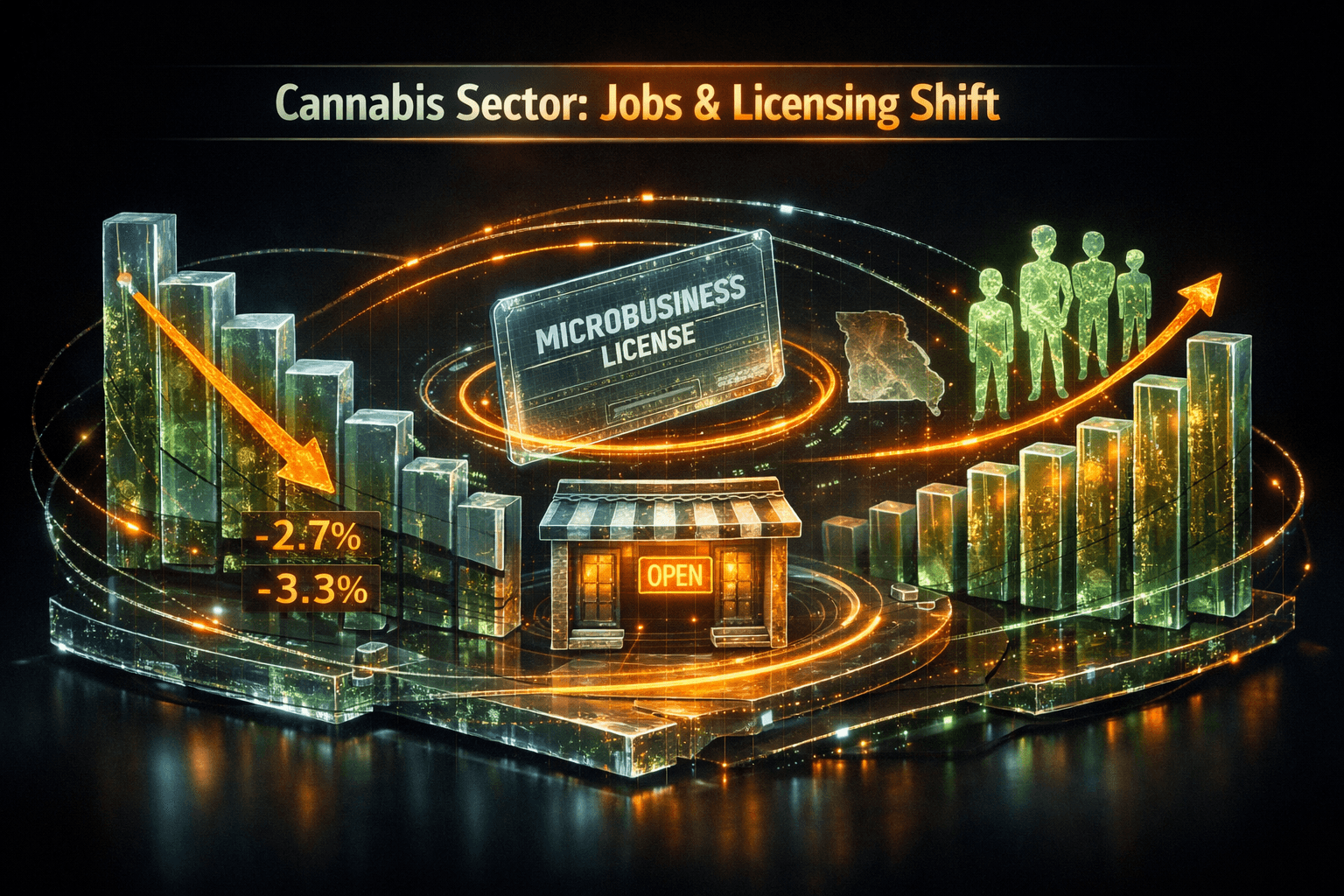
Jobs in the legal cannabis sector fell 2.7% year over year, and reported sales declined 3.3%. At the same time, Missouri will open a third microbusiness license round next month, and usage data shows high cannabis penetration among younger consumers with diagnosed depression. What does this mean for you as an investor, and where might opportunities or risks appear?
Market Highlights
Quick facts and numbers from today's sector headlines to help you scan the tape fast.
- Industry employment: Down 2.7% year over year in 2025, per Vangst and Whitney Economics' U.S. Cannabis Jobs Report.
- Retail sales: Reported U.S. cannabis sales declined 3.3% year over year in 2025, with price compression cited as a headwind.
- Consumer behavior: 50% of Gen Z respondents diagnosed with depression report using cannabis, per NeuroKaire; CBD use among depressed Gen Z was reported at 70% versus 44% among non-depressed peers.
- Regulatory: Missouri will accept online applications for microbusiness licenses July 13-27, offering 77 licenses in this third round.
- Names to watch: sector ETFs and large caps you may want to track today include $MSOS, $TCNNF, $GTBIF, $CURLF, $TLRY.
Key Developments
Jobs and Sales Show Modest Contraction
A new industry report found employment in the legal cannabis industry fell 2.7% in 2025, linked to a 3.3% decline in sales and ongoing price compression. Analysts note the decline reflects both macro factors and softer retail demand, and it helps explain why margins and headcounts have tightened in some operators.
For you, that means payroll and same-store sales are two metrics to watch when you evaluate company reports. If a producer or retailer is cutting costs while holding market share, the company may be better positioned than peers that are losing both sales and share.
Gen Z and Mental Health: Usage Trends That Matter
New survey data from NeuroKaire shows half of Gen Z respondents diagnosed with depression reported using cannabis, with higher CBD adoption for depressed individuals across age groups. This suggests product mix, medical positioning, and CBD market strategy could influence which companies capture this cohort.
Are you positioned for a consumer base that uses cannabis as part of self-care or symptom management? Product innovation, labeling, and clinical engagement could become differentiators for companies targeting younger patients and wellness consumers.
Missouri Expands Access with Microbusiness Licenses
Missouri's Department of Health and Senior Services announced the third microbusiness license window, July 13-27, with 77 licenses available. Microbusiness licenses typically allow smaller operators to cultivate, process, and sell in a single license, which can accelerate local competition and entrepreneurship.
For investors, state-level licensing rounds can create both disruption and opportunity. New entrants may pressure local pricing in the near term, while successful microbusinesses can be acquisition targets for larger MSOs looking to scale presence affordably.
What to Watch
Here are the catalysts and risks that could move the sector in the days and weeks ahead. Keep an eye on company-level reactions and state policy updates, because those will help you interpret the macro data.
- Earnings and guidance: Watch quarterly reports from major multi-state operators and producers that reference 2025 sales trends and 2026 outlooks, analysts note these calls for updated margin assumptions.
- State licensing calendars: Missouri's July 13-27 microbusiness application window is immediate. If you're tracking regional exposure, note which operators are active in Missouri and whether you see consolidation or localized price pressure after licenses are issued.
- Consumer data and product mix: The NeuroKaire findings suggest demand for CBD and certain formats may be higher among younger, medically diagnosed users. Monitor SKU-level sales and product launches that target wellness or mental health applications.
- Regulatory and tax developments: Any state tax changes or new compliance requirements could affect margins. You should watch for administrative guidance tied to the Missouri license round and similar moves in other states.
- ETFs and large-cap names: Track $MSOS, $TCNNF, $GTBIF, $CURLF, $TLRY for flows and relative strength. These tickers often lead sentiment and fund flows in the sector.
Bottom Line
- The sector shows mixed signals: jobs and sales contracted in 2025, but licensing and demographic use cases keep the market active.
- Short-term headwinds include price compression and softer retail sales, which can pressure margins and staffing levels.
- State license rounds like Missouri's create local competition but also acquisition targets for scaling operators.
- Demographic trends, particularly high cannabis and CBD use among younger patients with depression, may favor companies with targeted product strategies.
- Watch company earnings, state policy calendars, SKU-level sales, and flows into $MSOS, $TCNNF, $GTBIF, $CURLF, and $TLRY to help you interpret near-term moves.
FAQ Section
Q: What drove the reported job losses in the cannabis industry? A: The Vangst and Whitney Economics report ties the 2.7% decline in jobs to a 3.3% decrease in U.S. cannabis sales and ongoing price compression, which pressured staffing and operating budgets.
Q: Does higher cannabis use among Gen Z mean demand will rise? A: Higher reported use by younger people with diagnosed depression suggests a steady or evolving demand base, but demand growth depends on affordability, product availability, and regulatory constraints.
Q: How will Missouri's microbusiness license round affect companies? A: The July 13-27 window for 77 microbusiness licenses will increase local competitive dynamics; it may lower prices in the short term but create acquisition and growth opportunities for nimble operators.