The Big Picture
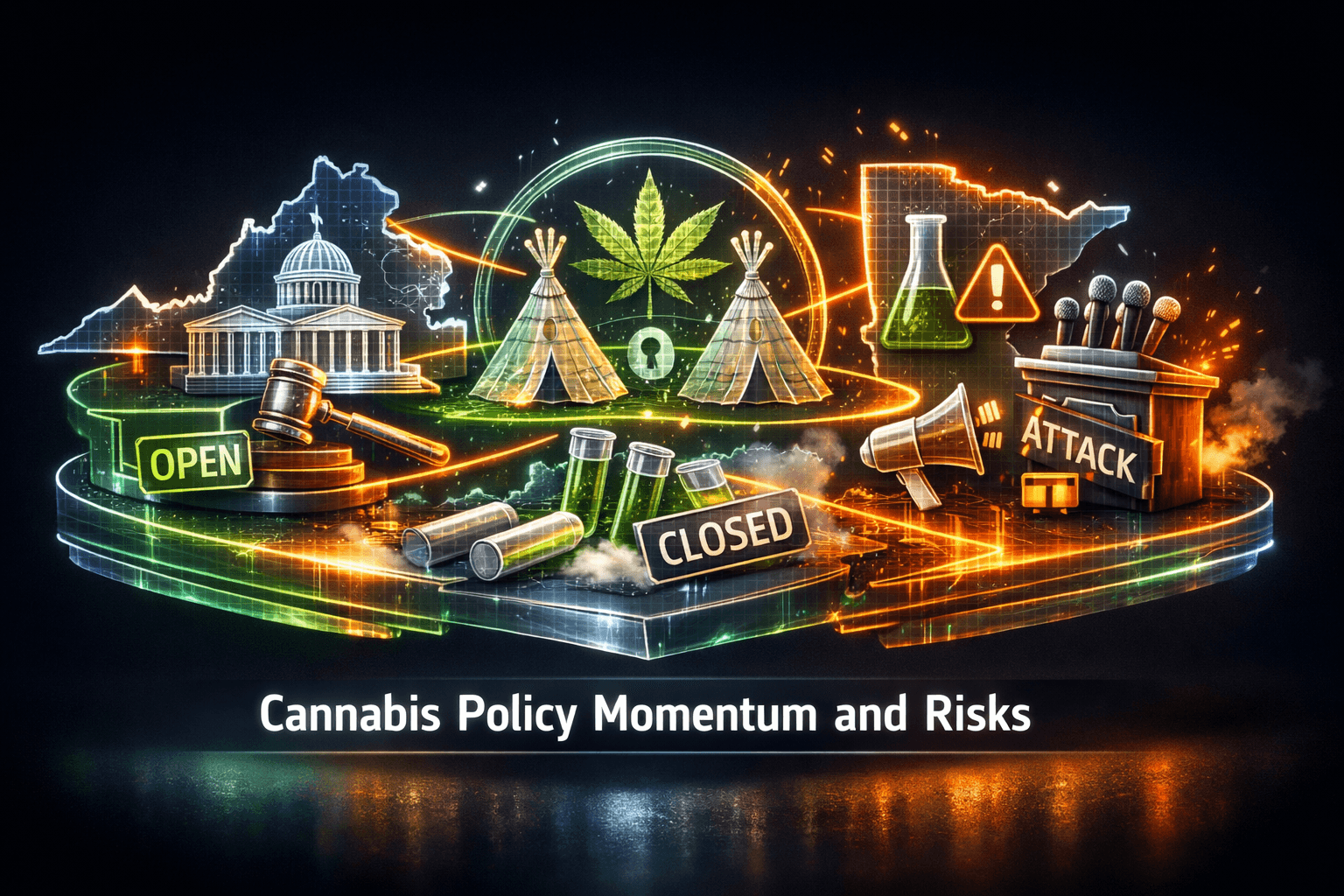
Today brought a mix of expansion and caution for the cannabis sector as lawmakers in Virginia approved a bill to legalize recreational sales, and Connecticut formalized its first tribal cannabis compact. Those moves add measurable market access and clarity for operators.
At the same time, a Minnesota testing lab closed after a license suspension and political attacks resurfaced in multiple states. If you follow the sector, you'll want to weigh new growth pathways against mounting regulatory oversight and reputational risks.
Market Highlights
The key policy developments drove headlines more than broad market moves, but they're important for companies with state footprints. Below are quick facts for you to scan.
- Virginia vote counts: Senate passed the budget measure including cannabis provisions 23-16, and the House of Delegates approved the package 71-22, moving recreational sales closer to reality.
- Connecticut reached its first tribal compact with the Mashantucket Pequot Tribe, allowing tribal and state-licensed businesses to transact under mutually recognized rules.
- Testing disruption: Legend Technical Services, a Minnesota lab first licensed in 2014 and expanded to adult-use testing in 2025, closed its cannabis testing program after state regulators suspended its license.
- Political pressure: In Maine and California, attention on ballot initiatives and campaign rhetoric kept regulatory risk on the front burner, with GOP figures publicly criticizing taxes and rules on marijuana.
- Stocks and ETFs to watch include sector tracker $MSOS and major names such as $TLRY, along with $TCNNF, $GTBIF, and $CURLF as you assess exposure to policy-sensitive moves.
Key Developments
Virginia Approves Recreational Sales
Virginia lawmakers passed a budget measure that includes language to legalize recreational marijuana sales after negotiating with the governor. The votes in both chambers clear a major legislative hurdle, and the measure now moves toward final implementation details.
For companies operating or planning to enter Virginia, this is a direct expansion of addressable market. You'll want to monitor the timeline for licensing rules and tax rates, because those will shape near-term competitiveness.
Connecticut Enters Tribal Cannabis Compact
Connecticut Gov. Ned Lamont and the Mashantucket Pequot Tribe signed the state's first tribal cannabis compact, recognizing tribal adult-use regulations and enabling commercial relationships between tribal and state-licensed operators.
The compact creates new distribution and partnership pathways in Connecticut. If you hold exposure in the region, watch for licensing frameworks and commercial agreements that could advantage early entrants.
Testing Lab Closure and Compliance Risk in Minnesota
Legend Technical Services announced it is closing its cannabis testing program after state regulators froze its license, removing a long-standing lab from Minnesota's testing network. The lab had been licensed for medical testing since 2014 and expanded to adult-use in 2025.
Testing capacity and regulatory compliance are practical risks for producers and retailers, because lost lab capacity can delay product release and raise costs. Will other labs face closer scrutiny? Regulators' next moves will matter for supply chain timing.
What to Watch
Expect a mix of policy rollouts, regulatory enforcement, and political noise to shape trading and strategic decisions this week. Here are concrete items to track.
- Virginia implementation timeline, licensing windows, and proposed tax rates, which will determine how quickly retailers can open and how margins look for producers and distributors.
- Minnesota regulator guidance and whether additional labs will be inspected or suspended, because you need to know if testing bottlenecks will slow inventory flow.
- Maine ballot activity and California campaign rhetoric on taxes and regulations, both of which could influence investor sentiment and local market rules. How will you interpret political signals in those states?
- Commercial impact of the Connecticut tribal compact, including prospectuses or press releases from state and tribal licensees that reveal partnership structures and market access.
- Sector trading gauges: watch cannabis ETF flows and volatility in $MSOS, plus moves in $TLRY, $TCNNF, $GTBIF, and $CURLF for industry sentiment and liquidity signals.
Heads up, you'll want to be selective: policy wins can take months to translate to revenue, and regulatory enforcement can have immediate operational consequences.
Bottom Line
- State-level gains in Virginia and Connecticut broaden market access, but implementation timing will determine when revenue follows policy changes.
- Regulatory enforcement, illustrated by the Minnesota lab closure, is an immediate operational risk that can disrupt supply chains and product timelines.
- Political pressure in Maine and California keeps tax and regulatory uncertainty alive, so you'll want to follow local ballot calendars and campaign developments.
- Watch sector ETFs and large-cap names such as $MSOS and $TLRY for sentiment cues; trading may reflect policy headlines more than fundamentals in the short term.
- Data suggests mixed signals today, so a selective approach that monitors regulatory milestones and licensing details is likely to be most informative for your decisions.
FAQ Section
Q: How soon will Virginia legal sales affect company revenue? A: Implementation timing varies by licensing rules; regulatory details and retail licensing windows typically take weeks to months after a bill's passage.
Q: Does a tribal compact in Connecticut mean immediate new stores? A: Not immediately, the compact allows business relationships and mutual recognition, but licenses, site approvals, and commercial agreements will take time to finalize.
Q: Should I worry about testing lab closures across states? A: Lab suspensions can cause short-term product delays and increased costs; you'll want to track regulator announcements and alternative lab capacity in affected markets.