The Big Picture
State-level policy continued to shape the cannabis landscape on Friday, June 12, with a string of bills and court rulings that create near-term opportunities and regulatory uncertainty for operators. Illinois approved a wide-ranging cannabis omnibus bill, Virginia lawmakers say they have a deal to legalize retail sales via budget legislation, and Massachusetts will let voters decide whether to roll back legalization.
These developments matter because state actions still set the addressable market, licensing rules, and product standards that drive revenue and margins for public and private companies. With US markets closed Saturday, this is policy-driven news you need to factor into your watchlist heading into the long weekend.
Market Highlights
No US equity trading occurred on Saturday. The items below summarize the stories that will likely influence sector sentiment when markets reopen Monday, June 15.
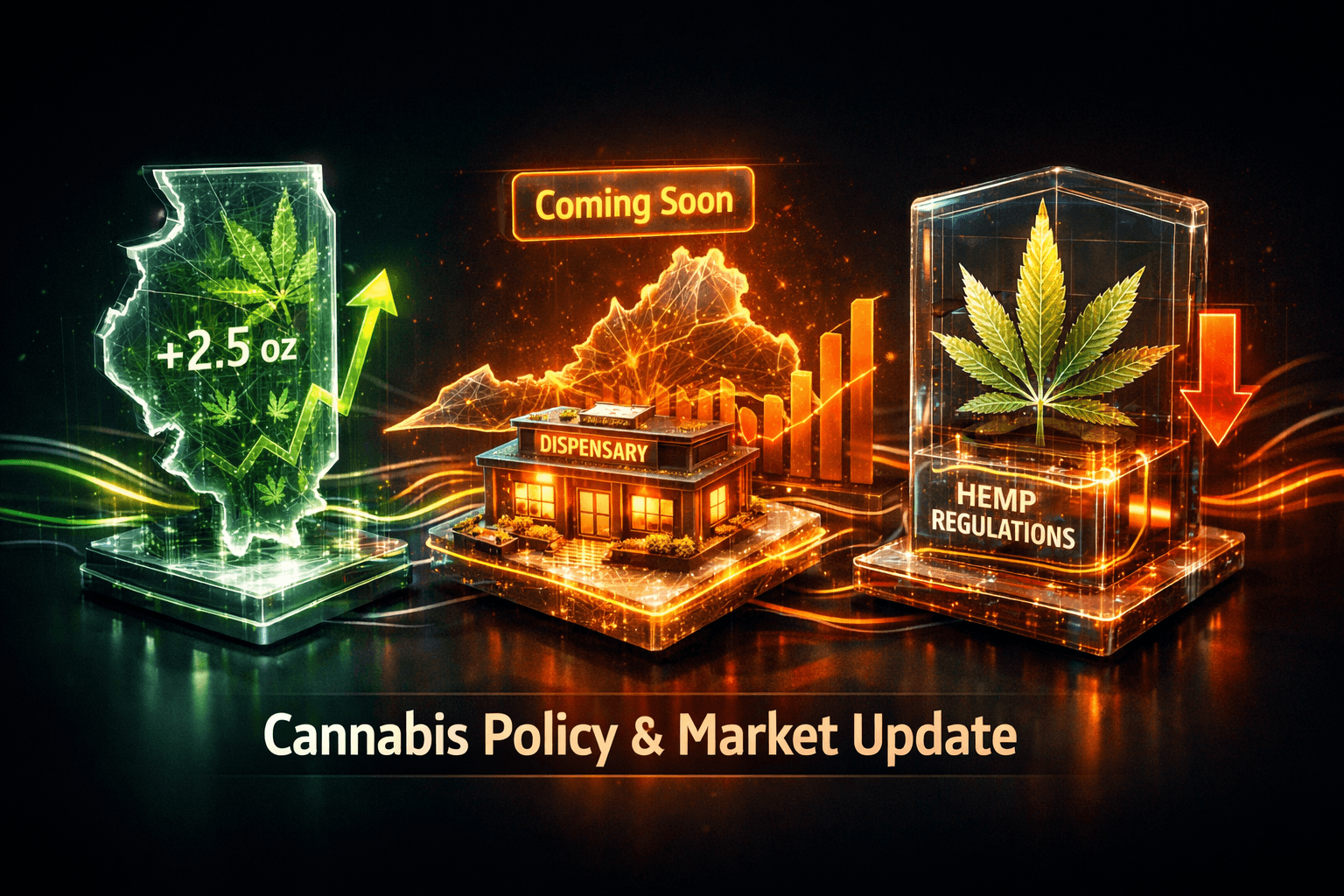
- Illinois signs omnibus cannabis bill, doubling adult possession limits while tightening rules on hemp THC products and changing business operations.
- Virginia lawmakers and the governor report a deal to authorize regulated retail marijuana sales this month, potentially unlocking a new statewide retail market.
- Massachusetts Supreme Judicial Court cleared a ballot initiative seeking to roll back recreational legalization, putting the question to voters this cycle.
- Pennsylvania Senate rejected a plan to create an independent Cannabis Control Board, keeping oversight within the Department of Health for now.
- North Carolina advanced a bill to set age 21 requirements for hemp products including delta-8 and delta-9 edibles, a regulatory trend to watch.
- Public-interest and cultural coverage continues, with High Times highlighting consumer trends and celebrity projects such as Zac Efron’s hemp home, which help mainstream perception.
Key sector names to watch on the reopening are ETFs and large operators that track state outcomes, including $MSOS, $TCNNF, $GTBIF, $CURLF, and $TLRY.
Key Developments
Illinois omnibus bill changes the rules
Gov. JB Pritzker signed a broad cannabis bill on Friday that doubles the lawful possession limit for adults and implements new compliance and business rules. At the same time the law tightens restrictions on intoxicating hemp products, a move that could shift demand back to regulated cannabis channels but also squeeze hemp-focused producers and retailers.
For you as a reader, that means companies with diversified state retail footprints may see mixed effects. Higher possession limits can normalize consumer behavior, but tougher hemp rules could pressure margins for firms exposed to that segment.
Virginia moves toward retail sales; Massachusetts ballot fight advances
Virginia’s reported agreement to legalize retail sales via budget language signals a rapid path to market entry if lawmakers and the governor finalize the deal. Retail licensing timetables and tax frameworks will determine how quickly retailers and cultivators can scale operations.
Contrast that with Massachusetts where the state’s highest court cleared a ballot initiative to roll back legalization. That creates potential volatility for operators with exposure in the state because a voter-led change could reshape the regulatory and retail environment.
Hemp policy is fragmenting across states
Pennsylvania’s Senate rejected creation of a Cannabis Control Board, keeping medical program oversight with the Department of Health and leaving intoxicating hemp regulation in flux. North Carolina is advancing a bill to set purchase age at 21 for hemp products, which would limit that market segment and could reduce sales for delta-8 retailers.
Meanwhile cultural and marketing efforts continue to normalize hemp as a sustainable material, exemplified by creative projects like Zac Efron’s hemp home. Still, you should expect the hemp product category to see uneven regulation and local restrictions for the foreseeable future.
What to Watch
Policy timelines, retail rollout plans, and regulatory standards will drive near-term share-price sensitivity when markets reopen Monday. Here are the specific items to track.
- Virginia finalization: Watch for formal language and effective dates for any retail licensing provisions. That will determine which operators can enter the market and when.
- Massachusetts ballot campaign: Monitor fundraising, polling, and legal challenges as you assess state exposure risk for operators with New England footprints.
- Hemp rule changes: Track state-by-state legislation such as North Carolina’s age requirement and Illinois’ hemp THC restrictions because they affect product demand and compliance costs.
- Federal cues: Any signals from DC on hemp or cannabis reform could amplify state moves, so stay alert to committee schedules and regulatory guidance.
- ETF and stock flow: Keep an eye on $MSOS, $TCNNF, $GTBIF, $CURLF, and $TLRY as traders price in these state-level outcomes and retail openings.
Bottom Line
- State policy continues to be the primary driver of cannabis sector dynamics, producing both market expansion and product-specific constraints.
- Virginia and Illinois moves are growth-positive on balance, but hemp restrictions and a Massachusetts rollback initiative introduce meaningful headwinds.
- Expect volatility when US markets reopen Monday, June 15, as traders digest regulatory winners and losers by state.
- Be selective and monitor licensing timetables, hemp product rules, and ballot campaigns, because those will directly affect revenues for operators and ETFs.
- This briefing is for informational purposes only. Analysts note these are policy developments to watch, not personalized investment advice.
FAQ Section
Q: How will Illinois’ new law affect cannabis businesses? A: Expanded possession may boost consumer demand in adult-use markets, but tougher hemp THC limits and altered business rules could raise compliance costs and shift sales between channels.
Q: Does the Virginia deal mean stores will open immediately? A: Not immediately, you should expect a rollout timeline tied to regulatory language and licensing processes that could take weeks to months depending on implementation speed.
Q: How should I track exposure across the sector? A: Monitor state legislative calendars, ballot campaign developments, and flows into ETFs such as $MSOS, $TCNNF, $GTBIF, $CURLF, and the major operators like $TLRY to gauge market reaction.