The Big Picture
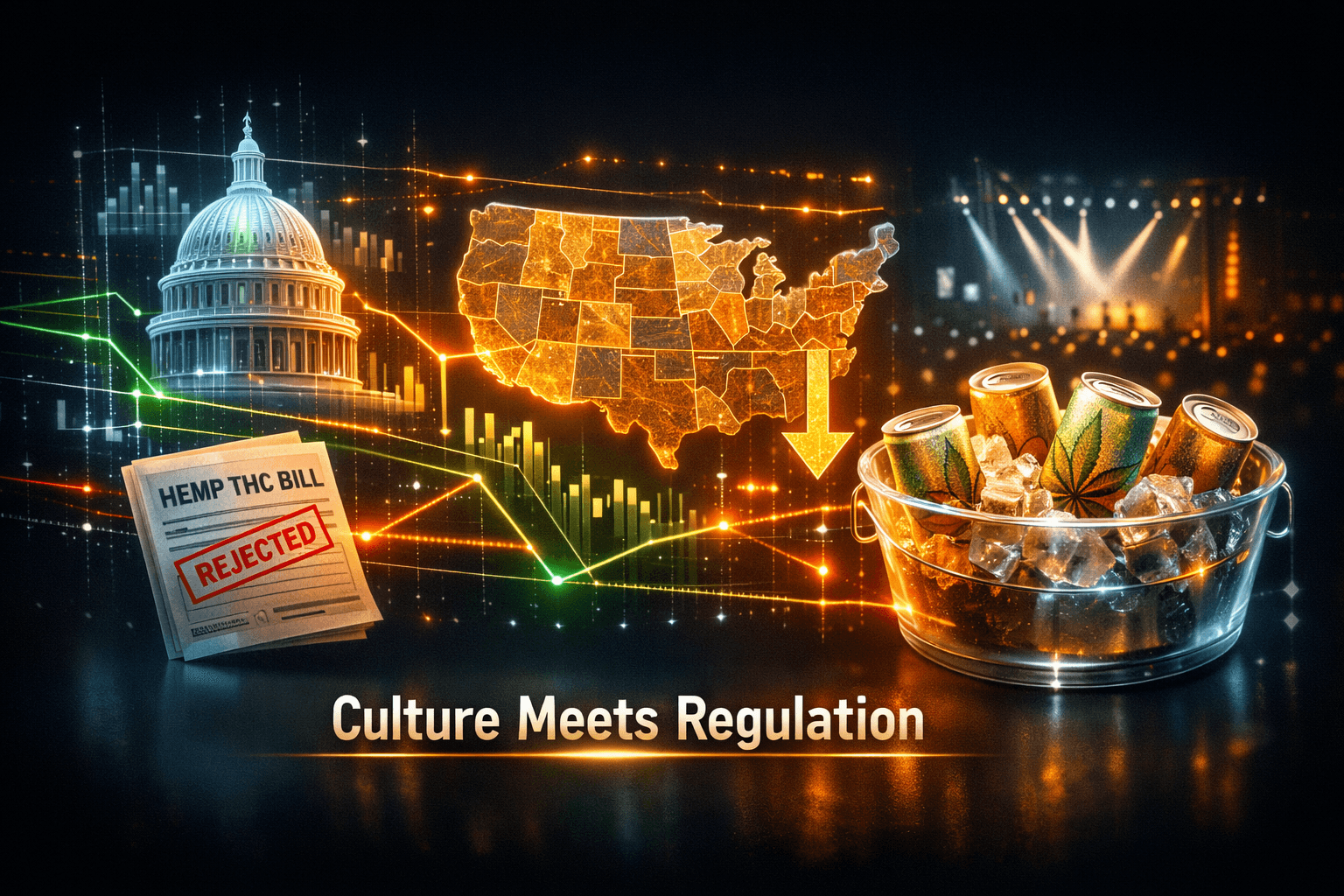
Overnight developments left the cannabis sector balancing cultural momentum and regulatory uncertainty. Lawmakers in Washington won't be taking up amendments that would delay or accelerate a federal hemp THC product ban, while states are still sorting out consequences from federal rescheduling moves.
At the same time, consumer-facing adoption showed up in a big way, with ayrloom launching low-dose THC drinks at Governors Ball in New York, signaling mainstream traction for cannabis-infused beverages. For investors, that mix means you should watch both policy calendars and brand-led demand signals closely.
Market Highlights
Here are the quick facts and names to track as markets open today.
- $MSOS, the sector ETF many traders use to gauge broad cannabis exposure, remains a go-to barometer for how Wall Street digests policy shifts and retail demand.
- Legacy and high-profile names like $TLRY continue to be watched for product launches and retail execution as the consumer landscape changes.
- Other stocks investors track closely include $TCNNF, $GTBIF, and $CURLF for different parts of the value chain, from cultivation to beverages and CPG-style products.
- Expect volatility around headline policy news today, with fast moves possible as traders reprice regulatory risk and state-level outcomes.
Key Developments
House won’t vote on Farm Bill amendments tied to hemp THC
Amendments that would either delay the scheduled federal ban on hemp-derived THC products or speed up its implementation were filed but will not be considered on the House floor this week. Rep. James Comer pushed for a delay and Rep. Mary Miller proposed an accelerated timeline, but neither amendment advanced.
Implication: the path to a clearer federal rule set just got murkier, at least in the short term, and companies that rely on hemp-derived THC products face continued regulatory uncertainty. You should expect states and individual companies to vary in how they respond, which can drive dispersion across names.
Rescheduling creates state-level surprises, South Carolina case shows
Federal rescheduling of marijuana is producing some unexpected legal outcomes at the state level, with analysis suggesting South Carolina may now face questions about medical marijuana access. States are parsing guidance and legal teams are racing to interpret new federal policy against existing state statutes.
Implication: as regulators and courts work through these gray areas, you can expect patchwork outcomes that benefit some operators and hurt others. The legal landscape could create both opportunities for state-level expansion and near-term operational headaches.
THC drinks go mainstream at Governors Ball
Ayrloom's low-dose THC beverages appeared at a major music festival in New York, underscoring increasing mainstream acceptance for controlled-dose cannabis drinks. Festival exposure helps normalize on-premise consumption and provides consumer data for beverage makers and retailers.
Implication: packaged consumer brands and CPG-style operators that execute on marketing and distribution could see stronger retail adoption, but you should remember that retail execution and regulatory compliance are crucial. Will broader demand follow or will distribution bottlenecks slow the rollout?
What to Watch
Here are the near-term catalysts and risks you should track as trading continues today.
- Congressional calendar: watch for any sudden scheduling changes or new amendments tied to the Farm Bill. A floor vote would be a high-impact event.
- State reactions to rescheduling: follow state AG opinions, emergency rules, and court filings, especially in jurisdictions like South Carolina that may see rapid legal shifts.
- Retail and CPG moves: track product rollouts, distribution deals, and festival activations after the ayrloom appearance, because consumer adoption data can change growth assumptions quickly.
- Key tickers to monitor intraday: $MSOS, $TCNNF, $GTBIF, $CURLF, $TLRY. Check volume and news flow around those names for signals about sector sentiment and relative winners.
- Risk factors: enforcement guidance, banking access, label and testing requirements, and state-level licensing changes can all cause rapid re-pricing. Are you positioned for regulatory swings?
Bottom Line
- Regulatory headlines remain the dominant drivers for near-term price action, even as consumer-facing brands push mainstream acceptance.
- The House decision not to take up amendments keeps federal ambiguity in place, which raises execution risk for hemp THC product companies.
- State-level interpretation of rescheduling can produce winners and losers, so expect a patchwork recovery rather than uniform outcomes.
- Brand and distribution wins, such as high-profile festival activations, matter for long-term category growth, but they won’t erase policy risk overnight.
- Use the next 24 to 72 hours to monitor official votes, state guidance, and company-level distribution news to recalibrate your view of the sector.
FAQ Section
Q: What does Congress not voting on these amendments mean for hemp THC companies? A: It means federal clarity is delayed, so businesses reliant on hemp-derived THC face continued regulatory uncertainty and potential state-by-state outcomes.
Q: Could rescheduling lead to faster medical programs in states like South Carolina? A: Possibly, but it depends on state lawmakers and courts; rescheduling opens legal paths that states or courts may interpret in different ways.
Q: Do festival activations like ayrloom at Governors Ball matter for public companies? A: Yes, they show consumer demand and brand momentum, but they must be paired with compliant distribution and strong unit economics to impact revenues meaningfully.