
 Bearish Sentiment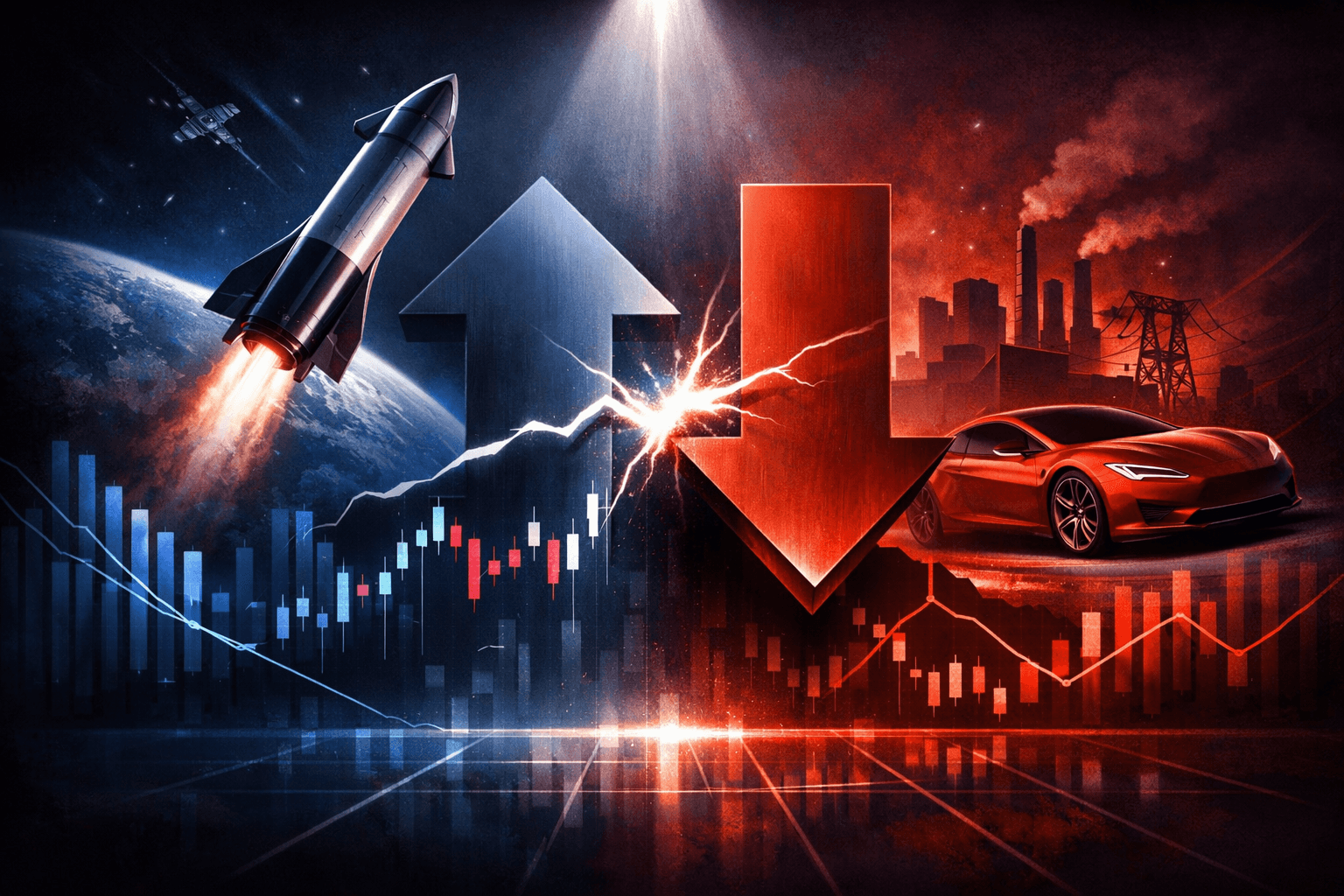
Share this article
Spread the word on social media
Opening: A $2 trillion idea, months before SpaceX is public
Market chatter places SpaceX’s IPO valuation between $1.5 trillion and $2.0 trillion, even as the company is still private and revenue estimates commonly cited around $15–16 billion; some projections or more speculative scenarios have suggested figures up to roughly $30 billion, depending on the source. That gap, 50x to 65x revenue if the higher valuation holds, makes the rumored idea of merging SpaceX with Tesla (TSLA) one of the most consequential corporate plays of this decade.
What happened: A private IPO, a public rumor, and a merger thesis
SpaceX is reportedly preparing for an initial public offering within months, with investors already pricing in extraordinary future scale. The conversation rapidly evolved from IPO sizing to a potential tie-up with Tesla, combining electric vehicles, energy storage, satellite broadband, and emerging AI projects under one publicly listed roof.
Elon Musk has led transformative growth at Tesla, steering it from a niche EV maker to a company that exceeded a $1 trillion market capitalization at its peak. The new thesis proposes folding SpaceX’s Starlink, manufacturing expertise, and AI initiatives into Tesla’s public structure, creating a conglomerate with multiple high-margin growth engines and, proponents argue, unique data advantages.
Why it matters: Valuation mismatch, regulatory risk, and integration complexity
A merger would force public markets to value long-duration, capital-intensive aerospace cash flows alongside automotive and energy returns. SpaceX investors are discussing numbers of $1.5–$2.0 trillion on $15–30 billion revenue, implying revenue multiples of 50x to 133x depending on assumptions. By contrast Tesla trades at roughly 3x to 10x forward sales historically, showing the valuation disconnect investors would have to swallow.
The regulatory and national security angles are substantial. SpaceX holds defense contracts and handles sensitive satellite and telemetry data, with revenue from U.S. defense work and Starlink service to government customers. Combining that with Tesla’s consumer-facing business invites an unusual level of scrutiny; historical precedents like the failed AT&T-T-Mobile merger in 2011 show antitrust and national security review timelines can extend beyond 12 months and extract concessions that materially change deal value.
Integration risk is nontrivial. Aerospace manufacturing cycles, rocket launch cadence, and satellite ops are different from automotive supply chains, which themselves are capital intensive and dependent on battery supply. When Amazon acquired Whole Foods for $13.7 billion in 2017, Amazon implemented price cuts and integration investments that put pressure on Whole Foods' margins initially, and some synergies took years to materialize. A hypothetical Tesla-SpaceX tie-up would be larger by orders of magnitude and more heterogeneous operationally, increasing execution risk.
The bull case: A vertically integrated AI and infrastructure champion
Proponents argue the combined enterprise would own physical infrastructure and edge compute at scale. Starlink could provide global low-latency connectivity for Tesla’s autonomous fleet, potentially accelerating self-driving monetization. If Starlink reaches 10 million subscribers at $100 per month, that is $12 billion in annual revenue alone, and close integration with Tesla’s vehicle fleet could produce proprietary telemetry datasets unmatched by competitors like (NVDA) powered fleets relying on third-party connectivity.
Synergies could unlock cross-selling and reduce long-term customer acquisition costs. Investors who can stomach an initial dilution might gain exposure to a company with multiple 10x growth engines, similar to early Amazon which combined retail, cloud, and logistics into one valuation trajectory.
The bear case: Overpaying for optionality and governance friction
The downside is clear. A combined market cap artificially anchored to a $1.5–$2.0 trillion narrative prices in fragile optionality. If Starlink or space transport scales slower than projected, the market will re-rate the combined entity brutally. Paying 50x to 100x sales for speculative future cash flows is historically a recipe for multi-year volatility; look at the dot-com corrections where high revenue multiples collapsed by 80% plus.
Governance is another practical risk. Tesla public shareholders would inherit SpaceX’s private investor preferences and complex cap table agreements. Any special voting rights, founder-friendly provisions, or siloed subsidiaries would complicate capital allocation. Combining a defense supplier and a consumer automaker increases political risk, with potential restrictions on operations and overseas investments that could force structural divestitures or value-destructive remedies.
What this means for investors: Watch metrics, windows, and alternatives
- Watch the IPO timeline, expected within months. If SpaceX files, the S-1 will disclose revenue and margin trends; a $15 billion revenue figure vs a $30 billion figure changes the math materially.
- Follow Tesla (TSLA) closely for board moves and any proposal language. A merger announcement would likely move TSLA shares by double-digit percentages intraday. Set volatility controls or option collars if you hold meaningful exposure.
- Monitor defense and regulatory signals. If the Committee on Foreign Investment or DoD expresses concern, expect multi-month delays. That raises downside risk and increases the probability of structural remedies.
- Consider alternative exposures. If you want spacecraft and satellite upside without governance complexity, look at suppliers and contractors with public tickers like LMT (Lockheed Martin) and RTX for defense revenue, or AMZN and MSFT for cloud and edge compute plays tied to AI scaling.
- Valuation guardrails. If you buy TSLA on merger speculation, set entry targets below 20x forward EBITDA of the combined narrative, and treat anything pricing SpaceX at 50x+ revenue as a speculative allocation under 3% of portfolio value.
Actionable takeaway: Treat the SpaceX-Tesla merger as a low-probability, high-impact event. If the IPO confirms modest revenue, pass on merger speculation. If regulatory green lights appear and the combined entity shows credible synergies with measurable KPIs, consider tactical exposure to TSLA below disciplined valuation thresholds.
Final note, size positions for scenario risk. A merger would be binary, and while the upside could be historic, the path will be volatile and policy driven. For most portfolios, monitoring filings, data points, and regulatory cues is the rational move, not preemptive leverage based on market chatter.