
 Neutral Sentiment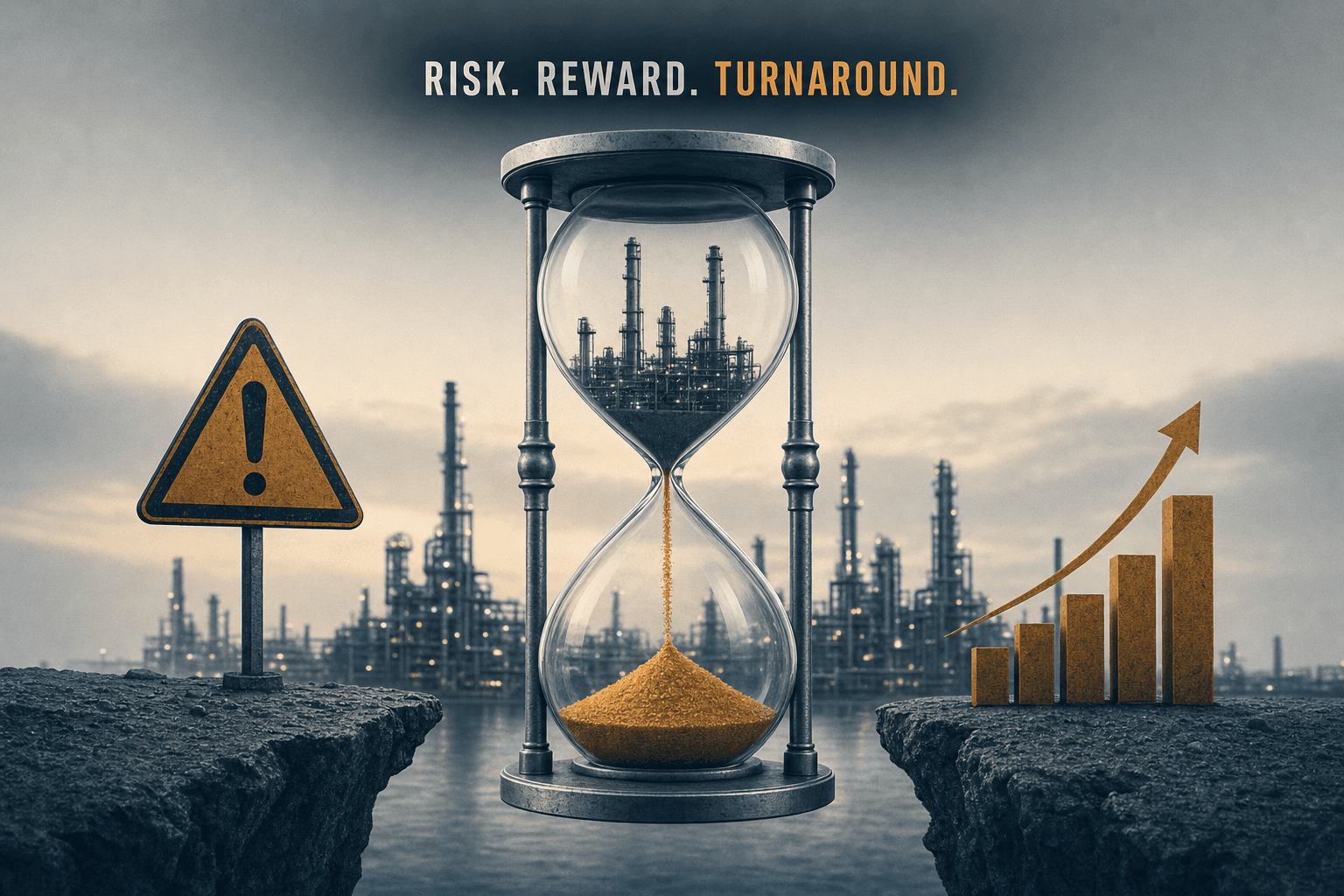
Share this article
Spread the word on social media
SKYQ: A Distressed Microcap Where the Risk Is Obvious. So Is the Asymmetry.
Sky Quarry owns Nevada's only licensed crude oil refinery, a going-concern warning, and a share count that more than doubled in one quarter. This is what the risk and the reward actually look like, in numbers.
The Setup
Most sub-$30 million companies on the Nasdaq are stories. Sky Quarry (NASDAQ: SKYQ) is a story attached to physical infrastructure. Through its Foreland Refining subsidiary, the company owns the Eagle Springs Refinery near Ely, Nevada. It is the only licensed and permitted crude oil refinery operating in the state. The facility has produced diesel, vacuum gas oil, naphtha, and liquid paving asphalt for regional markets for more than 25 years, with stated capacity of roughly 4,500 to 5,000 barrels per day.
That distinction matters. The bear case and the bull case here are not arguments about whether a product will ever exist. They are arguments about whether a company in serious financial distress can get an existing industrial asset running consistently before the capital structure gives out. The risk is obvious. The question is whether the asymmetry is real. We think the honest answer requires walking through numbers most promotional coverage of this name skips.
What the Latest Quarter Actually Said
Start with the hard part. A boiler failure knocked Eagle Springs offline in late 2025, and the damage to the income statement has been total. First quarter 2026 revenue was $383. Not $383,000. Three hundred eighty-three dollars, against $6.33 million in the first quarter of 2025. The second quarter of 2026, reported on August 13, was worse in one sense: revenue was zero. The refinery contributed no meaningful cash flow in the first half of 2026, and the six-month net loss was $6.4 million.
Here is the detail the market seems to keep trading past. On June 22, the company announced repairs were complete and said operations were expected to restart in July, with about 10,000 barrels of crude inventory on-site and more than 100,000 barrels of storage capacity. The stock more than tripled from the mid-June lows on that news. But the 10-Q filed August 13 states that, as of the report date, refinery operations had not yet restarted. Repairs are done and initial feedstock has been procured, but the restart remains subject to scale-up operational testing and state inspection. The stock fell about 20 percent on the report.
That gap between the June narrative and the August filing is the single most important fact in this situation. The bull thesis is intact only if the restart actually happens and holds. Until it does, the current financials describe a refinery that is not operating, and the market is paying for a promise.
The Balance Sheet Reset
Now the part that has genuinely improved. At March 31, Sky Quarry had $66,828 in cash against $16.4 million of current liabilities. That is not a tight balance sheet. That is a company weeks from the wall. By June 30, cash was $7.2 million, total shareholders' equity had risen from $2.0 million to $11.8 million, and the accumulated deficit stood at $42.5 million.
How did that happen? The at-the-market equity program. During the first half of 2026 the company issued about 4.8 million shares for roughly $12.5 million in net proceeds, almost all of it in the second quarter. Management also cleaned up the ugliest financing on the books. In late June, $3.985 million of merchant-cash-advance obligations owed to Libertas were converted into a single promissory note, extinguishing the old agreements. The new note still requires weekly payments of $15,000 to $70,000 over 86 weeks, so the obligation is defined rather than gone.
The distress has not been engineered away. The going-concern warning remains explicit in the August filing. Roughly $2 million of debt is past due across three lenders. One of them, KF Business Ventures, sued the company in March seeking repayment of about $2.2 million plus interest and foreclosure on collateral. Total liabilities were $16.6 million at June 30, with about $12 million of that in notes and lines of credit. The company itself says that without additional financing it lacks sufficient operating cash flow to settle obligations as they mature.
The Dilution Ledger
Dilution is not a risk here. It is the operating history. The share count went from 3.23 million at the end of 2025, to 3.76 million at March 31, to 8.78 million at June 30, to 8.83 million as of August 12. That is a rise of more than 170 percent in about seven months, and it comes after a 1-for-8 reverse split in March that was required to hold the Nasdaq listing.
Two forward-looking items deserve attention. First, another 863,000 potential shares sit in options, warrants, and convertibles, putting the fully diluted count near 9.7 million. Second, the company has called a special meeting for September 18 seeking authority for up to two additional discretionary reverse splits, each at ratios between 1-for-2 and 1-for-25, exercisable at the board's option over the next two years. Companies do not request that authority for fun. It is insurance against renewed listing pressure, and it tells you management expects the ATM and share issuance to remain a primary funding tool. With 2 billion shares authorized, the mechanical capacity for further dilution is effectively unlimited.
This is the paradox at the heart of $SKYQ. The ATM is the reason the company is still alive and the reason the refinery has a chance to restart. It is also the reason every existing shareholder owns a shrinking slice of whatever the recovery produces. Any valuation work that uses a stale share count is not analysis. It is fiction.
The Math
At the August 13 close of $2.74, the 8.83 million shares outstanding put the market cap near $24 million. Add about $12 million of debt and lines of credit, subtract the $7.2 million of cash on hand at June 30, and enterprise value sits in the neighborhood of $29 million. Cash has been burning since quarter-end, so treat that as a snapshot, not a resting value.
What does the asset earn when it runs? Fiscal 2025 revenue was about $12.5 million, down 47 percent from 2024, which implies 2024 revenue in the range of $23 to $24 million. The first quarter of 2025, the last clean quarter before the outage cascade, produced $6.33 million, which annualizes to roughly $25 million. So a functioning Eagle Springs at recent operating levels supports a revenue base of $20 to $25 million per year, before any improvement in throughput or feedstock supply. Against a $29 million enterprise value, that is the core of the bull argument: the market is valuing the whole company at close to one year of normalized refinery revenue.
Now the honest caveat, and it is a big one. Revenue is not margin. Even when the refinery was running, gross margin was negative: a loss of $843,000 at the gross line on $10.9 million of first-half 2025 sales. The company attributes the path to profitability to scale, feedstock access, and Nevada's structural fuel deficit, and management has flagged crude feedstock supply as the key constraint on refinery revenue. Those are plausible arguments. They are not yet demonstrated ones. A refinery that runs and still loses money at the gross line does not ease the liquidity pressure. It extends it.
On the upside math, use the fully diluted count of about 9.7 million shares. A $25 million valuation is roughly $2.60 per share, which is close to where the stock trades today. A $50 million valuation is about $5.15. A $100 million valuation is about $10.30. In other words, the market is currently paying almost nothing above the bear case, and a successful restart with visible margins is a plausible path to a double or more. But every additional ATM tranche pushes those per-share numbers down, and the stock has already traded as high as $4.35 in July and $19.45 over the past year, so volatility cuts both directions violently.
ECOSolv: Optionality, Not Valuation
Sky Quarry's longer-term concept is ECOSolv, a closed-loop solvent process for separating hydrocarbons from oil-bearing solids and waste asphalt shingles. Company disclosures describe up to 99 percent solvent recovery, no water requirement, and oil-separation rates of up to 95 percent in bench testing. The vision, recovering bitumen, aggregates, and granules from shingles that otherwise go to landfill, is genuinely interesting, and it connects to the PR Spring resource in Utah that the company describes as a 180-million-barrel opportunity.
But the commercial-scale facility is not expected to be completed until 2027, and only if financing is obtained. For a company that cannot yet fund its refinery restart from operations, ECOSolv should be treated as free or near-free optionality in any valuation. If you are paying for ECOSolv at these prices, you are paying twice for the same execution risk.
Three Scenarios
Bear case. The restart slips again or stalls after state inspection, feedstock supply disappoints, or margins stay negative once operations resume. Financing continues through the ATM at declining prices, the September reverse-split authority gets used, and the KF litigation or past-due lenders force unfavorable outcomes. Shareholder losses from here could be severe, and the going-concern language exists because a zero is genuinely on the table.
Base case. Eagle Springs restarts in the coming weeks, passes inspection, and resumes meaningful production. Revenue begins normalizing toward the historical $20 to $25 million run rate over several quarters, liquidity pressure eases, and the market slowly revalues SKYQ as an operating refinery rather than a distressed shell. Dilution continues but decelerates.
Bull case. The refinery stabilizes, feedstock arrangements including the company's planned Railroad Valley crude initiative improve throughput and margin, the balance sheet is refinanced into longer-dated debt, and ECOSolv progresses toward its 2027 target. In that world, today's roughly $29 million enterprise value would have dramatically understated the replacement value of Nevada's only refinery plus the technology, and the per-share outcome depends mostly on how many shares exist when the market notices.
The Bottom Line
SKYQ is a speculative turnaround, full stop. It carries a going-concern warning, active litigation, past-due debt, a restart that has been promised but not yet delivered, and a financing model that consumes shareholders to preserve the company. Anyone who buys this stock should assume further dilution and be prepared for the bear case.
What makes it worth writing about is that the distress is also the source of the asymmetry. There is a real refinery here, with a real revenue history, in a state that structurally needs refining capacity, trading at an enterprise value close to one year of its normalized revenue. The next two data points, confirmation that operations have actually restarted and the first quarter showing positive gross margin, are knowable and near-term. Until both arrive, this is a lottery ticket with an unusually well-documented prize and an unusually well-documented shredder. Size accordingly as energy is always a moving target and this isn’t Exxon.
Disclosure
This article is for informational purposes only and does not constitute investment advice, an offer to sell, or a solicitation of an offer to buy any security. The author and affiliated entities may hold positions in, or perform services for, companies mentioned. All figures are drawn from Sky Quarry's public SEC filings and press releases, including the Form 10-Q for the quarter ended June 30, 2026, and market data as of August 13, 2026, and are believed accurate as of publication but are not guaranteed. Microcap securities involve a high degree of risk, including the possible loss of the entire investment. Readers should conduct their own due diligence and consult a licensed financial advisor before making any investment decision.