
 Neutral Sentiment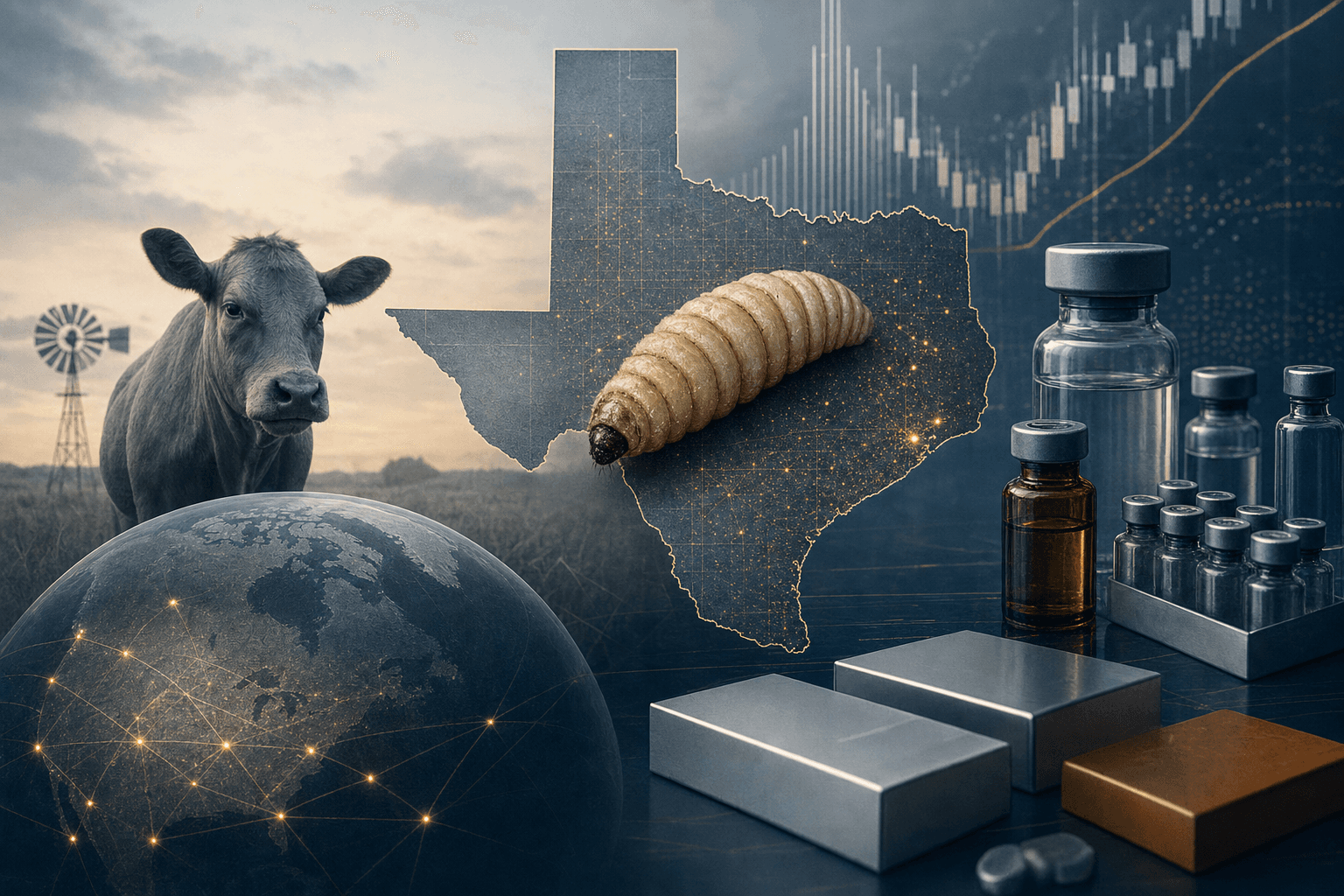
Share this article
Spread the word on social media
Opening hook: A 3-week-old calf, the first U.S. case since 1966
The U.S. Department of Agriculture announced that a sample from a 3-week-old calf in La Pryor (Zavala County), Texas tested positive for New World screwworm larvae at the National Veterinary Services Laboratories after an initial presumptive positive; it would be the first confirmed domestic case since the species was eradicated from the continental U.S. in the 1960s. Authorities established a roughly 20-kilometer (≈12-mile) infested zone around the detection site and activated response personnel on the ground.
What happened: Rapid containment steps and cross-border caseloads
USDA confirmed the detection this week and said it will impose quarantines, increase trapping near the border and coordinate with the Texas Animal Health Commission. Officials cited recent surveillance showing thousands of screwworm detections in Mexico; specific totals reported in media accounts vary and the precise figures cited elsewhere were not independently verified here.
The response is straightforward, but the numbers matter. A 12-mile cordon and intensified trapping are designed to stop spread locally, yet those containment measures will require staffing, diagnostics and treatments that scale with any additional detections.
Why it matters: A narrow herd, high stakes for beef supply and costs
U.S. beef producers are already operating with the smallest cattle herd in 75 years, so margin for a biological shock is thin. When biosecurity incidents hit a concentrated supply base, price volatility and supply disruptions magnify quickly.
Historically, the screwworm was eradicated from the continental United States using the sterile insect technique, the program that culminated in eradication in 1966. That historical precedent shows eradication is possible, but it required sustained public funding and cross-border coordination. With widespread detections reported in Mexico, the pathway for reinvasion is demonstrably real.
Why investors should care: Where risk compresses and where upside appears
For commodity players like Tyson Foods (TSN), a localized outbreak could shave margins if processing disruptions or regional herd losses occur. Even a modest regional reduction in supply, say a few hundred head in South Texas, can ripple through cattle-feeders and packers because cattle flows are seasonally lumpy.
On the flip side, animal-health companies and diagnostics providers stand to see meaningful near-term demand. Treatment, prophylactic products, increased surveillance and diagnostic testing will all scale if USDA finds additional cases beyond the initial 12-mile zone.
The bull case: Durable demand for animal-health and diagnostics
If USDA contains the outbreak within weeks, the immediate economic damage to beef supply will be limited and animal-health companies will capture a surge in one-time sales. Zoetis (ZTS) and Elanco (ELAN) could see elevated vet-product orders and off-label antiparasitic usage, while Neogen (NEOG) could capture higher volumes for diagnostic tests and lab consumables.
Public funding for eradication, like the sterile insect releases used historically, would create a government-funded revenue stream. A scaled response could mean millions in contracts for suppliers of traps, sterile flies and diagnostic kits during a multi-month campaign.
The bear case: Broader spread, export frictions and margin damage
If cases spread beyond the initial containment area, the scenario becomes materially negative for processors and producers. Trade partners could tighten inspections, pushing up compliance costs and reducing export volumes. Even a temporary export slowdown of just 5 percent could shave multiple points off earnings for large exporters such as Tyson (TSN).
Worse, the event could force more aggressive culling or prolonged quarantines. For an industry operating with the smallest herd in 75 years, those actions are not easily absorbed without price dislocations and margin compression.
What this means for investors: Positions to consider and watchables
Short term, this is a defensive play on animal-health exposure and diagnostics. Consider Zoetis (ZTS) and Elanco (ELAN) as primary beneficiaries if USDA scales treatments and vaccinations; both firms have the distribution reach to service large veterinary and producer networks. Neogen (NEOG) is a smaller-name way to capture increased testing and lab kit demand.
For commodity exposure, large diversified processors like Tyson Foods (TSN) and feedmakers such as Archer-Daniels-Midland (ADM) merit close watch. TSN is sensitive to cattle supply shocks, ADM benefits if feed demand shifts but also faces grain price transmission risks. Monitor USDA detections closely: additional domestic cases beyond a handful would raise probabilities of sustained supply impact.
Actionable takeaways
- Track daily USDA updates and the size of the infested zone, because containment expansion from 12 miles to a broader radius materially raises risk estimates.
- Favor animal-health names in the near term: ZTS and ELAN are the primary beneficiaries of treatment and prevention demand.
- For commodity exposure, avoid adding large long-only positions in beef processors until the outbreak is contained; TSN is vulnerable to sustained supply disruption.
- Watch diagnostics play NEOG for a tactical, event-driven lift if USDA scales testing; look for contract announcements or government procurement notices as confirmation.
Bottom line: the screwworm detection is a low-probability, high-consequence event for U.S. beef. The most likely market outcome is sector rotation into animal-health winners and defensive positioning in cattle processors while USDA pursues eradication. Investors should price in elevated volatility, watch for additional case counts beyond the initial detection, and favor names with direct exposure to treatment, diagnostics and government contracts.