
 Neutral Sentiment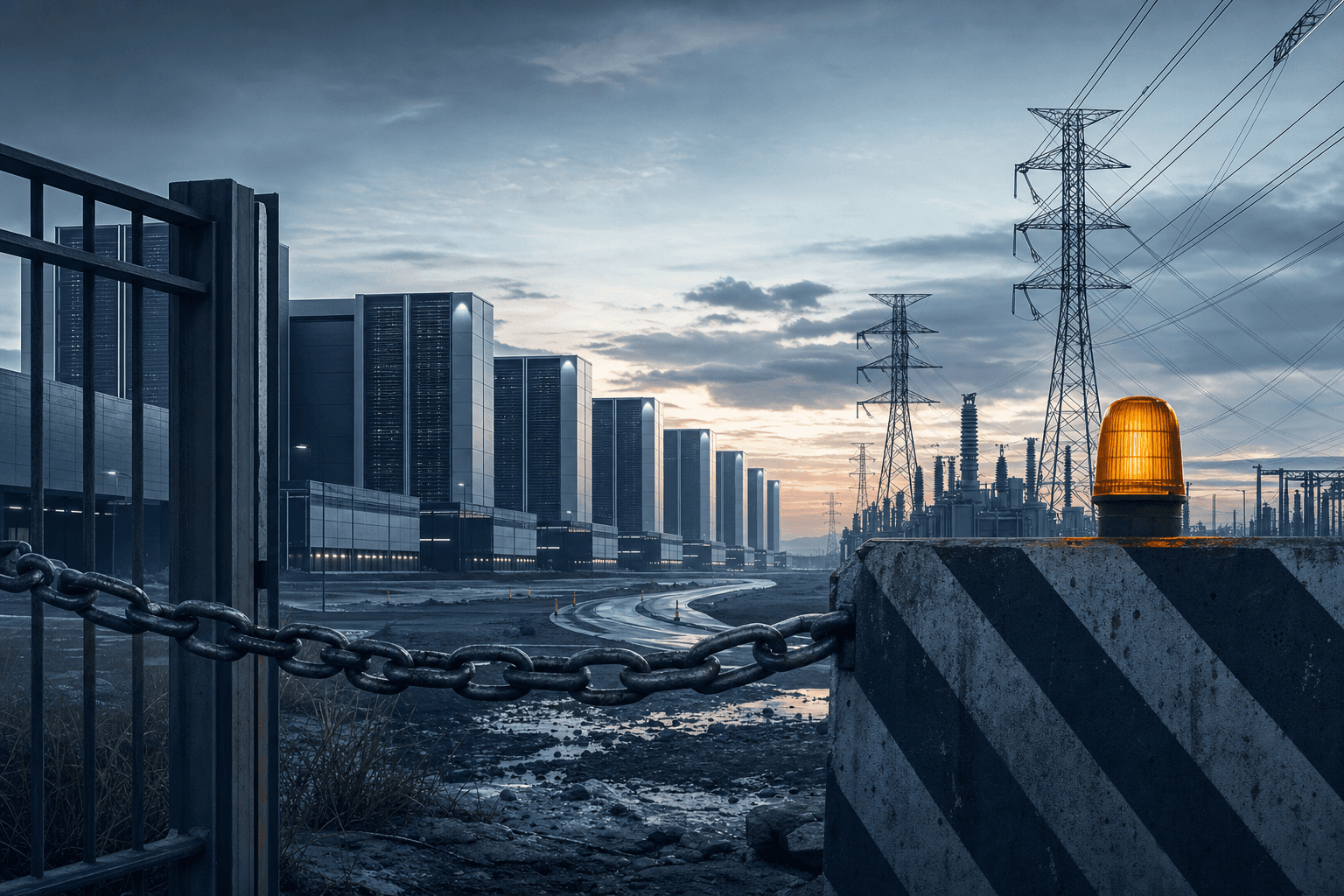
Share this article
Spread the word on social media
Opening hook: More than 60% of planned capacity for 2027 isn't even under construction
Some industry analyses — including social-media summaries of a JPMorgan satellite-image assessment — suggest that around 60% of the data-center capacity slated for 2027 in the U.S. was not yet under construction, despite hyperscalers and cloud operators committing hundreds of billions of dollars to AI infrastructure. That single figure flips the narrative: money alone no longer guarantees speed of build-out.
What happened: Capex commitments outran the logistical backbone
Big Tech, led by Amazon (AMZN), Microsoft (MSFT), Alphabet/Google (GOOGL), and Meta (META), has publicly committed to multi-year infrastructure programs that amount to hundreds of billions of dollars in aggregate capex. Some industry reports — including social-media summaries referencing JPMorgan satellite analysis — point to a large share of planned 2027 capacity not yet under construction, with primary bottlenecks being permitting, supply-chain friction, and grid interconnection.
Specific pain points are tangible. Local permitting processes can add months to years to project timelines — in some jurisdictions delays of 12 to 24 months have been reported — while utility interconnection queues have been reported to last multiple years in some regions, with some estimates citing lead times around 2 to 5 years depending on region. Those timeframes are now dictating which projects actually reach powered racks, not corporate balance sheets.
Why it matters: AI demand is durable, but execution risk is rising
AI compute demand is not hypothetical, it's measurable; estimates of data-center electricity use vary, with some analyses placing it roughly in the 1–2% range of U.S. electricity consumption, and that share is set to grow as generative AI models expand. If a large share of planned capacity is idle on paper, companies cannot translate chip demand into usable capacity at the expected pace.
Execution friction changes market dynamics. Historically, hyperscalers overcame local constraints by clustering builds and financing grid upgrades, as seen with earlier waves of Amazon Web Services and Google Cloud expansion in the 2010s. Now, industry-reported grid interconnection lead times of roughly 2 to 5 years and rising equipment lead times create a two-speed market: operators who can internalize power and permitting will accelerate, while pure-play colocation providers may face idle bookings and contract renegotiation risk.
Power economics are decisive. Securing firm, long-duration capacity typically requires either winning expensive utility upgrades or vertically integrating into generation. Companies that arrange long-term power purchase agreements, invest in on-site generation, or develop utility partnerships will shorten time to service. Google's recent moves to control its energy inputs illustrate this point; securing power can be worth hundreds of millions of dollars in avoided interconnection delay and stranded capex.
Bull case: Winners will be those who control the whole stack
The bullish scenario is straightforward. AI spending is structural and multiyear, with hyperscalers expected to keep pouring money into data centers. Firms that secure grid access and on-site power, as Alphabet (GOOGL) and Microsoft (MSFT) have been pursuing, will convert commitments into customer-ready capacity faster. That means higher utilization, premium pricing for low-latency colocations, and persistent demand for chips from Nvidia (NVDA). If builders can shave 12 months off delivery times, they capture disproportionate market share in a high-margin segment.
From a numbers perspective, even a small edge in time-to-service matters. If a hyperscaler converts an extra 10 MW of live capacity every quarter relative to peers, that scales to 40 MW a year, materially improving revenue-per-capacity metrics and absorbing incremental GPU demand at current pricing.
Bear case: Delays compress margins and reprice expectations
The bear case is equally plausible. If permitting and interconnection queues remain stuck, committed capex can turn into sunk cost, and providers like Equinix (EQIX) and Digital Realty (DLR) could face lower utilization or longer vacancy tails. Delays also propagate to the semiconductor cycle; if GPU deploy rates slow, companies like Nvidia (NVDA) could see quarter-to-quarter demand variability that complicates growth narratives.
Supply-chain stress remains real. Transformer lead times, specialty cabling shortages, and construction labor constraints can each add months and hundreds of millions in incremental project cost. If average interconnection timelines stay in the multiple-year range reported by industry observers, the market may start to price in a slower capacity ramp, pressuring multiples of infrastructure-exposed stocks.
What this means for investors: Position for operational advantage, not just capex scale
Actionable takeaways are clear. First, favor operators that control energy outcomes. Alphabet (GOOGL) and Microsoft (MSFT) have pursued Power Purchase Agreements and on-site generation, and NextEra Energy (NEE) is an active corporate energy partner; such arrangements can shorten build times in some cases. Include Nvidia (NVDA) on any AI hardware watchlist, but be ready for step-function demand volatility tied to capacity availability.
Second, watch data-center REITs selectively. Equinix (EQIX) and Digital Realty (DLR) own critical interconnection points, but their near-term occupancy growth may be uneven. A 10% miss in utilization compounds quickly because of fixed infrastructure costs. Check quarterly leasing metrics closely and stress-test occupancy assumptions over 12 to 36 months.
Third, regional utility exposure matters. Projects in regions with congested transmission and longer interconnection queues carry higher time-to-service risk. Investors should prefer exposure to markets with active grid upgrades or to companies with demonstrated utility partnerships.
Finally, the trade isn't binary. Short-term execution risk creates opportunities to buy AI secular winners at more attractive entry points if they demonstrate operational solutions to power and permits. Monitor permit approvals, signed PPAs, and interconnection queue positions as leading indicators of which names will actually monetize their AI commitments first.
Investor takeaway: The AI demand story remains intact, but the winners this cycle will be the companies that secure power and permits, not merely the deepest pockets. Watch GOOGL, MSFT and NVDA for operational execution, and EQIX and DLR for occupancy signals.