
Share this article
Spread the word on social media
Nvidia Told You the Constraint. It Isn't Chips.
Nvidia Nvidia (NVDA) just printed a $96.2 billion quarter. Data center revenue hit $89 billion, up 117% from a year ago, and guidance for next quarter is $108 billion. We broke down what the print means for the photonics trade the night it dropped. But the number that stuck with us wasn't revenue. It was where Jensen Huang spent his time on the call: power generation, land, shell capacity, cooling, construction. The world's most valuable chip company is now in the electricity business. Because electricity is the thing running out.
Demand isn't the question anymore. The grid is.
The Energy Math Doesn't Work
Data center electricity use grew 17% in 2025. Power use at AI-focused data centers grew 50%. The IEA now expects total data center power demand to double by 2030, with the AI slice tripling. Grid interconnection queues in the US stretch out for years. In Virginia, data centers already eat roughly a quarter of the state's electricity. You can order all the GPUs you want. Powering them is the fight.
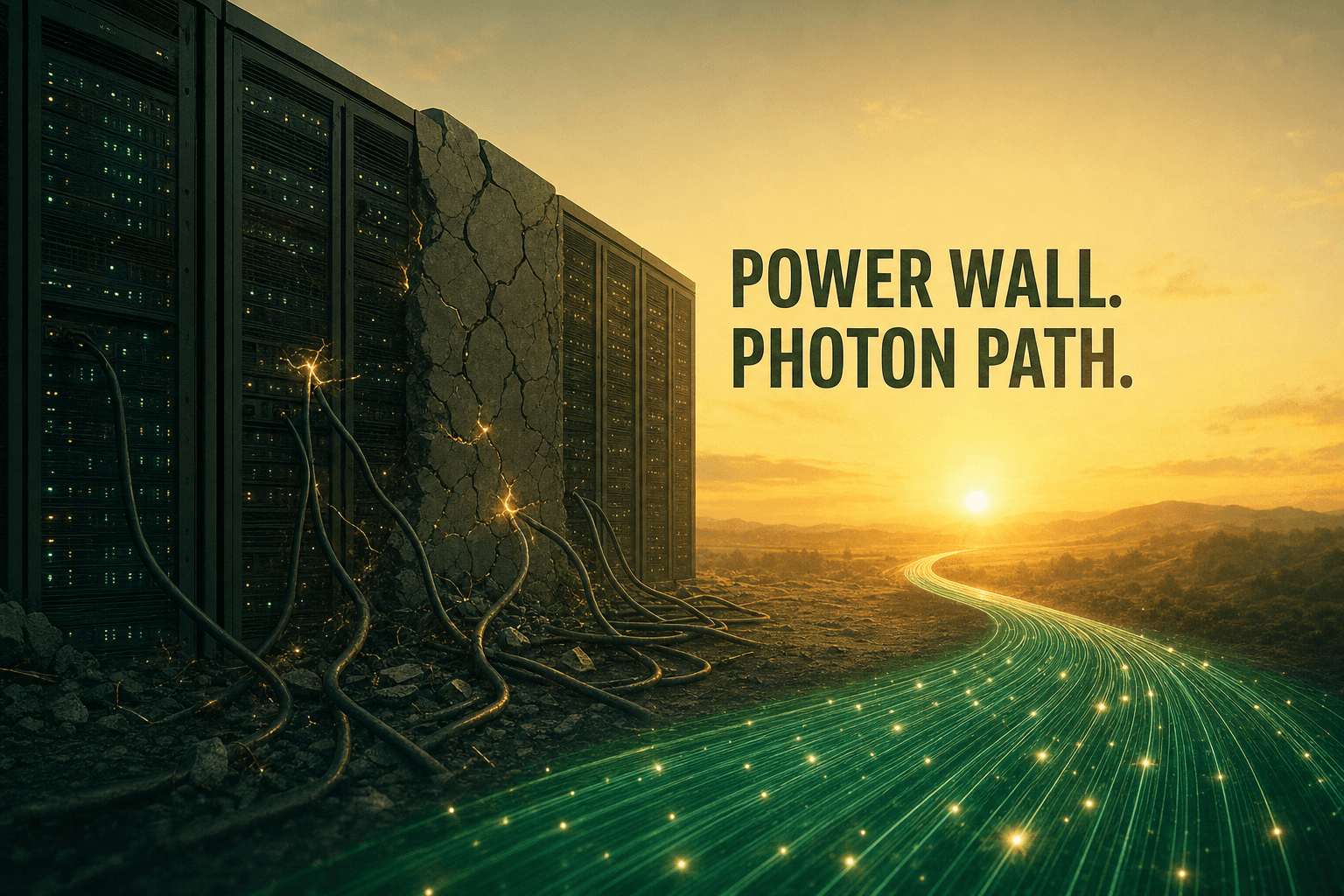
Here's the part most investors skip. A growing share of that power isn't spent computing anything. It's spent moving data between chips. Nvidia's own data center networking revenue grew 138% year over year, faster than the segment overall. As clusters scale from thousands of GPUs to hundreds of thousands, the interconnect becomes the tax. Copper burns power at high speeds, and its reach collapses as bandwidth climbs. So engineers bolt on retimers and DSP chips to push signals through. Each one draws more watts and throws off more heat. More heat means more cooling. More cooling means more watts. That loop is the energy problem inside the energy problem.
Light Fixes What Copper Can't
Photonics swaps electrons for photons. Light carries data farther and faster, with less energy lost per bit and far less heat. Optics has run the long-haul internet for decades. What's new is pushing it inside the rack, and eventually inside the package, right next to or near the GPU. That's co-packaged optics and near-packaged optics, and it's the industry's answer to the power wall. The catch has always been cost. Traditional optics gets hand-assembled from discrete parts. It never scaled like silicon. Whoever makes photonics manufacturable at chip volumes wins the buildout's component layer.
POET Builds the Piece Everyone Needs
This is where POET Technologies POET Technologies (POET) sits. The company's core platform is the Optical Interposer. In semiconductors, an interposer is the substrate that lets multiple chips talk inside one package. TSMC's Taiwan Semiconductor Manufacturing (TSM) CoWoS, which mounts HBM memory next to GPUs, is the famous electrical example. POET took the concept into light. Its interposer integrates lasers, modulators and photodetectors at wafer scale, using semiconductor processes instead of hand assembly. The company calls it the semiconductorization of photonics. The point is cost and power: fewer discrete parts, less assembly, less energy wasted between components.
At OFC 2026 in March, the optics industry's main event, POET ran the largest booth in its history and put hardware on the table. The first public live demo of Blazar, its hybrid laser external light source built for co-packaged optics, near-packaged optics and chip-to-chip links, with multi-wavelength output and wafer-level chip-scale packaging. A next-generation Starlight engine carrying eight high-power laser channels for the industry-standard ELSFP module. And an Elite Score of 4.5 from Lightwave Innovation Reviews for Teralight, its 1.6 terabit optical engine line, one of the highest marks the award has given. CEO Suresh Venkatesan's pitch on Blazar was blunt: it makes AI connectivity affordable because the design cuts cost and scales output. In a power-constrained buildout, affordable and efficient are the same word.
The Customer Already Showed Up
Then there's the order book. Lumilens, the AI infrastructure firm that raised over $700 million at a $5.51 billion valuation while still in stealth, placed a $50 million initial purchase order with POET under a supply framework worth up to $500 million over five years. A company that just banked $700 million doesn't commit half a billion in orders to a component vendor unless the component solves a real problem. Institutions took notice too: Q2 13F filings showed institutions tripling their footprint in the name. And POET is hiring like a company with customers, with headcount up about 35% in three months, most of it at its Singapore and Penang plants.
The iPhone Screen Trade
Here's the frame we keep coming back to. Every iPhone ships with a screen. Apple Apple (AAPL) doesn't make it; Samsung and LG do. When the iPhone took over the world, there were two ways to play it. Buy Apple, or buy the companies supplying the components inside every unit. The systems trade and the components trade. Both worked.
AI data centers have the same structure. Nvidia is the iPhone, the system everyone sees. But every system that scales past the copper wall needs light sources and optical engines, no matter whose logo is on the rack. That's the screen. POET makes the screen.
Execution still has to prove out, and we've said so. But the scoreboard is moving. POET has posted six straight quarters of sequential revenue growth, up 112% year over year, with $796.3 million in cash and a September update promised on its overall production ramp. The AI trade just repriced. The components underneath it are where the next leg gets built.
Disclosure
POET Technologies is a client of Jefferson Equity Derivatives & Intelligence LLC. POET Technologies paid Jefferson Equity Derivatives & Intelligence LLC $505,000 in cash compensation for a marketing program running from March 1, 2026 through December 31, 2026. As a result, this opinion is neither unbiased nor independent. The publishers of this article hold no securities of POET Technologies. This article is for informational purposes only and does not constitute investment advice. Always do your own research. Full disclaimers. For inquiries: Digital@jedifin.com.