 Sector Insights
Listen to this Recap
12:29
AI, Renewables and Project Finance Lead a Choppy Market: Utilities, Energy and Tech Outpace Policy-Exposed Names
Podcast • Loading audio...
Share this article
Spread the word on social media
Key Takeaways
- •Utilities, energy and technology led the day as government-backed project finance and AI product momentum supported pipelines and revenue visibility.
- •Materials were hit by a major operational and safety event at BHP’s Escondida, raising short-term copper supply concerns.
- •Tokenization and institutional crypto adoption advanced (ARK’s $1.3B tokenization), but privacy and security risks maintain volatility.
- •Cannabis and real estate remain policy- and execution-sensitive; Connecticut’s $713M in adult-use sales underscores demand but pricing and regulatory swings persist.
- •Investors should monitor project FIDs, mining operational updates, AI-driven revenue guidance and regulatory calendars for sector re-pricing triggers.
Executive summary
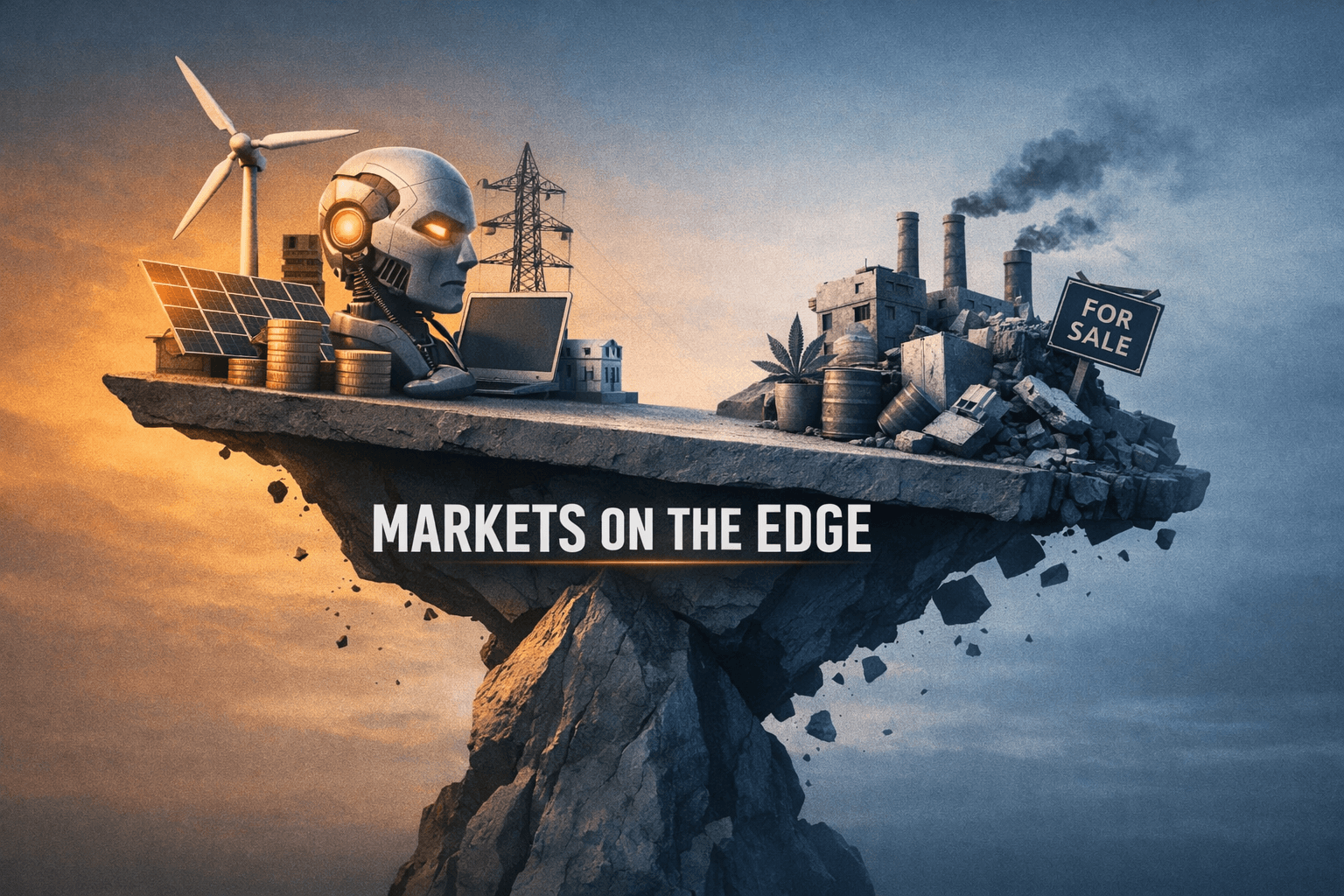
Markets digested a broad mix of sector-specific catalysts on Sep. 24 that favored capital-intensive, project-driven sectors and tech-linked revenue momentum while elevating regulatory and safety risks in a handful of cyclicals. Utilities and energy headlines were dominated by fresh federal and international project funding, LNG support and multiple renewables approvals — a news flow that underpinned relative strength in the infrastructure complex. Technology also produced constructive headlines tied to AI spending, hardware launches and startup ARR acceleration that sustained interest in software and cloud names.
At the same time, materials and mining faced a sharp negative shock after BHP halted operations at the Escondida copper mine following a fatal maintenance accident, reviving short-term supply and safety concerns for copper flows. Cannabis and segments of real estate were pressured by policy reversals, legal probes and operational servicing gaps. Crypto and consumer sectors showed mixed technical and fundamental signals: institutional adoption and tokenization advanced, yet privacy and quantum-security risks reminded participants of the space’s idiosyncratic hazards. Taken together, the tape felt like sector rotation more than a singular directional market move: capital chasing durable project cash flows and AI-era growth, and exiting names facing policy, safety or demand uncertainty.
Key datapoints to anchor the day: Connecticut reported $713 million in adult-use cannabis sales since 2023; ARK moved to tokenize a $1.3 billion venture fund; Mercuria committed $500 million to a US Project Vault stockpile; Lego announced a roughly $400 million Mexico expansion; Spain allocated 11 GW in a grid auction; and a 2,500-truck corporate order underscored logistics demand.
Sector grouping by performance (outperformers, underperformers, stable)
Note: Summaries supplied were narrative rather than intraday percentage returns. The grouping below reflects relative news-flow quality, structural tailwinds and headline risk as of Sep. 24.
Outperformers
- Utilities: Fresh federal grid and geothermal funding, utility-backed grid planning and multiple solar project milestones delivered clear positive catalysts for utility earnings visibility and capital deployment. Development and regulated cash flows drew attention.
- Energy: Momentum came from project finance wins, U.S. backing for an Argentina LNG export project, and renewables repowerings. News on LNG financing and large grid allocations (Spain’s 11 GW) reinforced the sector’s project pipeline narrative.
- Technology: AI product launches, startup ARR acceleration (DeepSeek reported rapid ARR growth), hardware pushes from Meta (META) and Google’s upcoming Gemini 4 created an innovation-led growth case for software, cloud and AI infrastructure providers.
Underperformers
- Materials & Mining: The suspension of operations at BHP’s Escondida after a fatal incident introduced near-term supply disruption risk for copper and underscored safety/regulatory uncertainty. That single event dominated otherwise constructive recycling and exploration headlines.
- Cannabis: Mixed policy movements — from Massachusetts veteran access wins to a criminal probe in Nebraska and Thailand policy rollbacks — left the sector uneven and policy-risk sensitive.
- Real Estate: While development financing and retail leasing deals (e.g., a Manhattan Sephora lease) illustrated pockets of demand, operational gaps in mortgage default servicing and legal disputes highlighted execution and credit risks, pressuring sentiment.
Stable / Mixed
- Industrial & Manufacturing: A U.S.-China two-month truce, large manufacturing expansions (Lego’s $400M Mexico plan) and relief from PFAS rulings supported a constructive tone, but logistical and hazardous-waste pressures add watchpoints.
- Finance & Banking: The picture was muddied by bond-market caution and select analyst upgrades, along with headline risk around Social Security payment security and student-loan reporting errors. Regional bank deals and hiring battles (Bank of America — BAC) were active but not uniformly directional.
- Healthcare: Clinical wins (Merck — MRK) balanced AI-related cost warnings, policy updates and safety flags. Biotech funding and an RNA therapeutic win were offsets to regulatory scrutiny.
- Consumer & Retail: AI and e-commerce initiatives (Best Buy, Tapestry) bumped up optionality, but price pressure and household strain kept the near-term spend outlook uncertain.
- Communications & Media: Content wins (Kodansha partnership via Dentsu, film festival accolades) were positive but censorship and regulatory risk in markets like Serbia tightened the narrative.
- Crypto: Institutionalization continued (Bitcoin ETFs showing inflows, IBM-SWIFT linkage), and ARK’s $1.3B tokenization push is notable, yet privacy and quantum-security calls kept the sector volatile.
Cross-sector themes and correlations
- Project finance and government backing are clustering flows into infrastructure, utilities and energy
- The pipeline of federally supported grid spending, geothermal and renewable project approvals is concentrating capital into developers, equipment suppliers and regulated utilities. Spain’s 11 GW allocation and U.S. support for Argentina’s LNG project are examples of government-enabled demand that benefits construction, engineering and equipment vendors.
- Correlation: Utilities, renewable developers and energy infrastructure names are behaving more cohesively — positive project news in one geography tends to lift relevant suppliers and financing vehicles globally.
- AI and cloud spending underpining tech–industrial crossovers
- AI product launches from major platform players (Google, Meta) and AI tools from Amazon (AMZN) are not only a pure-tech story; they’re driving product and capital needs across industrials (automation, logistics), consumer retail (personalization, inventory forecasting) and healthcare (drug discovery, imaging). This cross-pollination explains why both tech and industrial headlines were constructive.
- Supply-chain incidents and safety events transmitting to commodity and materials markets
- The Escondida halt highlights how a single operational incident can ripple into copper supply expectations and price discovery, which then feeds through to miners, smelters and midstream service companies.
- In practical terms, materials names may decouple from general cyclical beta when production shocks or regulatory scrutiny emerge.
- Regulatory and policy risk remains a structural cross-sector theme
- From cannabis legalization pilots and criminal probes to PFAS rulings affecting manufacturing cost structures, policy developments are causing selective re-rating across sectors. Financials and real estate are sensitive to servicing and compliance changes, while healthcare and communications face regulation-driven headline volatility.
- Institutional adoption vs. systemic risk in crypto
- Tokenization and ETF inflows are steadily institutionalizing crypto (ARK’s $1.3B tokenization, spot ETF traction), creating a correlation with traditional finance flows. Conversely, systemic-security concerns (privacy, quantum risk warnings) maintain an uncorrelated risk profile vis-à-vis equities and bonds.
The most significant moves — what happened and why it matters
BHP suspends operations at Escondida (Materials)
- What happened: BHP (BHP) halted operations at the Escondida copper mine after a fatal incident during maintenance.
- Why it matters: Escondida is one of the world’s largest copper suppliers; any prolonged outage tightens near-term copper availability and can lift prices, impacting miners’ revenue and escalating input-cost concerns for downstream manufacturers. Beyond price, the event spotlights operational and safety governance scrutiny — regulators and insurers may respond with tighter oversight and potential capex for safety upgrades.
Federal grid, geothermal and renewables funding (Utilities / Energy)
- What happened: Multiple federal and local funding wins, plus project approvals (including Spain’s 11 GW allocation and Puerto Rico and New York renewable approvals) were announced.
- Why it matters: New capital supports project pipelines and helps convert long-term policy goals into near-term revenue streams for developers and regulated utilities. For investors, improved project visibility often translates into clearer cash-flow timelines and de-risked construction schedules.
ARK tokenizes a $1.3 billion venture fund; institutional crypto flows (Crypto)
- What happened: ARK moved to tokenize a $1.3B venture fund, and Bitcoin ETF inflows continued.
- Why it matters: Tokenization represents deeper convergence between traditional asset management and crypto rails, potentially improving liquidity and opening new investor classes to digital assets. However, the technology and regulatory frameworks remain evolving; custody, AML/KYC and securities-law questions persist.
Merck clinical win and broader healthcare deal activity (Healthcare — MRK)
- What happened: Merck reported a clinical win and M&A and partnerships continued in the sector.
- Why it matters: Positive trial outcomes can materially re-rate individual biotech and drug developers, but AI cost pressures and regulatory moves temper the universe’s margin assumptions. For large pharmas like Merck (MRK), clinical validation strengthens pipelines and licensing leverage.
Lego $400M Mexico expansion and large logistics orders (Industrial)
- What happened: Lego announced a roughly $400M investment in Mexico while a corporate buyer ordered 2,500 electric trucks, underlining demand for EV logistics equipment.
- Why it matters: Capex-intensive factory expansions and fleet electrification orders are signals of durable demand in manufacturing and logistics, supporting equipment makers, EV-charging infrastructure companies and industrial services.
Mercuria’s $500M pledge to US Project Vault (Materials/Energy)
- What happened: Mercuria committed $500M to a US Project Vault stockpile.
- Why it matters: Large strategic stockpiles and financing commitments can smooth supply shocks and support commodity-flow certainty for major consumers and traders, but they also concentrate counterparty and project-development risk.
Connecticut cannabis sales $713M since 2023 and policy shifts (Cannabis)
- What happened: Connecticut reported $713M in adult-use cannabis sales since 2023; simultaneously, policy moves and enforcement actions appeared across Massachusetts, Nebraska and Thailand.
- Why it matters: The headline dollar figure underscores steady demand growth, yet price compression (unit growth outpacing dollars) and policy reversals show the sector’s sensitivity to regulation and competitive dynamics.
AI product launches (Tech) and platform-level competition
- What happened: Meta (META), Google (GOOGL) and Amazon (AMZN) had product and service updates; DeepSeek posted rapid ARR growth.
- Why it matters: Continued product cadence from large platforms keeps AI-driven monetization in focus and sustains spending on cloud, chips and model-inference infrastructure. This supports software-as-a-service (SaaS) and cloud-infrastructure revenue expectations for the near term.
Actionable insights for investors (informational, non-personalized)
Monitor project pipelines and contracted cash flows in utilities and energy: With federal and international backing flowing into grid, renewables and LNG, companies with secured offtake, contracted revenues or strong balance-sheet-backed development pipelines may see clearer near-term free-cash-flow visibility. Analysts note that visibility into contract start-dates and capex phasing is critical for reassessing earnings models.
Watch copper and base-metals flows after Escondida: Data suggests short-term price volatility is likely while market participants reassess supply timelines. Traders and thematic investors should track producer statements (BHP — BHP) and shipping/inventory metrics in the coming days.
Differentiate tech exposure between AI enablers and cyclicals: AI tailwinds are broad but not uniform. Companies selling infrastructure, cloud compute or developer tools may benefit more directly from higher enterprise AI spend than consumer-facing names that face discretionary-spend pressure. Monitor guidance for incremental AI-related revenue and margin cadence.
Treat cannabis as a policy-sensitive growth sector: Connecticut’s $713M sales figure highlights demand, but unit growth outpacing dollars signals pricing compression and competitive saturation in some markets. Investors should watch regulatory calendars, excise-tax changes and state-level enforcement actions for volatility triggers.
Incorporate operational-risk scenarios into materials allocations: Fatal incidents and stoppages at major mines can compress supply unexpectedly. Scenario analysis should consider longer repair timelines, potential regulatory fines, and the knock-on effect on smelter feedstock availability.
For fixed income and financials, watch bond-market cues and regional-bank headlines: Bond-market caution can feed into tighter borrowing conditions for smaller banks and real-estate developers. Investors should track loan-loss provisions, deposit dynamics and servicing performance metrics for exposure assessment.
Crypto: Watch custody and regulatory frameworks as institutional adoption accelerates via tokenization and ETFs. Technology progress (e.g., IBM’s linkage to SWIFT and quantum-security warnings) will shape longer-term institutional participation.
Keep an eye on logistics and supply-chain capital expenditure: Large orders (2,500 trucks) and new intermodal services (Amazon’s cross-country rail) suggest persistent investment in transport and decarbonization solutions — a positive for electrification suppliers and logistics-equipment manufacturers.
Risks and what to watch next
- Regulatory calendars (cannabis, PFAS, healthcare/FDA actions) that could produce abrupt re-pricing.
- Production and safety updates from major commodity producers (updates from BHP on Escondida), which would directly affect materials pricing and supply forecasts.
- Energy shipping risks (Red Sea disruptions) and LNG financing timelines, both of which can tighten global energy balances.
- Macro cues from bond markets and central-bank communications that influence funding costs and relative valuations across sectors.
- Corporate earnings and guidance, especially in tech and industrials, where AI-spend-related numbers could create sector-wide re-rates.
Conclusion — forward-looking perspective
Sep. 24 reinforced a market picture where policy-backed project finance and AI-related revenue momentum are attracting capital, while safety incidents and regulatory swings create concentrated risk pockets. In practical terms, look for the next wave of data to come from: (1) operational updates on major mining sites (including BHP’s public statements), (2) financing close and FID announcements in LNG and renewables projects, (3) quarterly commentary from cloud and AI infrastructure providers on incremental AI-related spending, and (4) regulatory or legal developments in cannabis and real estate servicing.
Cross-asset flows will matter: if bond-market caution persists, it could slow project finance and raise discount rates for long-duration tech winners. Conversely, continued government backing for infrastructure and steady corporate AI budgets would favor utilities, energy infrastructure and select technology enablers.
Investment teams and allocators should remain attentive to idiosyncratic operational risks (materials, servicing lapses) while monitoring the durability of AI and project-finance tailwinds. Strategy-wise, that implies balancing exposure to sectors with contractual cash flows and visible project pipelines against policy- and safety-exposed names that could reprice sharply on headline risk.
Investment disclaimer
This analysis is for informational purposes only and does not constitute investment advice or a recommendation to buy, sell or hold any security. It is not personalized advice and does not take into account an individual’s financial situation, objectives or risk tolerance. Analysts note risks and present market-derived insights; individual investors should consult a licensed financial professional before making investment decisions.
Sources
+ 14 more sources
Use these insights — enter this week's contest.
Free practice contests — earn Alpha CoinsExplore More Content
Disclaimer: StockAlpha.ai content is for informational and educational purposes only. It is not personalized investment advice. Sentiment ratings and market analysis reflect data-driven observations, not buy, sell, or hold recommendations. Always consult a qualified financial advisor before making investment decisions. Past performance does not guarantee future results.