 Sector Insights
Listen to this Recap
9:55
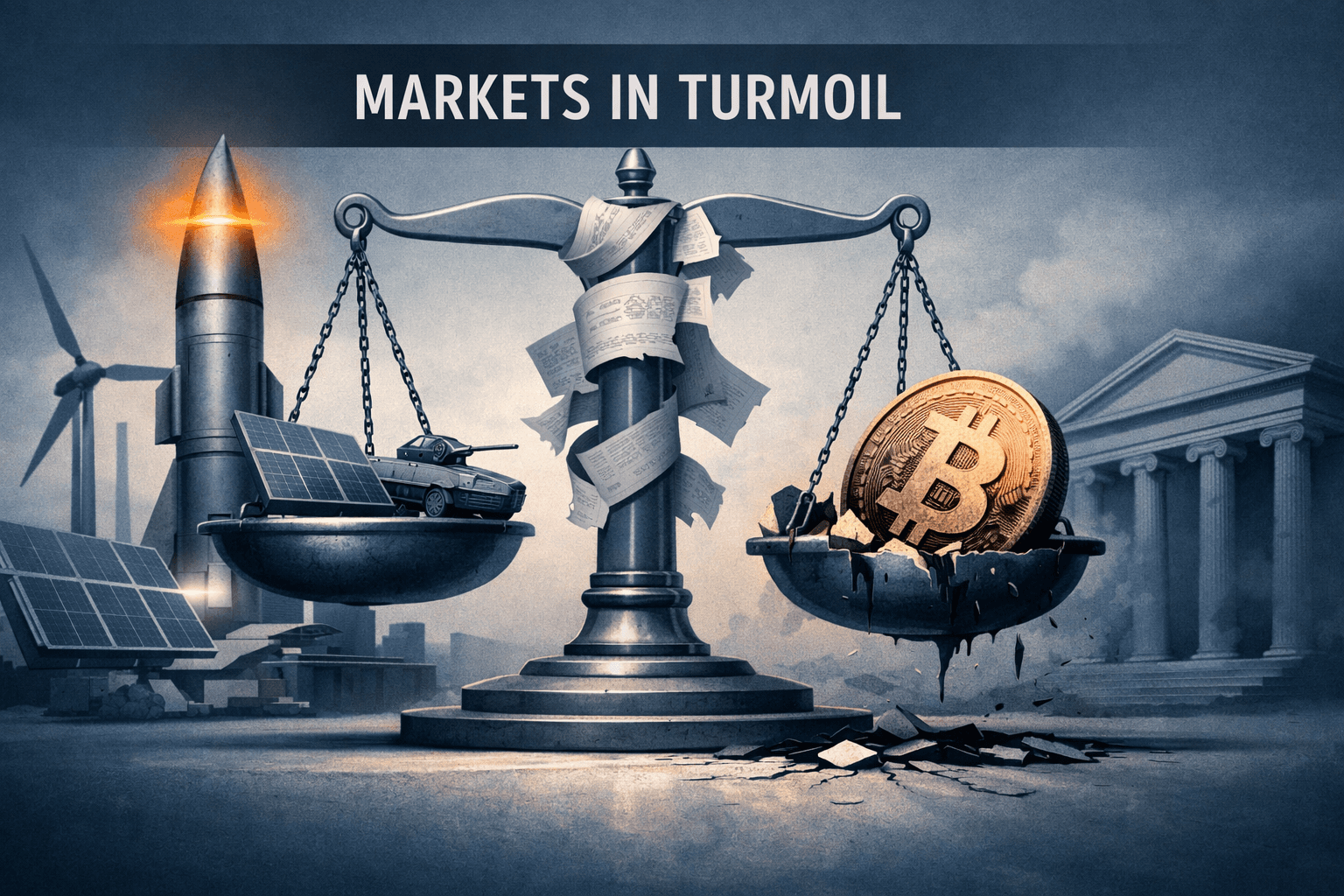
Regulation and Real-Economy Flows Steal the Tape: Renewables and Defense Outperform as Crypto and Policy Risk Pressure Markets
Podcast • Loading audio...
Share this article
Spread the word on social media
Key Takeaways
- •Utilities, industrials and materials outperformed as concrete project milestones and government-backed finance reduced execution risk.
- •Crypto sold off after the Senate failed to advance the Clarity Act, highlighting policy as a primary driver of short-term volatility.
- •Technology faced mixed forces: AI funding and product rollouts provided upside while regulatory and operational headlines capped momentum.
- •Investors favored capex- and contract-driven cash flows; sectors dependent on narrative expansion or regulatory clarity saw disproportionate downside.
- •Monitor upcoming policy calendars, project execution milestones and energy supply disruptions for near-term sector catalysts.
Executive summary
Markets on Sep. 15 traded around a mixed fundamental backdrop where regulatory headlines and hard, project-level news mattered more than macro rumors. Renewable energy and grid-technology headlines — a 512-MWh battery energy-storage system (BESS) coming online and several cross-border renewables deals — helped lift the utilities complex. Industrials were buoyed by fresh Department of Defense contracts and capacity expansions that point to near-term revenue visibility for manufacturers. Materials and mining saw targeted financing and government-backed capital support for projects such as a $150m–$175m funding package for a tungsten complex, which underlines investor appetite for resource projects with explicit public-sector support.
At the other end of the tape, crypto suffered after the Senate failed to advance the Clarity Act, triggering a pullback in Bitcoin and crypto-focused equities; anecdotal intraday data showed Bitcoin slipping several percentage points and a heavier hit to smaller-cap crypto miners and exchange plays. Banks and financials faced renewed friction as sanctions, regulatory uncertainty and an updated Fed outlook clipped confidence in the sector. Technology was conflicted — big AI funding and Apple’s iOS 27 rollout were offset by fresh crypto regulatory pressure and an emergency Windows 11 patch that reminded market participants of software-operational risk.
Overall sentiment was mixed-to-neutral. Tactical winners were sectors with concrete project milestones or contracts (utilities, industrials, materials); cyclical and policy-sensitive sectors (crypto, finance, parts of healthcare) saw outsized headline-driven moves.
Sector performance groupings
Below we group the 24 sectors into outperformers, underperformers and stable performers based on the day’s dominant headlines and momentum.
Outperformers
- Utilities: Storage and solar headlines (a 512-MWh BESS online, V2G and big hydro deals) plus cross-border renewables transactions gave the sector tangible revenue and project-readiness signals.
- Industrials: New DoD awards, logistics upgrades and capex into electrification/automation lifted sentiment for industrial and defense-related manufacturing.
- Materials & Mining: Targeted financing (including a $150m–$175m package for the Springer tungsten complex) and selective M&A/financing news supported mining and specialty materials names with explicit project funding.
Why these outperformed: investors favored sectors where cash flows or project milestones were concrete rather than purely sentiment-driven. Government involvement (defense contracts, project finance) reduced perceived execution risk and made near-term revenue more visible.
Underperformers
- Crypto: The Senate’s failure to advance the Clarity Act was the dominant story; the uncertainty forced a re-pricing of regulatory expectations and drove a selloff in crypto tokens and equities linked to the space.
- Finance & Banking: Sanctions risk, shifting Fed expectations and debt-related headwinds weighed on bank sentiment; transcripts and research showing macro impacts (e.g., student-debt effects on savings) added to the caution.
- Healthcare: Mixed clinical outcomes (oncology wins vs. late-stage failures) plus policy pressure around Medicare/Medicaid and device oversight produced headline-driven dispersion and selling pressure in vulnerable names.
Why these lagged: policy and regulatory uncertainty punctured sentiment more readily in sectors where valuation depends on clarity around market structure (crypto) or policy frameworks (banks, healthcare).
Stable / Mixed performers
- Technology: A tug-of-war between AI funding and product rollouts (Apple iOS 27, Microsoft patch) and crypto/regulatory headwinds kept the sector choppy but not uniformly down.
- Consumer & Retail: Deal activity (Watsco buy, Target expansion, Shein warehouse opening) produced idiosyncratic winners and losers; overall consumer demand signals were mixed.
- Energy: Mixed supply and demand signals — record U.S. gas output versus pipeline damage and refinery strikes — left oil and gas names with nuanced, region-specific moves.
- Communications & Media: Content momentum offset by geopolitical and regulatory friction; festival-driven demand and streaming slates provided some upside.
- Real Estate: A mix of industrial starts and multifamily refinancing against rising mortgage rates and stressed office assets produced a bifurcated market.
Cross-sector themes and correlations
Several themes threaded across the tape; understanding these linkages helps explain why otherwise disparate sectors moved in concert.
Regulation as a primary risk factor
- The Senate’s failure to advance the Clarity Act — and the attendant rhetoric — directly hit crypto prices and crypto-related equities. But regulatory pressure also showed up in cannabis (state and federal rulings) and communications (6G execution concerns, telco rip-and-replace delays). When Congress or regulators are in focus, liquidity typically shifts away from higher-volatility growth exposures and toward sectors with clearer near-term cash flows (utilities, defense-related industrials).
Government support and project finance lowers execution risk
- Materials and mining benefited from government-backed financing and large project funding. Similarly, defense contracts for industrials provide a multi-year revenue pipeline, which investors reward with multiple expansion relative to purely discretionary capex bets.
Energy security and transition coexist
- The energy tape mixed long-cycle transition headlines (solar builds, cross-border renewables deals) with short-cycle supply shocks (pipeline damage, refinery strikes). That correlation explains why some integrated energy names that offer exposure to both the renewables transition and commodity production outperformed more pure-play oil or gas names.
Tech infrastructure risk punctures momentum
- High-profile product rollouts (iOS 27) and AI funding created positive headlines for big-cap tech, but software-ops risk (a Microsoft Windows 11 emergency patch) and crypto regulatory headlines created episodic volatility. This underscores a wider market dynamic: narratives (AI, mobile OS upgrades) can drive conviction, but operational risk and regulatory uncertainty cap upside.
Capex and real assets are back in focus
- With a higher-for-longer rates backdrop priced in by some market participants, capital allocation appears to favor companies with visible capex cycles and tangible asset builds (BESS, industrial facilities, warehouses). These are seen as less dependent on multiple expansion and more on cash flow generation.
Most significant moves — context and implications
Here are the day’s most consequential sector stories with context on why they mattered.
Crypto: Clarity Act vote fails; market re-prices regulatory pathway
- What happened: The Senate failed to advance the Clarity Act, a high-profile market-structure bill that many in crypto had hoped would provide clearer federal guidance.
- Market impact: BTC and liquid crypto equities declined intraday; smaller-cap miners, exchanges and custody plays were hit hardest as leverage to on-chain activity and regulatory clarity is greatest there.
- Why it matters: Market-structure clarity is a prerequisite for broad institutional scale-up. Without it, custody, derivatives and exchange businesses face ongoing uncertainty, compressing multiples and increasing funding costs for crypto startups.
Utilities: 512-MWh BESS commissioned; renewables deals increase visibility
- What happened: Several utilities headlines highlighted project completions and cross-border deals; notably a 512-MWh BESS came online, representing a material storage capacity addition for the regional grid.
- Market impact: Utilities names with large storage or solar development pipelines outperformed peers; vendors of grid tech and storage components saw constructive trade.
- Why it matters: Large-scale BESS installations change the economics of renewable dispatch, improve reliability and support higher renewable penetration. For utilities, they can reduce peak capacity costs and defer transmission upgrades — a near-term earnings-positive pathway when projects are operational and accruing revenue.
Industrials: Defense contracts and facility builds boost order visibility
- What happened: New DoD-related awards and announced facility expansions were the day’s notable drivers for industrials and manufacturing suppliers.
- Market impact: Mid-cap industrial names with defense exposure or those supplying mission-critical components showed relative strength.
- Why it matters: Defense contracts often come with multiyear funding and conservative billing schedules, improving revenue visibility. For investors focused on cash-flow stability, defense and government-contracted manufacturing can be attractive sources of predictable earnings in a choppy macro environment.
Materials & Mining: Targeted project finance stabilizes select names
- What happened: A $150m–$175m funding deal for the Springer tungsten complex and other project-level financing headlines centered attention on miners with secured capital stacks.
- Market impact: Companies with project-level financing or government participation outperformed lightly financed peers; cost debates around copper and fuel surcharges, however, kept broader base-metals names volatile.
- Why it matters: Access to concessional or structured finance reduces dilution risk and execution uncertainty. For investors tracking resource exposure, distinguishing financed, permitted projects from greenfield development is key to separating winners from longer-term projects.
Technology: AI funding and iOS 27 meet operational and regulatory friction
- What happened: Apple’s iOS 27 rollout and fresh AI capital raised optimism for software and platform monetization. At the same time, crypto regulatory news and a Microsoft Windows 11 emergency patch injected caution.
- Market impact: Large-cap platform stocks were mixed — positive on product cycle benefits but tempered by risk-off flows tied to crypto and operational concerns.
- Why it matters: Tech narratives remain bifurcated: AI and platform upgrades can drive top-line expansion and monetization levers, but regulatory and operational shocks (security patches, crypto clampdowns) create headline risk that can erode short-term multiples.
Consumer & Retail: Deal-making and expansion offset macro caution
- What happened: Deal activity (Watsco’s announced acquisition), Target’s expansion, Shein’s large U.S. warehouse and Amazon’s retail wage moves were key consumer headlines.
- Market impact: Idiosyncratic winners emerged, with retailers focused on logistics, automation and price-competitive positioning rewarded.
- Why it matters: With consumer demand uneven, operational improvements — lower unit costs via automation and better fulfillment — and market-share plays can differentiate winners. But refinancing trends and mortgage-rate pressures remain downside risks for housing-linked retail categories.
Healthcare: Clinical bifurcation and policy noise
- What happened: Mixed clinical results (some oncology wins, an AstraZeneca late-stage failure) plus policy actions on Medicare/Medicaid and calls for tighter device oversight created headline volatility.
- Market impact: Biotech and device stocks with binary readouts were volatile; larger diversified pharmas held up better but were not immune to policy-driven rotation.
- Why it matters: Clinical outcomes remain pivotal for biotech valuation, but policy shifts can change payer dynamics and market access. For longer-term investors, separating clinical risk from policy risk is essential.
Actionable insights for investors (informational only)
These observations are intended to help investors frame risk and opportunities; they are not recommendations.
Differentiate between headline-driven and execution-driven exposures
- Sectors that outperformed today (utilities, industrials, materials) did so on concrete operational milestones or contracted revenues. Investors who prioritize downside protection may prefer names with visible cash flows or projects that have cleared permitting and financing steps.
Treat regulatory headlines as event risk across multiple sectors
- The Clarity Act outcome illustrates how a single regulatory event reverberates across crypto, custody, payments, and even some pockets of fintech. Consider shorter reaction horizons for names sensitive to policy shifts and stress-test positions for regulatory scenarios.
Focus on capex beneficiaries in a high-rate environment
- Projects with contracted revenue (grid upgrades, storage, defense supply) offer a clearer path to cash flow than speculative growth bets that depend on multiple expansion. Stocks tied to tangible asset builds or long-term service contracts may offer better risk-adjusted profiles in the near term.
Monitor supply-chain impacts for energy and materials plays
- Pipeline damage, refinery strikes and fuel surcharges on shipping are real variables that can move margins quickly. For commodity exposures, look for companies with hedges, diversified logistics or vertical integration to mitigate transient supply disruptions.
Expect dispersion in tech and consumer — favor operational clarity
- With AI excitement and product cycles on one side and regulatory/operational shocks on the other, the best opportunities will likely be in companies with clear monetization paths or durable competitive advantages, not simply narratives.
Prepare for volatility windows around policy calendars
- Upcoming congressional schedules, state regulatory rulings (cannabis) and agency rulemakings (EPA, Medicare/Medicaid changes) are potential volatility triggers. Institutional investors often reduce leverage ahead of such windows; retail investors may want to reassess position sizing.
Notable tickers and data points to watch (informational only)
- Big-tech product and platform leaders: AAPL, MSFT, NFLX — watch product cycles (iOS 27 cadence, AI announcements) and patch/operational risk.
- Retail and consumer: AMZN (Whole Foods pay moves, distribution push), TGT (store expansion), WSO (Watsco acquisition activity).
- Crypto and digital-asset indicators: BTC (Bitcoin price action following Clarity Act vote) and exchange/miner names — expect higher intraday correlation to on-chain regulatory headlines.
- Healthcare: AZN (AstraZeneca clinical news) and biotech cohort attached to recent oncology readouts.
- Materials & mining: Companies tied to financed projects (e.g., those linked to the Springer tungsten complex) and copper price trajectories, which remain sensitive to cost and demand debates.
Risks and watchlist for the next 1–3 months
- Regulatory pathways: Keep an eye on congressional activity related to crypto, cannabis, and technology policy. Legislative outcomes will remain primary market movers for the affected sectors.
- Fed and rates: The market is parsing Fed language and regional data for clues on rate trajectory. Rate volatility will influence real-estate financing costs, bank net-interest margins and capex discount rates.
- Energy supply shocks: Operational disruptions (refinery strikes, pipeline damage) can create short-term commodity price spikes; monitor headlines out of key production regions.
- Project execution: For utilities and materials, the difference between announced projects and commissioned assets matters. Project delays or cost overruns will be re-priced quickly.
- Clinical binary risk: As with the recent AstraZeneca report, biotech remains exposed to binary clinical outcomes; position sizing should reflect the asymmetric payoff structure.
Conclusion — forward-looking perspective
Sep. 15 was a reminder that in today’s market, policy and project-level clarity matter as much as macro narratives. Investors rewarded sectors where cash flows became more visible — a completed 512-MWh BESS, defense contracts and financed mining projects — and punished areas where regulatory clarity evaporated, most notably crypto. The cross-sector linkages are straightforward: when public capital (defense spending, project finance, regulatory clarity) is visible, markets award reduced execution risk. When policy is uncertain, sentiment-driven sectors re-price sharply.
Looking ahead, expect a continued bifurcation. Names and sectors with tangible, near-term revenue drivers and low execution risk should remain attractive to investors seeking stability, while those exposed to regulatory ambiguity or binary clinical outcomes will likely show elevated volatility. Watch the congressional calendar, agency rulemakings and key project milestones — they will be the primary catalysts shaping sector performance over the coming weeks.
Investment disclaimer: This analysis is informational only. It does not constitute an offer, solicitation, recommendation or personalized investment advice to buy, sell, or hold any security. Analysts note market-moving headlines and data; readers should consult a licensed professional before making investment decisions.
Sources
+ 14 more sources
Use these insights — enter this week's contest.
Free practice contests — earn Alpha CoinsExplore More Content
Disclaimer: StockAlpha.ai content is for informational and educational purposes only. It is not personalized investment advice. Sentiment ratings and market analysis reflect data-driven observations, not buy, sell, or hold recommendations. Always consult a qualified financial advisor before making investment decisions. Past performance does not guarantee future results.