 Sector Insights
Listen to this Recap
11:52
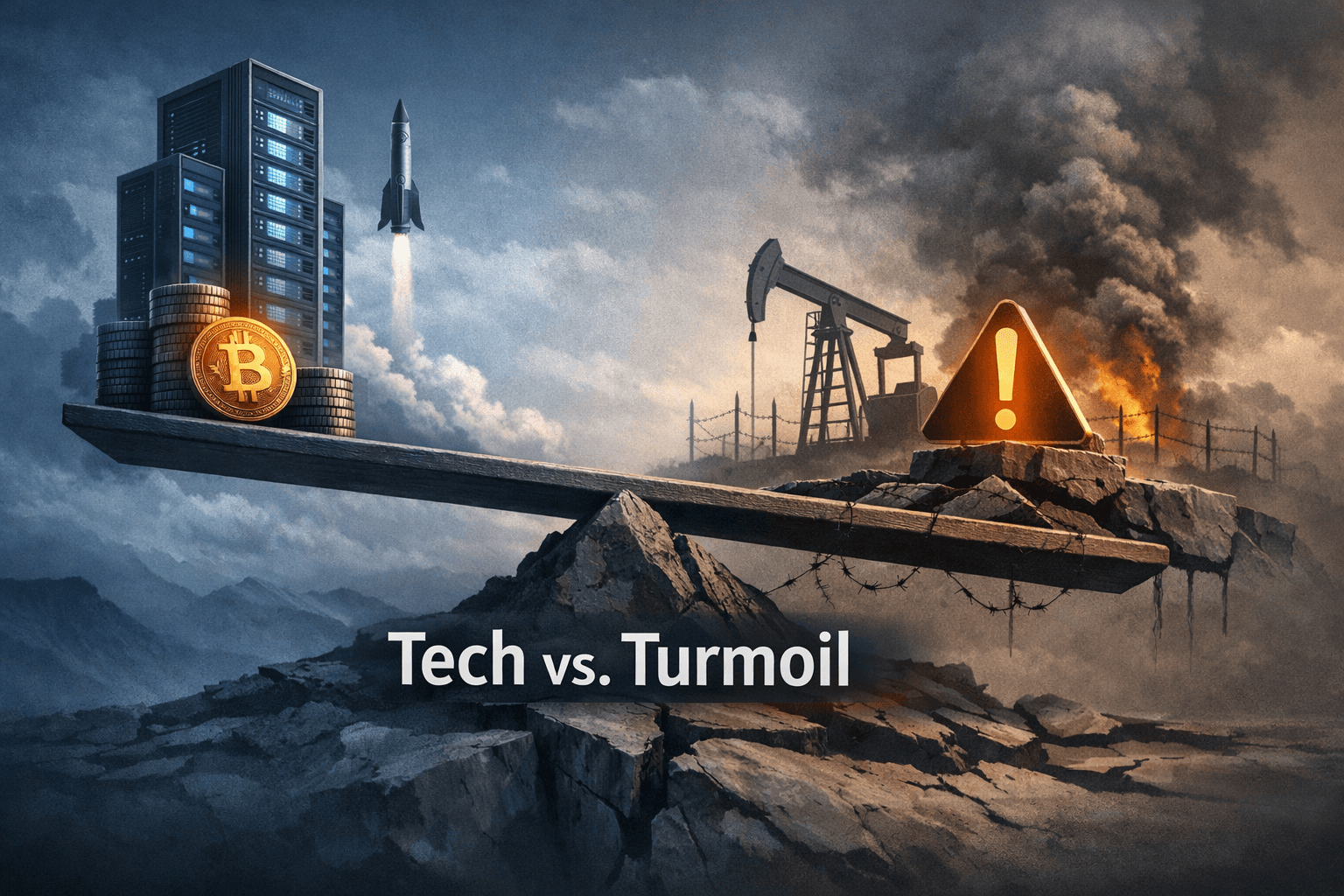
Crosscurrents: AI and Energy Drive Gains While Policy, Security and Execution Risks Cap Some Sectors
Podcast • Loading audio...
Share this article
Spread the word on social media
Key Takeaways
- •AI funding and data-center capacity expansion are creating cross-sector tailwinds for tech, utilities and materials.
- •Oil spikes and diesel tightness pushed energy into a short-term leadership role while raising cost pressures for fuel-sensitive sectors.
- •Regulatory and security headlines (AI lawsuits, cannabis policy, crypto hacks) are increasing dispersion and event-driven volatility.
- •Project and permit timelines (DOE loan, long-duration storage, data-center permitting) are now key pacing items for infrastructure-related equities.
Executive summary
Thursday’s tape was defined by two dominant narratives: an AI and data-center acceleration that underpins a rally in technology-related assets, and an energy shock that pushed oil prices toward the $100 mark, reshaping sentiment across utilities, materials and real assets. Large corporate and policy headlines — from multibillion-dollar fiber deals to a $1.9 billion DOE loan for a nuclear project — reinforced the view that capital is still being deployed into long-lead infrastructure and computing. Offsetting that momentum were renewed regulatory and security concerns in crypto and cannabis, legal friction around generative AI, and operational risks in consumer/retail execution as firms ready for a bigger Q4.
Key datapoints from the day: France TV exports plunged 21.6% (communications); California cannabis compliance reported at 99.33% (policy); materials deal activity included a €174 million circular IT merger; real-estate headlines included a $141 million CMBS refinance in Raleigh and a global mandate to JLL from Nestlé; utilities attention focused on Google-backed long‑duration storage and a $1.9 billion DOE loan for Duane Arnold; technology saw large funding rounds (Mistral) and a flurry of product and legal headlines (Meta’s Muse debut, Apple foldable event looming, and antitrust/AI lawsuits). Oil moved sharply higher after Middle East attacks and diesel concerns, putting energy and transport spreads under pressure.
Taken together, the market is signaling selective risk-on: capital favors AI, hyperscale compute and select infrastructure, while security, regulatory and execution risk are concentrating pressure in high-volatility pockets like crypto, health policy-exposed biotechs, and nascent legal-dependent sectors.
Performance buckets: outperformers, underperformers, stable/mixed
Outperformers
Technology
- Why: Large funding for AI (reports of sizable rounds such as Mistral), Arm’s next‑generation server and mobile GPU developments, and hyperscaler interest in expanding data‑center footprints (Patagonia interest reported) are reinforcing the sector’s growth narrative. Product launches and potential near-term catalysts (Meta’s Muse rollout and Apple’s pending foldable iPhone event) are generating investor attention and potential re-rating of hardware/software vendors tied to AI stacks.
- What moved: AI-focused funding, chip/design news from Arm, and data-center-related activity.
Energy
- Why: Geopolitical incidents and supply disruptions pushed oil toward the $100 mark, tightening diesel and refined-product markets. These price pressures revive cash flows for upstream names and tilt short-term economics in favor of fossil fuel producers, even as longer-term investment trends support renewables and electrification infrastructure (EV charging buildout reported).
- What moved: Attacks on Saudi facilities, diesel shortage concerns, and rising China crude imports set the tone.
Utilities
- Why: Large-scale project financing and technology adoption are lifting investor interest: Google-backed long-duration storage projects and a $1.9 billion DOE loan for Duane Arnold highlight both private and public capital chasing grid resilience. Virtual power plant (VPP) adoption and storage starts are advancing while high-voltage grid bottlenecks (765‑kV plans) keep the engineering and supply-side angle in focus.
- What moved: Storage project starts, nuclear loan financing, C&I solar control updates and VPP momentum.
Underperformers
Cryptocurrency
- Why: Security incidents, regulatory probes (Polish exchange probe) and the lingering macro risk backdrop pressured confidence; these negatives counterbalanced institutional accumulation headlines (Visa on‑chain lending pilot, notable BTC purchases). In short, episodic hacks and regulatory scrutiny continue to keep volatility elevated.
- What moved: Exchange probes, hacks and mixed institutional signals.
Healthcare
- Why: The sector delivered a patchwork of scientific wins and policy/clinical setbacks — mid-stage trial success stories compete with cost, access and regulatory uncertainty. That mix increases dispersion within healthcare: select biotechs see trial-driven upside while payer/policy risk suppresses multiples elsewhere.
- What moved: Clinical wins (e.g., a Roivant mid-stage victory) but offset by access and cost headlines.
Cannabis
- Why: Positive momentum on federal commutations and rescheduling discussions is being offset by state-level enforcement, compliance nuances and looming legal tests (potential Supreme Court licensing case). The result is high headline risk with limited visibility on near-term revenue expansion for listed operators.
- What moved: Federal policy chatter, state safety and enforcement items, California’s reported 99.33% compliance.
Stable / Mixed sectors
- Materials & Mining: Active deal flow and project starts kept the sector busy; record diesel costs and China demand remain dual risks.
- Real Estate: Financing and leasing activity (including a $141 million CMBS refinance) point to steady demand, though data-center permitting constraints and urban redevelopment dynamics (Lower Manhattan to Midtown flows) create localized dislocations.
- Finance/Banking: Regional bank leadership and recapitalization headlines dominated, while European banks broadly beat Q2 forecasts — suggesting a credit/earnings backdrop that is constructive but not uniformly so.
- Consumer & Retail: Retailers gearing up for a holiday season forecast north of $1 trillion face execution risk around inventory accuracy and product data integrity.
- Communications & Media: Content momentum (Prime Video originals) and large fiber deals (Verizon’s multibillion commitment) cohabit with export weakness in parts of Europe and resource rationalization at legacy vendors.
- Industrial & Manufacturing: Operational investments and safety/regulatory scrutiny (pollution mapping, supply chain effects) create a mixed backdrop for capex-linked industrials.
Cross‑sector themes and correlations
AI and hyperscale compute are creating a cross-sector growth axis
- Evidence: Funding for AI-native firms (Mistral), Arm’s server roadmap and mobile GPU moves, and hyperscalers expanding locations create demand for chips, networking gear, real-estate (data centers), power (utilities) and materials (specialty metals and cooling equipment).
- Correlation: Technology gains feed real estate (data centers), utilities (grid/storage), and materials (procurement cycles), producing positive beta across those sectors.
Energy shock lifts traditional producers and pressures transport/refining
- Evidence: Oil approaching $100 after attacks on Saudi facilities and diesel shortages; China crude imports rising.
- Correlation: Higher oil benefits energy producers and materials tied to oilfield services, pressures consumer discretionary and transport margins, and increases the cost base for industrials and materials (diesel input cost).
Policy and regulatory risk remains a key differentiator
- Evidence: Cannabis federal commutation/rescheduling chatter, a potential Supreme Court case on licensing, healthcare access/cost debates, and AI legal fights at Anthropic and OpenAI.
- Correlation: Sectors dependent on regulatory clarity (cannabis, healthcare, certain fintech/crypto services and AI platforms) trade with higher dispersion and event-driven volatility.
Security and operational execution are gating factors
- Evidence: Crypto hacks and exchange probes, retail inventory/data issues, industrial safety labels and pollution mapping.
- Correlation: Cybersecurity and operations-related vendors may see re-rated demand profiles; conversely, security incidents create idiosyncratic drawdowns in crypto and platforms tied to custody or payments.
Capital allocation is bifurcating between long-duration infrastructure and shorter-cycle consumer bets
- Evidence: Multibillion fiber deals, DOE nuclear loan, long-duration storage capital vs. retailers stocking for Q4 and increasing retail-media monetization.
- Correlation: Long-duration bets are boosting utilities, materials and real estate subsectors, while consumer and retail dynamics remain sensitive to execution and macro sentiment.
The day’s most significant moves and why they matter
Verizon inks a multibillion-dollar fiber deal
- Why it matters: Large fiber commitments are both demand signals for networking equipment and enablers for higher-capacity corporate and residential bandwidth; Dell’Oro’s PON spending surge comment suggests vendors could see a multi-year upgrade cycle. This supports telecom equipment suppliers, construction-related materials and real-estate entities serving fiber routes.
Google-backed long-duration storage and $1.9B DOE loan for Duane Arnold
- Why it matters: These items highlight where public and private capital is aligning: grid resilience and capacity firming. Long-duration storage projects change how utilities balance renewables, while the DOE nuclear loan underscores continued appetite for centralized, low-emission baseload capacity. Together they reinforce utility capex themes and ancillary supply chains (converters, transformers, critical minerals).
Oil spike near $100 after attacks and diesel shortage concerns
- Why it matters: Tightening fuel markets have immediate pass-through effects: refiners, transport, and consumer mobility. The short-term inflation impulse from fuel could complicate central bank narratives if sustained and will pressure sectors with high fuel intensity (airlines, trucking, and some industrials). This also shifts near-term investor focus toward energy producers and away from highly duration-sensitive assets.
Technology funding and product moves (Mistral funding, Arm roadmap, Meta Muse, Apple foldable)
- Why it matters: Continued funding and product cadence means a sustained wave of spending on compute, memory, networking and AI software. Legal friction (lawsuits involving Anthropic and OpenAI) tempers enthusiasm by highlighting potential costs and uncertainty around model deployment and content licensing.
Crypto: institutional accumulation vs. security incidents
- Why it matters: Institutional flows (including large BTC purchases and Visa’s on‑chain pilot) imply growing mainstream adoption, but hacks and regulatory probes preserve wide volatility. The sector will likely remain bifurcated between regulated institutional demand and headline-driven retail reactions.
Real estate: $141M CMBS refinance and data-center permitting tightening
- Why it matters: Successful CMBS transactions signal liquidity for commercial owners, but permitting constraints for data centers are a widening theme — potentially concentrating hyperscaler activity and increasing land/utility premium in approved jurisdictions.
Materials & Mining: €174M circular IT merger and Rio Tinto taking control of Aurukun
- Why it matters: Deal activity indicates continued strategic consolidation and verticalization (e.g., circular IT). At the same time, geopolitical and China demand risk remain, creating commodity-price and capex timing uncertainty.
Actionable insights (for informational purposes only)
Re-evaluate exposure to the AI/data‑center value chain
- Data suggests durable capex: funding rounds, Arm’s server roadmap, and hyperscaler footprint expansion cumulatively support suppliers across semiconductors, cooling, power conversion and specialized real estate. Analysts note that companies with direct revenue linkage to hyperscale customers or diversified enterprise AI offerings may see steadier demand.
Monitor fuel prices and refined-product spreads
- The oil spike, driven by geopolitical events and diesel tightness, can rapidly change sector returns. Momentum indicates cyclical energy and materials names will benefit near term, while high fuel-cost sectors could face margin compression. Watch refinery utilization and diesel crack spreads for leading indicators.
Watch regulatory calendars and legal headlines
- Several markets are policy-sensitive: cannabis (federal actions and court cases), healthcare (coverage and pricing debates), and AI (litigation around model use and licensing). Risk-managed positioning requires staying current on legislative timetables, Supreme Court dockets and major agency announcements that can change market access overnight.
Factor security and operational resilience into risk assessments
- Crypto hacks and retail/industrial operational lapses highlight the value of operational due diligence. For portfolio construction, analysts suggest stress-testing allocations for idiosyncratic operational shocks and monitoring vendor concentration in areas such as cloud custody, logistics, and payment processing.
Geographic/permit concentration matters for real assets
- Data-center permitting bottlenecks and urban redevelopment dynamics (Lower Manhattan to Midtown flow) mean location economics are changing; real-estate allocations sensitive to data centers or logistics should scrutinize local approval pipelines and grid interconnection timelines.
Prepare for event-driven volatility around consumer seasonality and product launches
- With retailers building for a holiday season forecast north of $1 trillion and product events (Apple foldable) approaching, sequential earnings and guidance updates can cause rapid re-pricing. Execution quality — inventory accuracy, fulfillment capability, and supply-chain integrity — will distinguish winners from losers in Q4.
Signals to watch next
- Legal and policy calendar: AI litigation outcomes, potential Supreme Court cannabis cases, any DOJ/FTC moves in the AI space.
- Energy flow indicators: OPEC+ statements, refinery utilization rates, diesel crack spreads, and China import data (already rising).
- Tech product cadence: Apple’s foldable event and vendor guidance from chipmakers and hyperscalers.
- Macro readings and rate commentary: Any shifts in central-bank rhetoric that could alter long-duration asset valuations amid higher energy-driven inflation.
- Security and regulatory actions in crypto: exchange probes, custody policy updates and payments-industry pilots (Visa).
- Real‑world project timelines: DOE loan disbursements, major storage project milestones, and data-center permitting approvals.
Conclusion — forward-looking perspective
The market is in a selective balance: structural growth stories tied to AI, hyperscale compute and grid resilience continue to attract capital, while short-term energy shocks and policy/regulatory headlines introduce episodic volatility. This confluence means investors and sector watchers should be prepared for increased dispersion — technology and infrastructure-linked sectors may outperform on momentum and visibility, while crypto, healthcare and policy-exposed areas may remain range-bound or volatile until regulatory clarity emerges.
Analysts note that diversification across the AI/infrastructure value chain and hedging for energy-price risk are prudent informational considerations in the current environment. Momentum indicates that near-term event risk — product launches, legal rulings and supply-shock developments — will drive day-to-day moves. For market participants, the next week’s headlines around Apple’s event, AI legal developments and any new energy-supply updates will likely determine which of today’s cross-currents dominate the market narrative.
Investment disclaimer: This analysis is informational only. It does not constitute a recommendation to buy, sell or hold any security, and it is not personalized investment advice. Analysts note that individual circumstances vary; readers should consider their own objectives and consult a licensed advisor before making investment decisions.
Sources
+ 14 more sources
Use these insights — enter this week's contest.
Free practice contests — earn Alpha CoinsExplore More Content
Disclaimer: StockAlpha.ai content is for informational and educational purposes only. It is not personalized investment advice. Sentiment ratings and market analysis reflect data-driven observations, not buy, sell, or hold recommendations. Always consult a qualified financial advisor before making investment decisions. Past performance does not guarantee future results.