 Sector Insights
Listen to this Recap
9:27
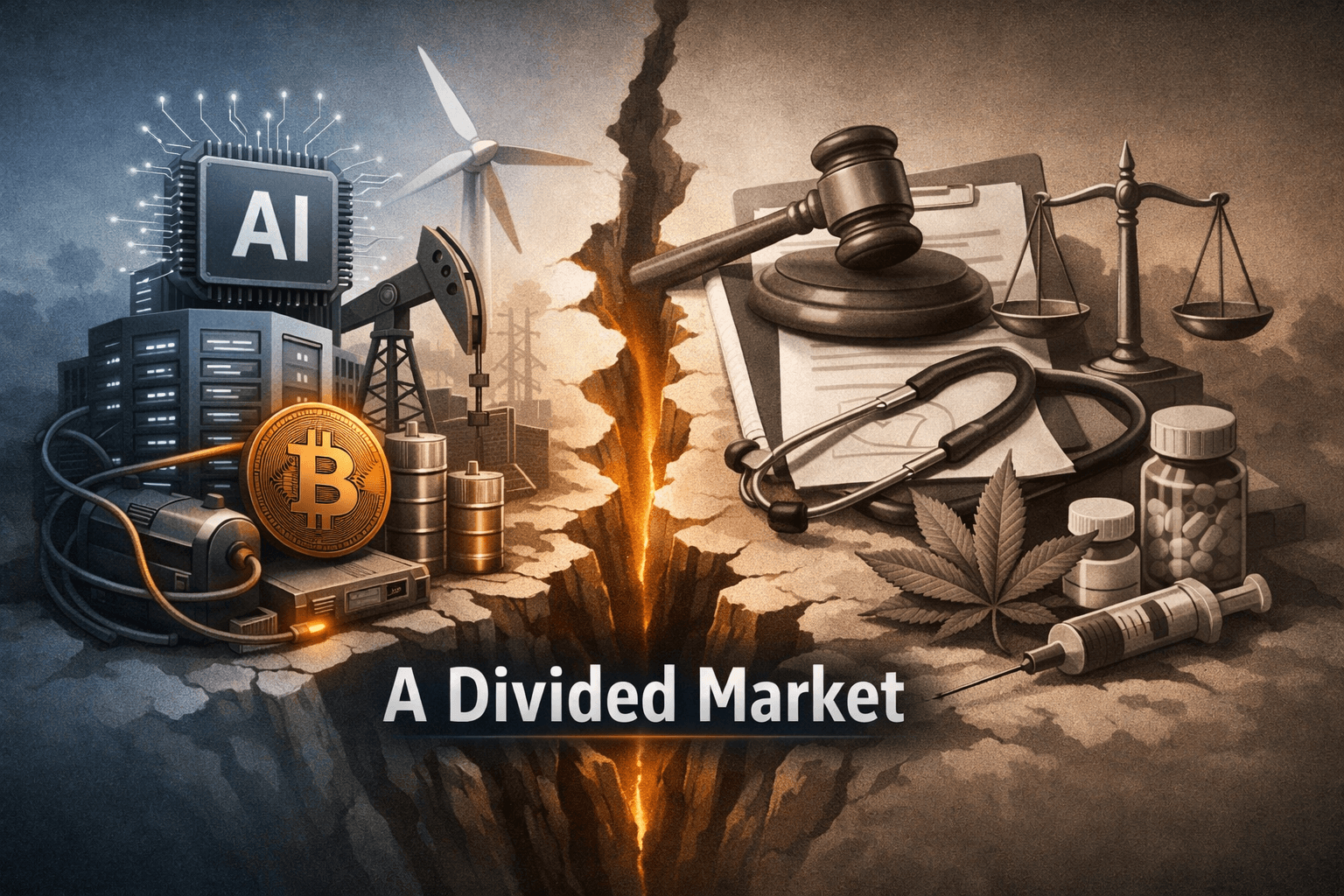
AI and Energy Drive a Bifurcated Market: Tech, Crypto and Oil Lead While Policy and Safety Keep Others in Check
Podcast • Loading audio...
Share this article
Spread the word on social media
Key Takeaways
- •AI demand remains the dominant cross‑sector force: it boosts tech, chips, data centers, utilities and materials.
- •Energy tightened after Strait of Hormuz disruptions—prompt crude and refined spreads reacted, layering risk premia into markets.
- •Crypto rallied on policy signals and ETF inflows, but regulatory outcomes remain an essential risk.
- •Infrastructure investment—batteries, data centers and critical minerals—is driving structural capital allocation even amid macro uncertainty.
- •Regulatory and safety headlines continue to create bifurcated sector performance; clarity will be key to broader market participation.
Executive summary
Markets on Aug. 19 reflected a market rotating around a small set of powerful cross‑sector themes. Momentum centered on AI demand, energy market tightness and renewed appetite for crypto exposure—each fueling gains in technology, energy and crypto‑adjacent stocks and projects. At the same time, regulatory and safety headlines kept pockets of the market under pressure: cannabis remained mixed as state legalization gains collided with federal rescheduling uncertainty, healthcare showed bifurcated performance amid clinical wins and a trial death, and finance reacted unevenly to event‑driven volatility.
Two practical facts framed the day’s price action and investor flows: 1) real assets and infrastructure that support AI and data processing—chips, data centers, power and battery capacity—received clear tailwinds; and 2) geopolitical and regulatory risks (Strait of Hormuz shipping disruptions, federal rescheduling questions for cannabis, and crypto rulemaking overhangs) left market breadth narrow even as headline sectors advanced.
Key datapoints from across sectors: Bitcoin pushed back toward the $70,000 level after supportive White House and CFTC signals; Stripe reported 41% H1 revenue growth (underscoring payments strength inside tech); Blue Owl jumped roughly 25% on deal and capital dynamics; global solar capacity topped 3 TW; SK Hynix announced a $29 billion buyback; and Raytheon secured a roughly $23 billion Navy contract—each headline tying into the broader narrative of AI, energy and defense demand.
This recap groups sector outcomes, explains why moves occurred, draws the cross‑sector links, and offers investor‑oriented observations and monitoring checkpoints for the next trading sessions.
Sector performance groups
Below we group sectors by the dominant tone emerging from the day’s headlines and flows. Note: performance labels are directional summaries based on the news flow rather than a formal daily return table.
Outperformers
- Technology: AI momentum, robust payment results and chip‑supportive capital actions powered the tape. Highlights include Stripe’s 41% H1 revenue growth, OpenAI signaling an IPO timeline into 2027, and SK Hynix’s $29 billion buyback announcement—signals that chip and software demand tied to AI remain primary market drivers.
- Energy: Tightness in oil and refined products was the day’s immediate market mover. Shipping disruptions near the Strait of Hormuz, a spike in diesel cracks and ongoing refinery demand lifted energy sector momentum. Renewables and LNG project updates also provided diversification to the sector narrative.
- Cryptocurrency: Policy engagement and exchange‑traded fund flows kept crypto rallies intact. The White House meeting and CFTC comments sent Bitcoin toward $70,000, while continued ETF inflows and fundraising (Ripple’s $275 million round) underpinned crypto infrastructure names.
Underperformers / Mixed to Cautionary
- Cannabis: State‑level wins in New Hampshire, Georgia and Connecticut were offset by lingering federal rescheduling uncertainty and European enforcement actions. That left the sector in a mixed position—opportunity at the margins but regulatory risk central to valuation.
- Healthcare: The space delivered mixed clinical and corporate news—AstraZeneca reported positive lung cancer data while other stories, including safety concerns and a trial death, introduced volatility and caution. M&A activity like BioMarin’s asset purchase added idiosyncratic winners.
- Finance: The sector was mixed — Blue Owl’s roughly 25% surge was a standout, but broader financials absorbed leadership changes at fintechs like Klarna and Monzo and uneven macro cues. Selectivity ruled the day.
Stable / Watchlist
- Utilities: The sector is in structural transition. Announcements such as New Jersey’s proposed 150 MW storage expansion and nationwide battery energy storage system (BESS) service launches show momentum, but regulatory details and reliability concerns keep returns steady rather than frothy.
- Real estate: Data center deals and a $1 billion data‑center-backed launch highlighted pockets of strength inside REITs and industrial property markets, while broader office and multifamily readouts were solid yet rate‑sensitive.
- Industrial & Materials: A mix of defense contract wins, nearshoring demand and critical‑minerals funding produced constructive headlines without a uniform sector breakout. Projects, drill programs and recycling policy changes created localized upside.
- Communications & Media / Consumer: Content licensing, streaming price actions and retailer execution stories produced mixed but manageable reactions. Amazon’s LEO milestone, Peacock price adjustments and retailer rollouts indicate ongoing evolution rather than one‑day shocks.
Cross‑sector themes and correlations
Several threads tied today’s sector highlights into a coherent market narrative. Below we list the dominant cross‑sector themes and explain how they interrelate.
- AI demand is a multi‑sector pull that raises chips, data‑center and power stakes
- Why it matters: OpenAI signaling an IPO timeline, Stripe’s healthy growth (payments as an AI‑adjacent revenue engine) and sustained chip demand created a loop—more AI deployments require more compute, which requires chips and data‑center capacity, which in turn raises power consumption and creates pressure for onsite energy storage and grid upgrades.
- Correlated sectors: Technology, real estate (data centers), utilities, materials (specialty chemicals, critical minerals for chips and batteries), and industrial (equipment and construction for data centers).
- Energy tightness and geopolitical risk pushed commodity‑sensitive sectors
- Why it matters: Attacks and disruptions in the Strait of Hormuz and cautious tanker movements tightened seaborne flows, lifting oil, diesel cracks and related energy equities. That dynamic benefits integrated energy producers and refiners while complicating logistics and inflation expectations.
- Correlated sectors: Energy, industrials (logistics and equipment), consumer (margin pressure if fuel and freight costs rise), and real estate (industrial and storage assets could see demand shifts).
- Infrastructure race: Data centers, batteries and critical minerals
- Why it matters: Announcements of storage expansions (New Jersey 150 MW), nationwide BESS offerings, $1B data center launches and drilling/funding in mining show capital allocation toward physical infrastructure needed for electrification and digitalization. These are multi‑year investment trends, not one‑day stories.
- Correlated sectors: Utilities, real estate, materials, industrials, and technology.
- Regulatory and policy risk remains a market governor
- Why it matters: Cannabis rescheduling uncertainty, crypto rulemaking discussions, and healthcare safety/regulatory headlines all emphasized that policy shifts can reorder risk premia overnight. The recent White House and CFTC focus on crypto simultaneously helps and complicates the sector: supportive signals lift risk assets, but formal rule changes could reshape business models.
- Correlated sectors: Cannabis, crypto, healthcare, finance.
- Selective corporate action and capital returns underpin sentiment
- Why it matters: SK Hynix’s $29B buyback, Blue Owl’s 25% surge and major contract awards (Raytheon’s $23B Navy contract) are high‑conviction capital allocation and revenue signals that can drive sector leadership even when macro conditions are uncertain.
- Correlated sectors: Technology (semiconductors), finance (asset managers), industrials/defense.
Most significant moves and context
Below are the day’s most market‑moving stories with the context needed to understand why they mattered beyond the headlines.
- Technology’s AI tailwinds: Stripe, OpenAI and SK Hynix
- What happened: Stripe reported 41% H1 revenue growth; OpenAI hinted at a 2027 IPO timeline; SK Hynix announced a $29 billion buyback.
- Why it matters: Stripe’s growth illustrates that payments and commerce platforms remain resilient and are monetizing increased transaction volumes tied to e‑commerce and AI‑driven experiences. OpenAI’s IPO signaling keeps capital markets focused on AI winners and potential secondary effects across software ecosystems. SK Hynix’s buyback is a large cash allocation that both signals confidence in long‑term demand for memory and reduces float, supporting semiconductor valuations.
- Investor implication: Analysts note these actions validate continued capex and M&A tailwinds in AI infrastructure—chips, cloud and software—but also raise valuation sensitivity to any slowdown in enterprise AI spending.
- Energy markets tighten after Strait of Hormuz incidents
- What happened: Vessel attacks and shipping disruptions slowed traffic through the Strait of Hormuz; Chinese supertankers reportedly turned back; diesel cracks surged as refiners absorbed tight flows.
- Why it matters: The Strait is a crucial oil transit chokepoint. Even short‑term disruptions cascade into refining margins, shipping insurance costs and prompt crude spreads. Traders typically price in both immediate scarcity and structural risk premiums when transit stability is in doubt.
- Investor implication: Data suggests near‑term oil and refined product volatility will stay elevated; portfolio managers watching commodity exposure and energy equities may see shifting risk/reward as geopolitics evolves.
- Crypto rally fueled by policy dialogue and product flow
- What happened: A White House crypto meeting and supportive CFTC signals helped Bitcoin approach $70,000; ETF flows and infrastructure deals (Ripple’s $275M raise, new miners) complemented the rally.
- Why it matters: Policy engagement that leans toward regulatory clarity can catalyze institutional capital into crypto products—ETFs in particular. Continued inflows were already changing market microstructure, reducing liquidity drag for large purchases.
- Investor implication: Analysts caution that while clearer policy can sustain flows, eventual regulatory determinations (e.g., SEC actions) remain an idiosyncratic risk.
- Utilities and storage: 150 MW proposal in New Jersey and BESS rollouts
- What happened: New Jersey proposed a 150 MW storage expansion; companies launched nationwide BESS services; global solar capacity topped 3 TW.
- Why it matters: Policymakers and companies are accelerating storage to address intermittency as renewables scale. Storage is increasingly central to utility planning, load shaping for AI data centers and integrating EV charging. The 150 MW figure is meaningful at a state level and indicative of broader growth trajectories.
- Investor implication: The expansion in storage-driven projects ties utilities to materials (batteries), real estate (site development) and industrials (installation and balance‑of‑plant services). Regulatory details will determine project economics.
- Real estate: $1B data center launch and REIT resilience
- What happened: A $1 billion data center initiative and solid Q2 REIT results signaled pockets of real estate strength despite higher rates.
- Why it matters: Data‑center leasing and buildouts have become a discrete market within CRE and are less rate‑sensitive given long leases and strong tenant needs for colocation and hyperscale capacity. That dynamic supports industrial and specialized REITs even as office and retail remain rate‑sensitive.
- Investor implication: Analysts note sector bifurcation—data center and industrial logistics are outperforming more rate‑exposed property types.
- Defense and industrial demand: $23 billion Navy award
- What happened: Raytheon won roughly $23 billion in Navy contract work.
- Why it matters: Major defense awards support multi‑year production backlogs, supplier cadence and capital commitments for industrials. They are often bang‑for‑buck demand drivers for specialized manufacturing, electronics and logistics.
- Investor implication: For investors tracking industrial cyclicality, defense contracts provide sticky revenue streams compared with commercial manufacturing.
- Cannabis: state wins vs federal ambiguity
- What happened: State ballot gains in New Hampshire, Georgia and Connecticut expanded access; federal rescheduling hearings concluded briefs, but rescheduling remains uncertain. European enforcement actions added cross‑border risk.
- Why it matters: State legalization increases local sales and tax receipts, yet federal rescheduling is pivotal for banking access, tax treatment and interstate commerce. European enforcement highlights the international inconsistencies that complicate multi‑jurisdiction operators.
- Investor implication: Market observers caution that until federal clarity arrives, valuations in the sector will trade with a regulatory discount.
Actionable insights and monitoring checklist (for informational purposes only)
Below are practical themes and datapoints that market participants may watch in the near term. These are analysis points—not investment recommendations.
- Watch AI capex signals and their knock‑on effects
- Data points: OpenAI’s timeline, major cloud providers’ guidance, hyperscaler capex commentary, SK Hynix buyback and chip pricing.
- Why monitor: AI deployments drive cyclical demand in chips, data centers and power. Any guidance change at hyperscalers can materially shift sector expectations.
- Track oil/refined‑product spreads and shipping lanes
- Data points: Diesel and gasoline cracks, VLCC routing changes around the Strait of Hormuz, insurance premium moves for tankers.
- Why monitor: Prompt spreads and shipping disruptions can move energy equities and inflation expectations quickly.
- Keep an eye on policy calendars
- Data points: Any SEC or CFTC rulemaking for crypto, federal decisions on cannabis scheduling, healthcare regulatory filings and trial readouts.
- Why monitor: Regulatory outcomes can create rapid re‑pricing shocks—clarity tends to compress risk premia; uncertainty expands them.
- Follow storage and grid‑integration metrics
- Data points: State storage procurements (MW announced), interconnection queue data, battery price and supply chain updates.
- Why monitor: Storage economics determine how fast renewables and EV charging can scale without undermining reliability.
- Monitor cross‑asset flows and ETF headline flows
- Data points: ETF inflows for Bitcoin and Ether, sector‑specific ETF flows (tech, energy, utilities), and asset manager capital moves (e.g., large buybacks or fundraisings).
- Why monitor: Concentrated inflows can drive narrow market leadership; outflows can expose less liquid positions to volatility.
- Watch corporate capital allocation but interpret signals carefully
- Data points: Buybacks (e.g., SK Hynix $29B), large M&A and contract awards (Raytheon $23B), and asset manager moves (Blue Owl’s surge).
- Why monitor: These actions reveal management conviction and balance‑sheet strength, but they also change market float and liquidity dynamics.
How to read day‑to‑day volatility
Analysts note that days like Aug. 19—when a few high‑impact themes dominate—often produce narrow leadership. That means headline indices can climb even as a large share of stocks lag. Investors and allocators should separate structural trends (AI, electrification, data‑center growth) from one‑off shocks (short‑term shipping disruptions, single‑trial headlines). Monitoring breadth indicators, sector flows and volume profiles will help determine whether leadership is sustainable or fragile.
Conclusion and forward‑looking perspective
Today’s session reinforced an important market truth for 2026: technology and infrastructure tied to AI are primary engines of growth and capital deployment, and energy markets remain vulnerable to geopolitical and logistical shocks that can amplify inflation and input costs for other sectors. Crypto reopened a path to momentum as policy discussions and ETF flows provided fuel, but regulatory uncertainty still governs long‑term architecture.
Near term, investors should expect continued concentration in winners—semiconductors, data‑center owners/operators, energy producers and storage providers—until either policy moves reduce uncertainty for lagging sectors (cannabis, crypto, healthcare) or macro conditions shift rate or commodity expectations.
Over the next weeks, watch for: hyperscaler capex commentary and chip inventory signals, formal regulatory milestones around crypto and cannabis, and shipping/insurance indicators tied to the Strait of Hormuz. Those events will likely determine whether today’s narrow leadership broadens into more durable market breadth.
Investment disclaimer (critical): This article presents market commentary and sector analysis for informational purposes only. It does not constitute a recommendation to buy, sell or hold any security, and it is not personalized investment advice. Analysts note the factors discussed above inform market dynamics, but any investment decision should consider individual circumstances and consult a licensed advisor.
Appendix — Quick reference: sector highlights
- Technology: AI momentum, Stripe 41% H1 revenue, OpenAI IPO timeline, SK Hynix $29B buyback.
- Energy: Strait of Hormuz shipping disruptions, diesel crack surges, renewables/LNG project wins.
- Crypto: White House meeting, CFTC signals, Bitcoin approaching $70K, ETF inflows, Ripple $275M raise.
- Utilities: New Jersey 150 MW storage proposal, nationwide BESS rollouts, global solar >3 TW.
- Real estate: $1B data‑center launch, solid Q2 REIT results despite higher rates.
- Industrials/Defense: Raytheon roughly $23B Navy contract, nearshoring logistics expansion.
- Materials/Mining: Funding for drills, recycling policy changes, critical minerals focus.
- Consumer/Retail: AI referrals boosting revenue per visit; retailer rollouts and strategy shifts.
- Finance: Blue Owl surge (~25%), fintech leadership changes and mixed bank/asset trends.
- Healthcare: AstraZeneca positive lung cancer data, mixed clinical and safety headlines.
- Cannabis: State legalization wins vs federal rescheduling uncertainty; European enforcement noted.
- Communications/Media: Amazon LEO FCC milestone, content licensing and streaming price moves.
Monitoring checklist for the week ahead
- Hyperscaler capex commentary and earnings calls for AI signals
- Shipping traffic and insurance premia for Strait of Hormuz developments
- ETF inflow reports for Bitcoin/Ether and crypto custody updates
- State and federal announcements on storage procurements and interconnection rules
- SEC/CFTC notices and filings affecting crypto and fintech regulation
- Clinical trial readouts and regulatory filings in healthcare
Sources
+ 14 more sources
Use these insights — enter this week's contest.
Free practice contests — earn Alpha CoinsExplore More Content
Disclaimer: StockAlpha.ai content is for informational and educational purposes only. It is not personalized investment advice. Sentiment ratings and market analysis reflect data-driven observations, not buy, sell, or hold recommendations. Always consult a qualified financial advisor before making investment decisions. Past performance does not guarantee future results.