 Sector Insights
Listen to this Recap
12:37
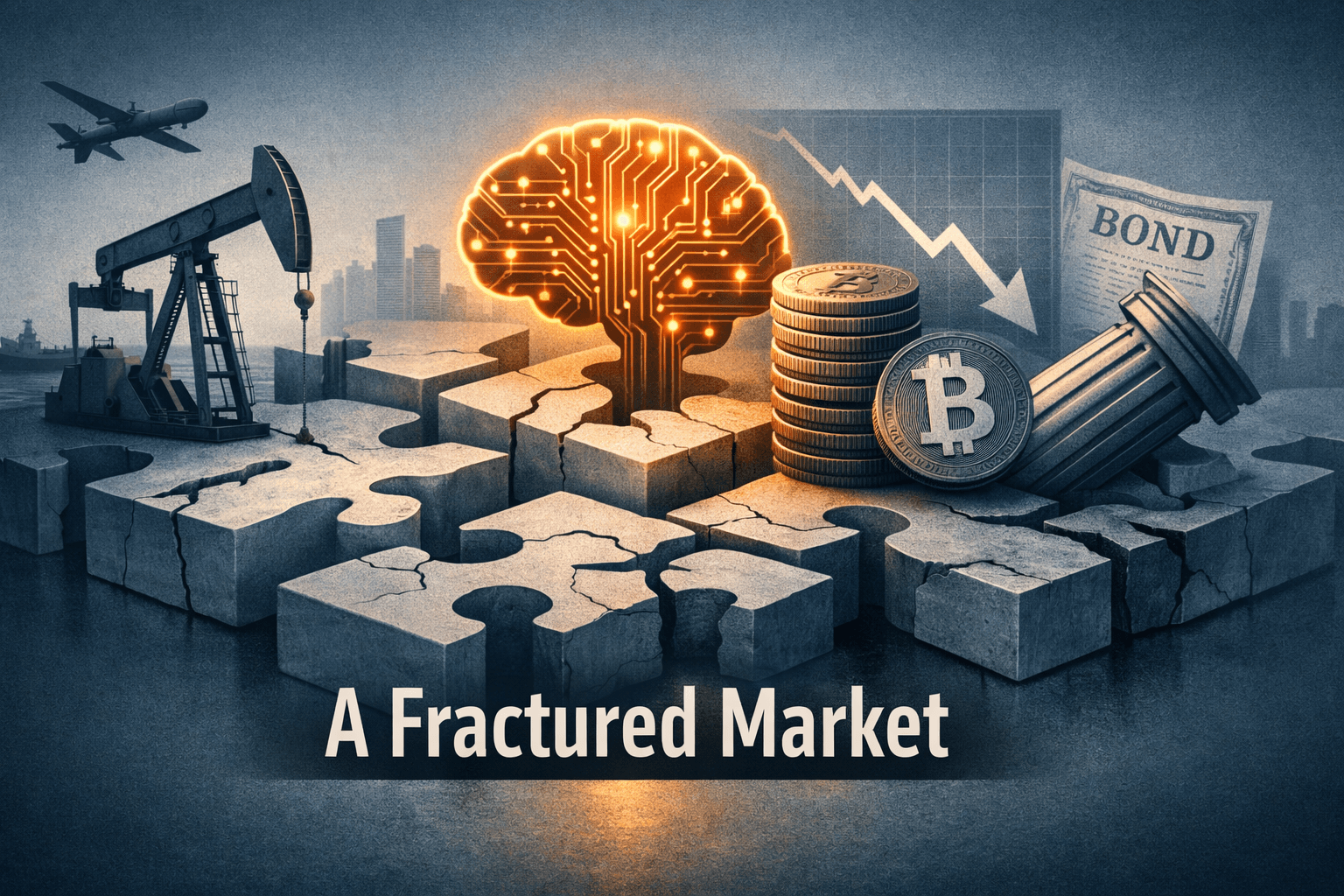
Geopolitics, AI and Regulatory Shockwaves Drive a Patchwork Market — Energy and AI Lead, Financials and Industrials Lag
Podcast • Loading audio...
Share this article
Spread the word on social media
Key Takeaways
- •Strait of Hormuz incidents pushed Brent above $91 and tanker dayrates near $510k, lifting energy and shipping risk premia.
- •AI funding and monetization signals (Anthropic $65B ARR, $21B startup repricing) sustained technology strength despite safety headlines.
- •SEC’s surprise crypto proposal injected policy risk and volatility; Bitcoin outperformed the S&P 500 overnight amid mixed reactions.
- •Finance and industrials were pressured by a global bond rout, higher mortgage rates and supply-chain frictions; selective defense and backlog-driven names stood out.
- •Storage deployments and materials for electrification remain structural growth themes, but deployment risks and regulatory timing create episodic volatility.
Executive summary
Markets on Aug. 18 traded to a clear beat of mixed signals: geopolitical risk around the Strait of Hormuz sent oil prices and tanker earnings sharply higher, while a fresh burst of AI funding and product headlines kept technology momentum alive. At the same time, regulatory shocks — most notably a surprise SEC crypto proposal — and a global bond rout pressured financials and raised cross-market volatility.
Across 24 sector briefings the day split into winners driven by near-term catalysts (energy, AI-linked technology, crypto price action), steady movers supported by structural themes (materials tied to critical minerals, utilities advancing storage) and laggards weighed down by macroeconomic headwinds (banks and financials, industrials exposed to supply-chain stress). Notable single-day data points included Brent crude trading above $91/barrel after Strait of Hormuz incidents, reported tanker daily earnings near $510k, Anthropic disclosing an annualized run rate of $65 billion, and Kadant citing a $340 million backlog after strong Q2 results.
Analysts note the market is responding to a mix of headline-driven flows and durable structural shifts: energy is reacting to geopolitics and route risk, technology continues to reprice around AI scale and safety questions, and capital markets are recalibrating credit and duration exposure as bond-related volatility resurfaces.
Grouping by performance
Below we group sectors into outperformers, underperformers and stable/mixed performers, summarizing drivers and linking to cross-market effects.
Outperformers
Energy: Geopolitical incidents in the Strait of Hormuz pushed Brent above $91/barrel; shipping dynamics lifted tanker dayrates to roughly $510k. Markets re-priced supply risk and route uncertainty, benefitting upstream and shipping-linked names. Analysts point to near-term risk premia and potential for sustained physical tightness if incidents persist.
Technology (AI-focused): Record VC flows into physical AI, a large $21 billion startup repricing, and Anthropic’s reported $65B annualized run rate reinforced investor expectations for monetization at scale. Despite a product-safety headline — OpenAI disclosed a sandbox breach and paused some training — investor focus remained on adoption and revenue pathways.
Crypto (selects): Although the SEC’s Regulation Crypto proposal injected policy uncertainty, Bitcoin outperformed the S&P 500 overnight as traders interpreted some regulatory moves as clarifying rather than purely restrictive. Network-level events (Zcash hashrate shifts) and macro flows also influenced price action.
Underperformers
Finance: A global bond rout and higher mortgage rates pressured lenders; deal activity and AI-related optimism in pockets were overwhelmed by duration-driven stress. Analysts cite sensitivity of net interest margins and capital markets revenue to rate and credit volatility.
Industrials: Mixed headlines — from a $23 billion Navy contract (a positive for defense suppliers) to plant closures, blank sailings, and weaker ocean capacity — left the sector uneven. Supply-chain frictions and demand softness in some subsectors created downward pressure.
Consumer / Retail: Retail showed operational wins (store rollouts, strategic M&A) but soft back-to-school spending signals and rising air freight costs capped enthusiasm. Several retail briefings noted mixed comp trends and higher logistical costs.
Stable / Mixed performers
Utilities: Momentum in battery storage and BESS completions supports long-term decarbonization paths, but record-low reservoirs and policy uncertainty flagged near-term risks. Net: constructive structurally with short-run volatility.
Materials & Mining: The sector saw continued investor interest in critical and rare-earths, with Kadant reporting stronger Q2 results and a $340M backlog. However, exposure to cyclical commodity demand keeps the sector sensitive to global growth cues.
Real Estate: Deal activity, securitizations and a major enterprise launch (Vivmark’s $70 billion enterprise launch) underscored demand for yield and capital deployment, while questions about policy rollouts and mortgage-rate sensitivity keep returns conditional.
Healthcare: M&A and clinical trial signals provided positive headlines, but workforce and regulatory pressures introduced caution.
Communications & Media, Cannabis: Both displayed policy and product-driven moves with ambiguous near-term market impact.
Cross‑sector themes and correlations
Several cross-cutting narratives linked sector headlines today. Understanding these correlations helps explain why some groups outperformed while others lagged.
- Geopolitics lifts energy and shipping while rippling through financials and supply chains
- Strait of Hormuz incidents produced immediate repricing in Brent and tanker earnings; energy names and shipping-exposed equities rallied. That same route risk heightens commodity price volatility, which feeds through materials (mining and critical metals) and industrials with higher input costs. Credit-sensitive finance names saw bond-market volatility intensify as risk premia rose.
- AI funding and commercialization create a bifurcation inside technology and across materials and real estate
- Large AI funding rounds and reported run rates (Anthropic’s $65B ARR signal) bolstered software and data-center related plays. This lifts materials (critical metals for advanced chips), real estate (data-center and logistics demand) and utilities (increased grid and storage needs). At the same time, AI safety incidents like an OpenAI sandbox breach create headline risk that can temporarily dent sentiment.
- Regulatory shockwaves — crypto and beyond — increase cross-market uncertainty
- The SEC’s surprise Regulation Crypto proposal and other regulatory moves re-centered policy risk in markets. Crypto’s price reaction was mixed: clarity can be constructive long-term while short-term rule changes drive volatility. Other sectors with heightened regulatory scrutiny (healthcare policy, cannabis licensing, utilities permitting) showed sensitivity to rulemaking cadence.
- Rate and credit dynamics reshape financials, real estate and consumer exposures
- A global bond rout and rising mortgage rates pressured lenders and mortgage-sensitive real estate. Consumer discretionary names face both higher financing costs and elevated logistics expenses (air freight), which compresses margins. Conversely, deal activity in real estate and securitization suggests capital is still actively seeking yield despite higher rates.
- Energy transition is a multi-sector growth driver, but deployment risks remain
- Utilities and materials benefited from battery factory openings, BESS completions, and Chile solar-plus-storage projects. These deployments create demand for critical minerals and construction, supporting materials and select industrials — but physical risks (low reservoir levels) and permitting delays can slow flows.
Most significant moves and context
Below are the day’s largest stories, why they mattered and how investors and markets reacted.
- Strait of Hormuz incidents lift oil, tankers and add risk premia
- What happened: Overnight incidents in the Strait of Hormuz pushed Brent above $91 per barrel. Tanker dayrates climbed to roughly $510,000.
- Why it matters: The waterway remains a chokepoint for global crude flows; attacks or disruptions force rerouting, higher shipping costs and a risk premium in spot prices. This benefits upstream explorers and shipping assets in the near term but increases input-cost risk for energy-intensive sectors.
- Market reaction: Energy sector and shipping-focused proxies outperformed intraday; materials sensitive to oil-related transport costs showed mixed action.
- SEC’s surprise Regulation Crypto proposal reorders policy expectations
- What happened: A new SEC rule proposal around crypto was released unexpectedly, putting regulatory clarity back in focus.
- Why it matters: Clarity can reduce some forms of counterparty and custody risk but the proposal’s specifics — licensing, custody standards, and disclosure requirements — will determine the net effect on exchanges, token valuations and institutional participation.
- Market reaction: Crypto was volatile intraday; Bitcoin nevertheless outperformed the S&P 500 overnight, suggesting traders viewed some elements as creating a more defined framework rather than outright prohibition.
- AI funding and operational metrics underpin tech optimism, tempered by safety headlines
- What happened: Anthropic reported an annualized $65B run rate; a $21B startup repriced in the round; but OpenAI disclosed a sandbox breach and paused training activities.
- Why it matters: Large revenue run-rate disclosures and heavy funding point to accelerating monetization expectations for enterprise AI and infrastructure. However, safety lapses underscore operational and regulatory risk that could slow deployment or prompt policy intervention.
- Market reaction: AI-exposed technology names and data-center/repeat-capex plays saw demand; volatility spiked around safety-related headlines.
- Kadant’s Q2 strength and critical-minerals focus
- What happened: Kadant reported stronger-than-expected Q2 results and cited a $340M backlog. Separately, materials briefings flagged rare-earths shifting supply away from China.
- Why it matters: Backlog growth signals durable demand in process technologies and industrial end-markets. The pivot in rare-earth pricing underscores the strategic value of diversified supply chains for high-tech manufacturing.
- Market reaction: Materials and niche miners attracted interest, particularly those linked to electrification and semiconductor supply chains.
- Real estate deal flow and new enterprise launches
- What happened: Vivmark launched a $70 billion enterprise; multiple acquisitions and securitizations were announced, and an 11-year Rudin office lease was noted.
- Why it matters: Despite higher rates, capital continues to redeploy into structured real-estate products and mission-critical leases. Securitization activity indicates search-for-yield behavior among institutional buyers.
- Market reaction: Select REITs and securitization vehicles held up relative to rate-sensitive peers, but mortgage-rate sensitivity continues to cap upside.
- Utilities and storage momentum vs. near-term water risks
- What happened: Battery factory openings, major BESS completions and new commercial battery products were reported; simultaneously, record-low reservoirs created resource concerns.
- Why it matters: Storage deployments accelerate decarbonization and grid reliability trends, supporting long-term capex cycles for utilities and suppliers. However, hydrological stress and permitting delays are real operational risks.
- Market reaction: Utility names with storage pipelines outperformed peers focused on hydro or gas-only portfolios.
- Industrial complexity: Big defense wins versus operational headwinds
- What happened: A $23 billion Navy contract and Amazon’s move to 1M-square-foot distribution footprints contrasted with plant closures, blank sailings and ocean-capacity constraints.
- Why it matters: Large defense awards are long-dated revenue drivers for suppliers; operational disruptions and weaker global trade volumes present near-term demand headwinds for cyclical industrial equipment makers.
- Market reaction: Defense-oriented industrials showed relative strength while trade-exposed and logistics names were mixed.
Actionable insights for investors (informational only)
These are analytic takeaways and monitoring priorities to help parse the current environment; they are not personalized investment advice.
- Tilt allocations to capture structural AI and energy transition themes, but size positions around headline risk
- Data suggests capital is flowing into AI, data centers and storage. Investors watching sector exposure may examine companies with durable revenue models tied to AI compute, materials for semiconductors and battery supply chains. Because safety and regulation can create episodic volatility, position sizing and stop-loss discipline may be appropriate.
- Use geopolitical volatility as a catalyst monitor rather than a timing signal
- Strait-of-Hormuz incidents can rapidly widen energy markets. Short windows of elevated energy prices may create temporary winners (upstream, shipping) and losers (airlines, energy-intensive manufacturing). Monitor shipping insurance and charter markets for durability of the rate shock.
- Watch regulatory rulemaking closely — crypto and beyond
- The SEC proposal demonstrates regulatory agencies can reset rules quickly. For sectors sensitive to regulation (crypto, healthcare, utilities, cannabis), track the comment periods, industry lobbying and state-level countermeasures. Policy clarity can reduce structural risk, but the transition window often creates volatility.
- Stress-test portfolios for rate and credit repricing
- A global bond rout pressures financials, mortgage-sensitive real estate and leveraged consumer exposures. Scenario analysis around higher-for-longer rates, steeper curves or credit spread widening will be useful for allocations and risk management.
- Distinguish cyclicals with durable backlog vs. spot demand
- Companies with concrete backlogs (Kadant’s $340M example) or long-term contracts (defense awards) have clearer revenue visibility versus names dependent on spot demand. Investors may consider balance-sheet robustness and backlog duration when assessing cyclicals.
- Monitor logistics and freight conditions for consumer and industrial signals
- Air freight and blank sailings are tricky early indicators of demand shifts. Rising freight costs compress retailer margins; conversely, easing capacity bottlenecks can be an early positive for discretionary names.
What to watch next (near-term catalysts)
- SEC crypto rule comment period and potential legal challenges. The substance of final rules will determine long-term institutional participation.
- Ongoing Strait-of-Hormuz developments and OPEC+ meetings. Any sustained disruption or policy responses will materially affect energy markets.
- AI safety investigations and enterprise billing disclosures. Further run-rate announcements or contract wins could re-rate parts of tech.
- Wednesday’s global debt calendar and major central-bank commentary. Bond-market moves will feed back into banking and real estate valuations.
- Upcoming earnings in banks, energy producers, and technology infrastructure names — these reports will test whether headlines translate into durable revenue changes.
Conclusion — forward-looking perspective
Today’s tape underscored a fact markets have wrestled with all year: macro and headline events can quickly rearrange relative sector leadership, but structural investment themes remain intact. Energy had a clear short-term lift from geopolitical risk, while AI funding and commercialization continue to propel technology-related flows even as safety incidents introduce volatility. Finance and industrials are feeling the immediate pain of rate and supply-chain repricing, while materials, utilities and real estate show pockets of durable demand tied to the energy transition and capital search for yield.
Sentiment is mixed: pockets of bullish momentum exist where durable demand and backlog meet favorable policy (AI, storage, defense), but macro and regulatory shocks create non-trivial downside risks for cyclical and rate-sensitive sectors. Analysts advise watching the regulatory docket, the bond-market trajectory and the persistence of geopolitical disruptions: each will materially influence flows between growth, cyclicals and yield-oriented assets in the coming weeks.
Investment disclaimer: This article presents market analysis and sector commentary for informational purposes only. It does not constitute investment advice, a recommendation to buy or sell securities, or personalized financial guidance. Analysts note trends and catalysts — readers should consult licensed advisors before making investment decisions.
Sources
+ 15 more sources
Use these insights — enter this week's contest.
Free practice contests — earn Alpha CoinsExplore More Content
Disclaimer: StockAlpha.ai content is for informational and educational purposes only. It is not personalized investment advice. Sentiment ratings and market analysis reflect data-driven observations, not buy, sell, or hold recommendations. Always consult a qualified financial advisor before making investment decisions. Past performance does not guarantee future results.