 Sector Insights
Listen to this Recap
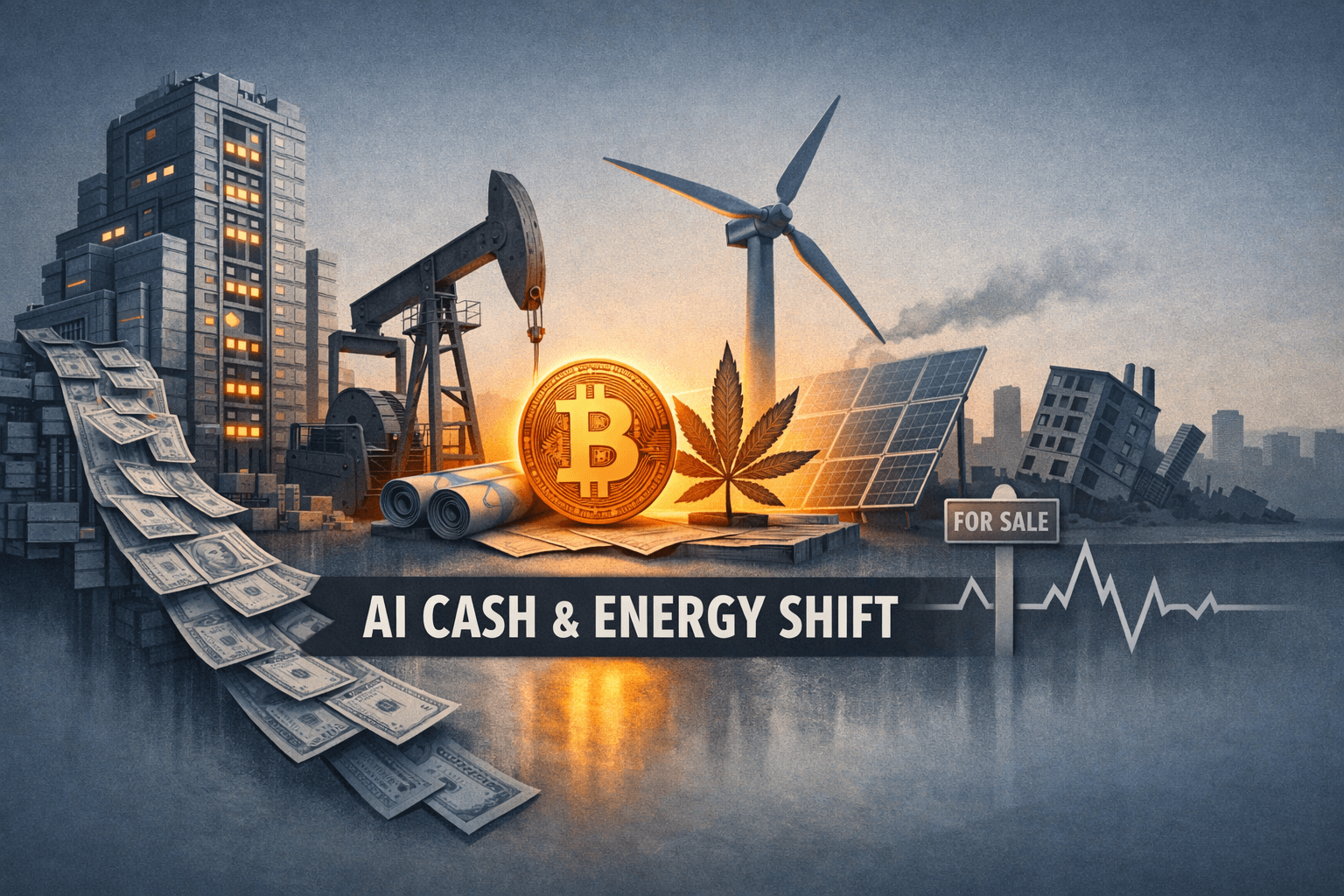
AI Cash Meets Energy Risk: A Day of Policy Wins, Project Finance and Cross‑Market Rotation — Aug. 10 Recap
Podcast • Loading audio...
Share this article
Spread the word on social media
Key Takeaways
- •AI funding expectations (a $500B infrastructure estimate) are widening investment flows into semiconductors, data centers and utilities via higher capex demand.
- •Energy saw bifurcated strength: state‑backed gas and big PV plans drove project finance while geopolitical risks keep price volatility elevated.
- •Utilities and storage financing accelerated as grid reliability concerns push capital into BESS and transmission; execution risk remains critical.
- •Policy developments eased short‑term regulatory risk for cannabis and supported crypto flows, but delayed votes and hacks keep binary outcomes on the table.
- •Real‑estate, health care and industrials carry specific operational and refinancing risks that can rapidly translate into credit stress.
Executive summary
Today’s trading tape was defined less by one dominant market move than by a constellation of policy, project‑finance and regulatory headlines that pushed investors to re‑rate risk at the sector level. Technology grabbed attention after a landmark $500 billion AI infrastructure funding report and fresh chip/robotics flow; energy saw pockets of strength tied to natural gas, LNG deals and multibillion‑dollar project commitments; utilities continued to attract capital as storage and grid resilience initiatives gained momentum. At the same time, real‑estate and health‑care headlines reminded market participants that pockets of credit and clinical risk persist, and industrials highlighted operational vulnerabilities amid rising cargo theft.
Several cross‑cutting threads stand out: policy moves (from hemp THC delays to telecom and offshore wind adjustments) temporarily reduced regulatory overhang for specific groups; large project financing commitments — Resolution Copper’s $110 million contract awards, ADNOC’s $8.2 billion gas push and Italy’s 10 GW PV plan — are reshaping capex flows into materials and energy; and flows into bitcoin‑linked ETFs and BlackRock commentary kept crypto on the radar even as regulatory and security concerns linger.
This note groups sectors by relative performance drivers, explains the primary catalysts behind the moves, highlights the most consequential developments, offers investor‑oriented takeaways, and ends with a forward‑looking checklist of catalysts to monitor.
Grouping sectors by performance
Note: Sector performance is inferred from headlines, flows and the magnitude of reported policy/project announcements reported today.
Outperformers
- Technology — Headline: $500 billion AI infrastructure funding report; meaningful robotics and chip developments; Nvidia’s centrality to AI demand drove optimism across hardware and software supply chains. Key names in focus: NVDA, CME (for crypto‑derivative flows tied to digital assets indirectly supporting infra demand), BLK (active in AI‑linked ETF products).
- Energy — Headline: natural gas and LNG earnings strength, ADNOC’s $8.2 billion gas commitment, and Italy’s 10 GW PV plan. Renewables/utility‑scale solar policy plus geopolitical supply risks (Middle East, Arctic) pushed energy real‑asset rotation.
- Utilities — Headline: accelerating storage and battery finance, transmission investment and advanced nuclear finance. Persistent grid reliability warnings combined with financing activity made the sector a capital‑attractor.
Stable / Mixed
- Finance — Headline: mixed earnings performance outside the Magnificent Seven, JPMorgan raising its S&P 500 year‑end target; FedNow adoption and payments innovation provided offsets to regulatory challenges in banking. Activity suggested selective strength but broad dispersion.
- Materials & Mining — Headline: federal commitments and DFC project finance boosted strategic minerals, while juniors face execution and supply‑chain caution. Project wins (e.g., $110 million Resolution Copper contracts) supported select names.
- Communications & Media — Headline: telecom regulatory shifts and strong results at Hutchison Hong Kong bolstered telecoms, even as content rights and creator policy changes introduced cross‑media uncertainty.
- Crypto — Headline: ETF inflows and institutional commentary signaled demand resilience, while hacks and delayed regulatory votes (e.g., CLARITY) kept regulatory overhang elevated.
- Consumer & Retail — Headline: pockets of resilience in grocery and product innovation counterbalanced store closures, leadership churn and margin pressure.
Underperformers / Areas under stress
- Real Estate — Headline: leasing and refinancing activity showed resilience but lender/liquidity risks and margin compression kept the outlook cautious.
- Health Care — Headline: clinical trial failures (a CF trial), regulatory scrutiny despite breakthroughs in genetics and neonatal HIV work created mixed sentiment with downside risk for binary outcomes.
- Industrials — Headline: rising cargo theft and supply‑chain operational risks amplified delivery and insurance exposures for manufacturers and carriers.
Cross‑sector themes and correlations
- AI spending as a cross‑sector liquidity amplifier
The $500 billion AI infrastructure funding report operates like a gravitational pull for capital: it reinforces demand for semiconductors, data‑center construction, advanced materials (for chip fabs and cooling systems), and electricity/utility services. That linkage helps explain concurrent strength in technology hardware/software and the pickup in utilities and materials financing. Analysts note that AI is not just a software story — it’s driving capex across energy, real estate (data center leasing) and materials.
- Project finance and government policy are re‑allocating capital to hard assets
Announcements such as Italy’s 10 GW PV plan, ADNOC’s $8.2 billion gas push, Resolution Copper’s $110 million construction awards and advanced nuclear financing show a near‑term tilt to projects with state or quasi‑state backing. Materials and energy companies with near‑term, shovel‑ready projects or strategic minerals exposure are benefiting from de‑risked financing; smaller juniors without the same access remain under pressure. This dynamic is increasing correlations between materials, industrials and energy as capital seeks physical‑asset returns.
- Policy wins and regulatory delays temporarily compress binary risk
Across cannabis (Senate delay on hemp THC ban; hemp lifeline) and crypto (ETF inflows, BlackRock commentary, CLARITY vote delay), policy developments reduced immediate regulatory tail risk and freed up short‑term flows. However, unresolved longer‑term policy frameworks keep volatility elevated: a delayed decision doesn’t equal a favorable one, and markets are pricing a time‑value effect rather than structural certainty.
- Geopolitics and commodity flows remain an asymmetric tail risk driver
Tanker strikes, Arctic drilling scrutiny and Middle East tensions are feeding a premium into energy and shipping uncertainty, which in turn affects industrials (supply chains), insurance, and materials pricing. Energy sector strength in natural gas and LNG today should be read alongside heightened geopolitical skew.
- Operational risk translates directly into credit and margin considerations
Real estate and industrials illustrate how operational stress — whether rising cargo theft or margin pressure for homebuilders — can quickly become a credit story. Lenders, insurers and servicers are watching default probabilities and recovery values with growing granularity, especially where refinancing needs are concentrated.
Significant moves and why they mattered
- $500 billion AI infrastructure funding report (Technology)
What happened: A high‑profile $500 billion estimate for AI infrastructure funding — encompassing data centers, chips, networking and related capex — dominated headlines and investor flows.
Why it mattered: The figure crystallizes a multi‑year capex cycle that benefits semiconductor equipment, chip designers, cloud providers, and data‑center REITs. It helps justify higher valuations for AI‑exposed names because the spending is tangible — not just end‑user software monetization. The report also acts as a positive feedback loop: announced funding plans make it easier for municipalities and utilities to plan grid upgrades, linking directly to the utilities/storage story.
- ADNOC’s $8.2 billion gas push and Italy’s 10 GW PV plan (Energy / Renewables)
What happened: Large state‑level project commitments — ADNOC’s multibillion gas investment and Italy’s 10 GW PV ambition — pushed capital into both hydrocarbons and renewable supply chains.
Why it mattered: ADNOC’s move signals that state energy actors are still allocating large sums to near‑term gas and LNG development even as renewables accelerate; this duality supports midstream and service providers while tightening the narrative that energy returns will remain bifurcated. Italy’s solar target emphasizes rapid renewables deployment in Europe, increasing demand for PV panels, mounting tape/balance‑of‑system orders and related materials.
- Utilities: storage and transmission financing acceleration (Utilities)
What happened: New financing rounds and project awards for big battery energy storage systems (BESS) and transmission upgrades were announced, alongside renewed grid‑reliability warnings.
Why it mattered: The convergence of financing availability and reliability concerns de‑risks a pipeline of storage projects, supporting equipment makers, EPC contractors and utility procurement cycles. From an investor vantage, this reduces technology adoption uncertainty and shifts focus to execution and supply chain constraints for critical minerals.
- Resolution Copper $110 million contracts and B2Gold permit (Materials / Mining)
What happened: Resolution Copper awarded $110 million in construction contracts; B2Gold secured a key permit in Mali.
Why it mattered: These project milestones show that on‑the‑ground execution continues despite broader macro caution. For materials markets, confirmed project spending can ease supply tightness expectations over time and support commodity prices for strategic minerals. Analysts caution that permitting, local politics, and slow supply‑chain rebuilding will still cap near‑term production gains.
- Crypto flows, institutional signals and regulatory friction (Crypto)
What happened: ETF inflows and institutional commentary (including from BlackRock) signaled persistent demand for bitcoin exposure, while CME leveraged funds flipped net long and a delayed CLARITY vote left regulatory outcomes uncertain.
Why it mattered: The flow dynamics underline increasing institutional adoption which can sustain price action; however, regulatory ambiguity and episodic security breaches (hacks) keep the risk premium intact. The net‑long flip at CME suggests positioning is shifting meaningfully in futures markets, increasing sensitivity to macro shocks.
- Consumer sector: AI adoption and Gen‑Z demand (Consumer & Retail)
What happened: Retailers reported resilience in staples/grocery and are leveraging AI for operations; at the same time, leadership shakeups and store closures caused uneven results.
Why it mattered: Operational AI adoption can drive margin improvement and better inventory turns for omnichannel retailers, but demographic shifts (Gen‑Z preferences) and structural real‑estate pressures create winners and losers within the sector.
- Real‑estate refinancing and lender risk (Real Estate)
What happened: Leasing activity in offices and industrial remained solid, but refinancing needs and mortgage‑sector headwinds raised lender‑risk concerns.
Why it mattered: Even with leasing strength, refinancing squeezes can increase spreads and force repricing of property valuations — a reminder that real‑estate performance is sensitive not just to cash flows but to the availability and cost of leverage.
- Health‑care trials and regulatory moves (Health Care)
What happened: A cystic fibrosis (CF) trial failure offset positive dealmaking and genetic breakthroughs; regulatory scrutiny rose for certain classes of therapeutics.
Why it mattered: Research outcomes continue to be binary drivers for health‑care equities. Trial failures can trigger large re‑ratings, while clinical successes or compelling one‑time regimens (e.g., neonatal HIV clearance work referenced today) create concentrated upside but remain contingent on regulatory timelines.
Actionable insights for investors (informational, not advice)
Reassess exposure to AI across the capital stack. The $500 billion funding signal disproportionately helps semiconductor equipment suppliers, data‑center REITs and utility/supply companies involved in large‑scale electrification. Analysts note exposure to NVDA‑led AI demand may be a multi‑year thematic rather than a near‑term earnings bump.
Monitor project finance rollouts and government guarantees. Materials and energy companies with secured offtake or public backing (e.g., ADNOC, Italy’s PV plan) are less exposed to immediate financing risk. Keep a watch on contract awards and permit milestones as hard confirmation of capital deployment.
Watch grid and storage execution risk. With utilities and storage developers moving from planning to construction, near‑term returns will hinge on supply chain execution (batteries, inverters, transformers) and permitting. Transmission bottlenecks remain a key execution risk.
Treat cannabis and crypto developments as policy‑sensitive swing exposures. Today’s hemp THC delay and ETF flows illustrate how policy headlines can alter momentum quickly. Position sizing should reflect binary outcomes: a delayed vote reduces immediate downside but doesn’t eliminate long‑term regulatory uncertainty.
Stress‑test real‑estate allocations for refinancing cycles. Even modest interest‑rate moves or widening mortgage spreads can materially affect NAVs for leveraged property owners. Analyze debt ladders and covenant triggers for concentrated exposure.
Incorporate operational risk into industrials exposure. Cargo theft and supply‑chain disruptions have direct margin and earnings impacts; companies with stronger logistics control and insurance programs will be better insulated.
For health care, focus on pipeline diversification and regulatory timetables. Binary trial readouts can dominate returns; diversification across modalities or markets helps manage idiosyncratic trial risk.
Observe positioning in derivatives as a sentiment barometer. The CME flip to net long for leveraged funds in bitcoin suggests changing risk appetite among professional traders — an important gauge for crypto volatility ahead.
What to watch next — catalysts and risk events
- Policy votes and hearings: Any definitive votes on hemp THC, the CLARITY regulatory framework for crypto, offshore wind policy adjustments and other legislative moves could swing pockets of risk.
- Project finance milestones: Contract awards, construction starts and permitting (Resolution Copper, B2Gold, Italy PV projects, ADNOC developments) will determine whether announced plans convert to realized capex.
- Earnings and guidance season: Outside the Magnificent Seven, bank and energy earnings will be scrutinized for credit trends, commodity realizations and capex plans that affect sector allocations.
- Security and regulatory incidents in crypto: Hacks or enforcement actions can produce rapid repricing given the still‑fragmented oversight landscape.
- Grid reliability indicators and extreme weather: Any disruption (heat waves, storms) that triggers brownouts can accelerate storage demand or reveal transmission weak points.
Conclusion — forward‑looking perspective
Today’s market action reflects a bifurcated economy: large‑scale, policy‑backed capex (AI infrastructure, energy project finance and grid investment) is pulling capital into technology, energy and utilities, while credit and operational fragilities are keeping a lid on real estate, certain segments of health care and industrial supply chains. The net effect is a market that looks constructive for sectors tied to long‑dated infrastructure and AI spending but remains vulnerable to idiosyncratic, binary risks — regulatory votes, trial readouts, and execution on construction and supply chains.
Investors and analysts will therefore need to balance thematic allocations toward AI and hard‑asset projects with active monitoring of refinancing cycles, regulatory calendars and operational execution. Market momentum today favors capital‑intensive, policy‑aligned sectors, but volatility will remain elevated around the many binary outcomes still in play.
Investment disclaimer: This article is for informational purposes only. It does not constitute investment advice or a recommendation to buy, sell or hold any security. Readers should consult a qualified financial advisor about their personal circumstances. Analysts note that sentiment ratings and sector observations reflect publicly reported headlines and market flows, not personalized guidance.
Sources
+ 13 more sources
Use these insights — enter this week's contest.
Free practice contests — earn Alpha CoinsExplore More Content
Disclaimer: StockAlpha.ai content is for informational and educational purposes only. It is not personalized investment advice. Sentiment ratings and market analysis reflect data-driven observations, not buy, sell, or hold recommendations. Always consult a qualified financial advisor before making investment decisions. Past performance does not guarantee future results.