 Sector Insights
Listen to this Recap
12:00
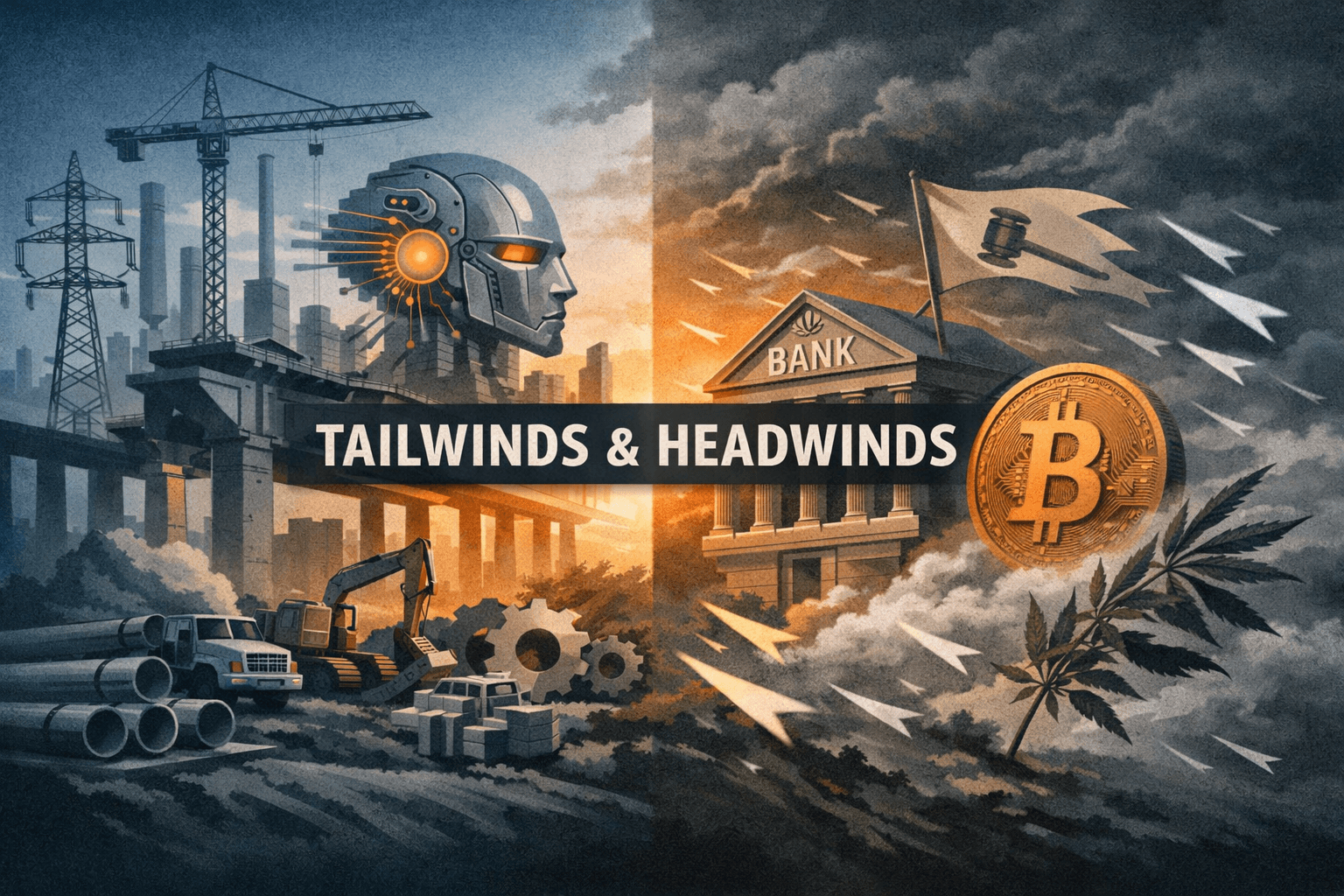
Infrastructure, AI and Regulatory Crosswinds Define the Tape: Utilities, Industrials and Materials Lead While Banks and Crypto Face Headwinds
Podcast • Loading audio...
Share this article
Spread the word on social media
Key Takeaways
- •Infrastructure and capex stories (utilities, industrials, materials) dominated the day, driven by large projects and long-term contracts.
- •Regulatory and liquidity risks weighed on finance, crypto and cannabis—Banc of California’s $251.3M loss and $526M in Bitcoin ETF outflows were notable stress signals.
- •AI is a cross-sector driver: from Microsoft’s $60M nuclear AI pledge to consumer and retail automation initiatives, shifting capex and operational priorities.
- •Regional policy divergence (state cannabis rules, FDA panels) is creating idiosyncratic winners and losers — monitor calendars closely.
- •ETF flows and balance-sheet metrics are practical, near-term risk indicators for volatile, flow-sensitive sectors.
Executive summary
Markets opened and traded under a theme of pragmatic re-allocation: long-horizon infrastructure and industrial exposure attracted attention while pockets of regulatory and liquidity risk forced caution in finance, crypto and regulated consumer sectors. Large, publicized infrastructure plans — a Brookfield and NEE-led $100 billion Paducah data center concept with 4.6 GW of dedicated generation, DOE picks for nuclear fuel-cycle hubs, and a raft of solar PPAs and supply wins — anchored a constructive tone for utilities, energy and materials. At the same time, headline losses and activism in regional banking ($251.3 million loss reported at Banc of California) and notable outflows from spot Bitcoin ETFs ($526 million) tempered enthusiasm for financials and crypto.
AI threads ran across sectors: Microsoft pledged $60 million for nuclear AI work; technology firms announced model updates and device plans; consumer and retail firms rolled out AI-driven loyalty and automation initiatives. These cross-sector AI moves are changing capex and operational priorities, supporting names in tech, industrials (automation and supply-chain tech) and consumer-facing firms pursuing digital sales. Regulatory divergence — visible in cannabis policy flips between states (California enabling RFID self-checkout, Texas reinstating a delta‑8 ban with felony enforcement) and in active FDA and payer scrutiny in healthcare — produced localized volatility.
Taken together, the day’s tape favors sectors tied to durable physical investment (utilities, industrials, materials, select energy) and sensitive to policy or liquidity shocks (finance, crypto, cannabis). Technology and consumer remain differentiated: headline-driven winners and losers within each group rather than broad-sector moves.
Grouping by performance: outperformers, underperformers, and stable sectors
Note: public summaries did not provide intraday index percentages for every sector. Groupings below synthesize the breadth and frequency of positive catalysts versus headwinds reported across the day’s sector briefs.
Outperformers
- Utilities: Multiple large-scale projects and corporate commitments — Brookfield/NEE $100B Paducah plan with 4.6 GW of dedicated generation, Microsoft’s $60M nuclear AI support, and Tesla’s 509-MW solar + 1.4-GWh PPA — provided several concrete creditable catalysts for asset owners, project developers and regulated utilities. Policy and DOE hub picks added to the constructive narrative.
- Industrials & Manufacturing: Defense contract awards, prototype wins, record steel quarters (Nucor), logistics expansions and federal Manufacturing Extension Program funding pointed to durable demand and backlog visibility for industrials and 3PLs.
- Materials & Mining: A spate of deals and project milestones from rare-earth tie-ups (Meteoric and POSCO in Brazil) to metallurgical test wins and recycled-aluminum agreements for autos supported positive sentiment for miners and materials suppliers.
Underperformers
- Finance & Banking: Regional bank pressure intensified after Banc of California posted a surprise $251.3M loss and activist pressure on a small Washington bank surfaced. These developments drew attention back to balance-sheet quality and concentration risks in smaller banks.
- Cryptocurrency: Overall flat price action in spot crypto markets following a Federal Reserve pause masked important flow dynamics — spot Bitcoin ETFs registered $526M of outflows — plus regulatory fights (e.g., CLARITY Act) and geopolitical/legal noise.
- Cannabis: Mixed legal and policy developments — California approving RFID self-checkout (incremental retail efficiency) versus Texas reinstating a delta‑8 ban and felony enforcement — created bifurcated outcomes and regulatory risk for operators.
Stable / Mixed
- Technology: Headlines mixed between AI model upgrades and platform device plans on the one hand, and a security incident and product skepticism on the other. Net: selective winners; broad indices largely range-bound.
- Consumer & Retail: Momentum in AI tools, loyalty programs and automation contrasted with grocer price wars and share loss. Winners will be the digitally native and high-margin brands; legacy grocers face margin pressure.
- Energy & Renewables: A split tape — big wins for nuclear-related funding and project approvals, fossil-oriented gains from shipping and EPC contracts, but China’s solar demand softening into 2026 introduces uncertainty for suppliers.
- Healthcare: Mixed as biotech partnerships and reverse-merger activity drive deal headlines while regulatory scrutiny and payer pressures introduce volatility.
- Real Estate & Communications: Active deal flow and portfolio trades in real estate point to continued private-public capital movement; communications saw content catalysts mixed with reputational risk.
Cross-sector themes and correlations to watch
Infrastructure meets AI: The day highlighted that physical infrastructure spending and AI investment are not mutually exclusive. Microsoft’s $60M nuclear AI initiative and utility-level commitments to dedicated generation for data center buildouts show AI demand is funneling into power, grid and big‑capex projects. Expect cascading procurement, copper and transformer demand and a longer horizon of contracted power purchase activity.
Capex-heavy sectors gaining relative preference: Industrials, materials and utilities posted tangible project and contract news that improve visibility on multi-year revenue backlogs. Where companies can sign long-term PPAs or secure government-backed funding, earnings predictability rises — a positive offset to cyclical slowdown worries.
Regulatory divergence equals idiosyncratic risk: Cannabis and crypto headlines showed how local or jurisdictional policy choices can dominate sector performance. For cannabis, statewide rules (California vs Texas) materially change retail economics and compliance costs; for crypto, ETF flows and the evolving regulatory framework (U.S. and Europe) continue to govern liquidity more than macro alone.
Liquidity and capital-allocation scrutiny in finance: The Banc of California loss and activist calls reflect ongoing scrutiny of capital allocation and the vulnerability of smaller banks to deposit and credit shocks. Index concentration debates in finance are pushing analysts to re‑examine stress cases and capital buffers.
Supply-chain reconfiguration and materials sourcing: Rare-earth and recycled-aluminum stories reflect a broader push for supply diversification and onshoring. These moves correlate with industrial and defense spending and will have medium-term implications for metals pricing and miner valuations.
Earnings and buybacks still moving energy and large caps: Eni’s decision to raise its 2026 buyback after a Q2 beat underscores how earnings beats and capital allocation changes continue to be a driver, especially in energy where cashflow visibility can shift quickly with commodity prices and project wins.
The day’s most significant moves — context and implications
Below are the moves that carried the most cross-market weight, and why they matter beyond their immediate headlines.
Brookfield and NEE-led $100B Paducah data center proposal and 4.6 GW of dedicated generation
- Why it matters: A combined $100 billion-scale project would be a multi-year engine for power demand, construction, materials, grid upgrades and data-center services. The inclusion of 4.6 GW of dedicated generation suggests advanced contracting for generation capacity and long-term PPA structures with implications for utilities, independent power producers and transmission developers.
- Cross-sector impact: Materials (steel, copper), utilities (generation and distribution), industrials (construction, EPC), and real estate (land and zoning) are all in scope.
DOE nuclear hub selections and Microsoft’s $60M nuclear AI pledge
- Why it matters: DOE picks for nuclear fuel-cycle hubs plus private-sector investments in nuclear AI represent a push to restore certain parts of the nuclear supply chain. Microsoft’s $60M earmark for nuclear AI signals enterprise-tech capital flowing into heavy industry modernization.
- Cross-sector impact: Utilities, energy engineering firms, specialized software providers and industrials with nuclear experience stand to see multi-year demand. The political and permitting landscape will remain a gating factor.
Banc of California’s surprise $251.3M loss and activist pressure in regional banking
- Why it matters: A headline-sized loss in a regional bank re-opens scrutiny of credit risk, interest-rate exposure, and excess concentration in non-core lending segments. Activist pressure on smaller banks heightens the chance of M&A or balance-sheet fixes.
- Cross-sector impact: Financials broadly, regional bank equity and fixed income, and sectors reliant on regional credit (commercial real estate, small-business lending) face renewed caution.
Spot Bitcoin ETF outflows of $526M
- Why it matters: Outflows from spot Bitcoin ETFs indicate short-term liquidity rotation out of crypto products even as spot prices held flat after the Fed pause. ETF flows are a real-time proxy for retail and institutional sentiment and can amplify price moves in illiquid markets.
- Cross-sector impact: Crypto-adjacent equities (miners, exchanges), fintech platforms, and ETF providers will feel the spin; persistent outflows could pressure protocols and raise funding costs for crypto businesses.
Meteoric and POSCO rare-earth tie-up in Brazil; recycled-aluminum supply agreements
- Why it matters: Deals to secure strategic and critical minerals — rare earths particularly — underscore a race to lock down supplies for EVs, renewables and defense. Recycled-aluminum deals point to OEMs’ push for arbnets and cost control.
- Cross-sector impact: Materials & mining, auto suppliers, renewable equipment manufacturers, and defense supply chains where critical-mineral security is critical.
Tesla’s 509-MW solar + 1.4-GWh PPA and other renewable PPAs
- Why it matters: Large PPAs like these are commercially significant for project developers and signal continued corporate demand for renewables, even amidst broader uncertainty in China’s solar market.
- Cross-sector impact: Renewable developers, inverter and module makers (sensitive to China demand), and utilities with PPA exposure.
Eni raises its 2026 buyback after a Q2 beat; Gulf refinery consortium proposal
- Why it matters: Energy majors turning strong cashflow into buybacks demonstrates the linkage between commodity performance and shareholder returns. The $5B Gulf refinery proposal indicates continued appetite for traditional refining assets where margins are attractive.
- Cross-sector impact: Oil & gas, refining services, shipping, and companies exposed to refining throughput.
Consumer moves: Coca-Cola volume growth and Conagra’s $125M plan
- Why it matters: Coca-Cola’s volume jump is a rare macro-consistent sign of resilient consumer demand for staple brands. Conagra’s $125M initiative is an example of CPG companies investing for efficiency and top-line programs in a pressured grocery environment.
- Cross-sector impact: Consumer staples, packaged-foods suppliers, grocery retail margins and marketing/innovation spend patterns.
Healthcare: Centene surprise profit and guidance lift; Capricor faces an FDA advisory panel
- Why it matters: Outperformance at a major payer like Centene lifts some sentiment in managed-care names but the risk is underscored by biotech regulatory events (Capricor) where FDA panels can dramatically rerate small-cap names.
- Cross-sector impact: Healthcare insurers, managed-care providers, and small/mid-cap biotech names undergoing regulatory scrutiny.
Actionable (non‑prescriptive) insights for investors
Below are pragmatic points for portfolio managers, allocators and market participants to consider as they digest the mix of infrastructure spending, AI integration and regulatory noise. These are informational and not individualized investment advice.
Reassess exposure to capex and order-book visibility
- Data points: Brookfield/NEE Paducah concept, Nucor’s record steel quarter and multi‑GW PPAs.
- Why: Sectors with visible multi-year revenue (utilities with PPAs, industrials with multi-year contracts, materials with long-term offtake) generally offer clearer cashflow visibility in a cyclical slowdown. Analysts note that clearing backlog and contract cover can cushion near-term margins.
Monitor liquidity metrics and deposit trends in regional banking
- Data points: Banc of California $251.3M loss; activist activity in small Washington bank.
- Why: Banks with concentrated commercial real estate exposure or volatile deposit bases may face cost-of-capital and funding strains earlier. Momentum indicates M&A or capital raises could surface where losses are material.
Treat ETF flows as a real-time risk overlay for niche asset classes
- Data points: Spot Bitcoin ETFs saw $526M of outflows.
- Why: For sectors where price action is flow-sensitive (crypto, thematic ETFs), tracking daily flows provides a leading indicator of sentiment; large or persistent outflows can trigger multiple-day volatility.
Watch regulatory calendars and state-level policy divergence
- Data points: California RFID self-checkout approval vs Texas delta‑8 ban reinstatement; FDA advisory panel for Capricor.
- Why: Active, jurisdiction-specific policy can create idiosyncratic winners and losers. Investors should incorporate policy binary risk into valuation scenarios for affected companies.
Read AI headlines through a capex and margin lens
- Data points: Microsoft $60M nuclear AI pledge; consumer firms rolling out AI-driven loyalty/automation.
- Why: AI moves that materially change op-ex or capex should be treated as fundamental events (reducing labor costs, increasing automation) rather than pure sentiment. Evaluate whether AI initiatives are likely to be one-time investments or sustainable margin drivers.
Account for China/Asia demand cycles in renewables and materials
- Data points: China solar demand projected to shrink into 2026; module and upstream suppliers vulnerable.
- Why: Commodity and component prices are influenced by regional demand shifts. Materials and renewables manufacturers with exposure to China’s demand will see earnings volatility tied to policy and installation cycles.
Keep a balanced watchlist of macro catalysts
- Items to watch: Upcoming Fed guidance and any market reaction to policy; earnings from big banks and energy majors; DOE implementation milestones for nuclear hubs; major biotech regulatory panels; and consecutive days of ETF flows in crypto.
Sector-specific watch points
- Utilities: Track permitting and interconnection timelines for GW-scale projects, rate-case signals, and PPA counterparties. Utility capex visibility will be a multi-quarter story.
- Industrials: Focus on backlog conversion rates, defense prototype-to-production awards, and supply-chain automation adopters.
- Materials & Mining: Monitor feasibilities and metallurgical test confirmations, along with geopolitical developments affecting rare-earth trade.
- Finance: Watch credit metrics, deposit flows, and activist filings for insights into consolidation or recapitalization risk.
- Technology: Prioritize security posture disclosures after incidents and revenue impact discussions tied to AI product adoption.
- Energy: Follow regional demand signals (China solar) and capital-allocation moves at majors (buybacks, dividend updates).
- Crypto: Pay attention to ETF flow trends, regulatory guidance, and derivative market positioning for signs of systemic stress.
- Healthcare: Track FDA calendars and payer guidance for implications on near-term valuations.
- Cannabis: Model out jurisdiction-by-jurisdiction regulatory risk and retail cost-of-compliance where laws diverge.
Important investment disclaimer (read carefully)
This analysis is for informational purposes only. It does not constitute a recommendation to buy, sell, or hold any security or to pursue any investment strategy. It is not personalized investment advice. Analysts note trends, flows, and catalysts; readers should consult their own financial, tax and legal advisors before making investment decisions.
Conclusion — forward-looking perspective
Today’s tape reinforced a bifurcated market structure: sectors dependent on long-term capex and government-backed projects (utilities, industrials, materials) are attracting positive technical and fundamental interest, while sectors exposed to regulatory uncertainty or liquidity sensitivity (regional banks, crypto, cannabis) face episodic pressure. AI remains the connective tissue across industries, increasingly directing capex and operational spending into both cloud and physical infrastructure.
Over the coming weeks, three catalysts will likely drive cross‑market re-rating: incoming earnings and buyback announcements from cyclical and energy names, regulatory calendars (state cannabis rulings, FDA advisory panels, and crypto rule-making), and persistent ETF flow patterns in crypto and thematic strategies. If capex-backed sectors continue to produce visibility on multi-year contracts and backlog conversion, analysts expect that investor allocation may tilt toward durable cashflow stories. Conversely, renewed stress in bank earnings or accelerating ETF outflows could re‑energize risk-off moves.
Bottom line: momentum currently favors companies with visible multi-year revenue streams tied to infrastructure and industrial renewal, but investors should account for policy-driven idiosyncratic shocks and monitor liquidity flows as a real-time risk signal.
Key catalysts to watch this week: further PPA announcements, DOE implementation notes on nuclear hubs, any regulatory rulings impacting delta‑8 or cannabis retailing, continuing ETF flow reports for crypto, and bank earnings/credit metrics.
Sources
+ 13 more sources
Use these insights — enter this week's contest.
Free practice contests — earn Alpha CoinsExplore More Content
Disclaimer: StockAlpha.ai content is for informational and educational purposes only. It is not personalized investment advice. Sentiment ratings and market analysis reflect data-driven observations, not buy, sell, or hold recommendations. Always consult a qualified financial advisor before making investment decisions. Past performance does not guarantee future results.