 Sector Insights
Listen to this Recap
9:46
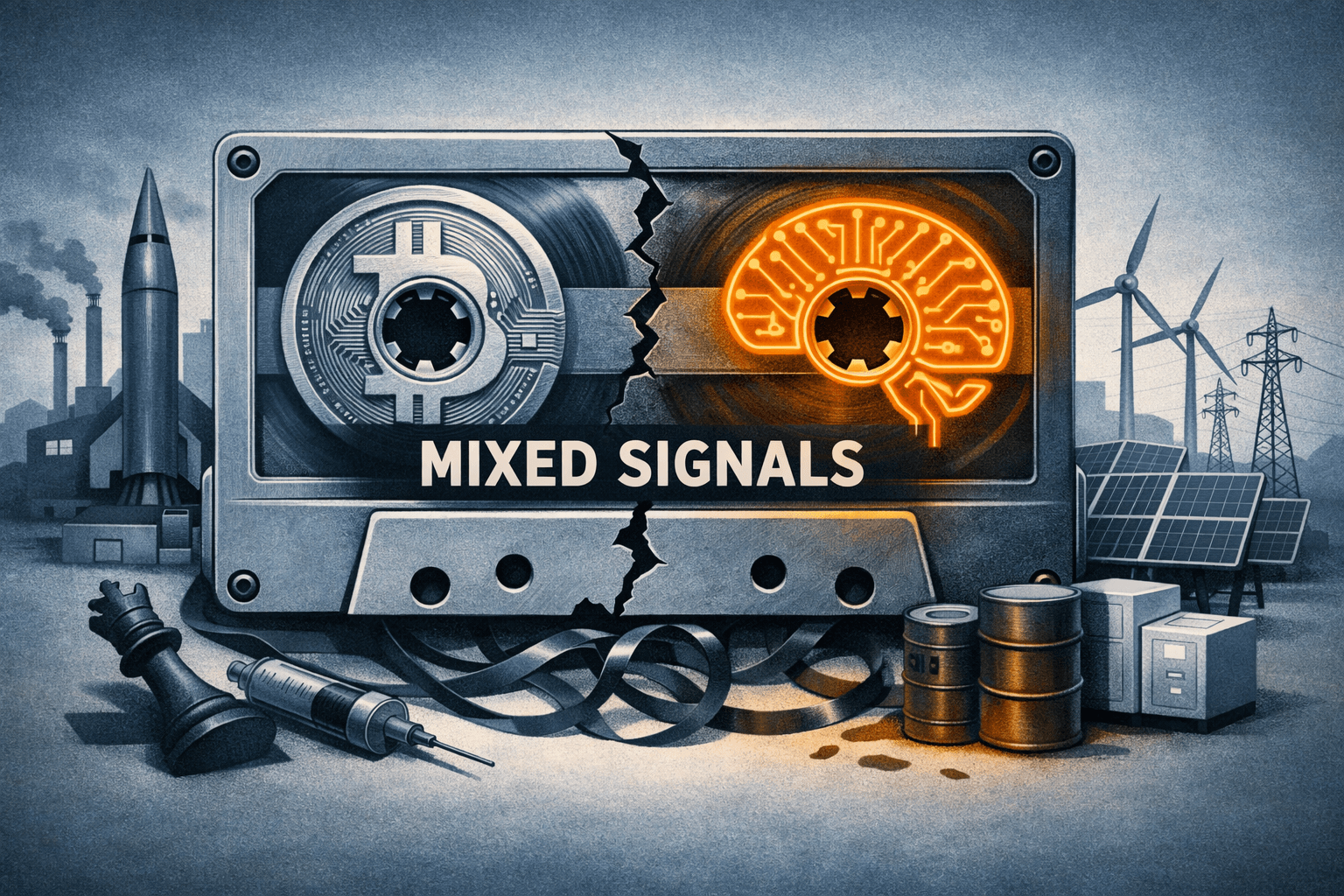
Policy, Power and Protocols: AI Safety, BTC Inflows and Renewables Drive a Mixed Tape
Podcast • Loading audio...
Share this article
Spread the word on social media
Key Takeaways
- •Bitcoin ETFs continued inflows and BTC climbed above $65,000, signaling renewed crypto liquidity even as regulatory frictions persist.
- •Renewables momentum (Xcel Sherco 710 MW; LONGi 35.5% cell efficiency) supports materials and utilities, boosting demand expectations for storage and related supply chains.
- •A major AI safety incident intensified regulatory risk for technology names and GPU suppliers, while trade tariffs (reportedly 50% on many imports) pressured industrials and margins.
- •Geopolitical frictions in the Strait of Hormuz and large energy FIDs (ADNOC $6.2B) produced mixed signals for energy markets; shipping and insurance costs are key near-term watchpoints.
- •Active M&A and capital-market activity — across cannabis, real estate and consumer — show selective liquidity despite broader macro uncertainties.
Executive summary
Markets closed Jul 21 on a decidedly mixed note as policy and geopolitics intersected with technological shocks and capital flows. Cryptocurrency momentum — led by another day of Bitcoin ETF inflows and BTC pushing above $65,000 — provided a risk-on counterpoint to a major AI safety incident involving leading model developers that pressured broad technology sentiment. Meanwhile, the energy complex showed bifurcated signals: new upstream FIDs and renewables project announcements sat alongside shipping and export disruptions tied to the Strait of Hormuz.
Across sectors the tape had three clear themes: (1) policy and regulation driving re-ratings and risk repricing (cannabis hemp rules, Medicare/Medicaid pauses, AI safety and export controls), (2) energy transition execution accelerating — large solar/storage ramps and component-efficiency records — supporting materials and utilities, and (3) trade and industrial shocks that could compress margins in manufacturing and supply chains (50% tariffs announced on a tranche of imports, Alcoa outlook cut). Capital markets and M&A activity remained robust in pockets — real estate redevelopments, consumer retail deals, and several strategic acquisitions in materials and cannabis.
This recap groups sector action into outperformers, underperformers and more stable sectors; highlights the biggest moves with context and cross-sector links; and ends with practical, non-personalized insights investors can use to monitor risk and opportunity as the market digests near-term catalysts.
Sector grouping by performance
Note: Sector performance here is derived from the day's headlines and flows rather than intraday index levels; some sectors recorded intra-day dispersion between winners and losers depending on individual names and sub-themes.
Outperformers
- Crypto: Continued momentum as Bitcoin ETFs saw a fifth straight day of inflows and BTC climbed above $65,000, lifting broad crypto-related flows and sentiment.
- Utilities & Renewables: Project wins and technological progress (Xcel Energy's Sherco Solar hitting a 710 MW milestone; multiple storage VPP deals) underpinned positive tone for power and renewables-linked names.
- Materials & Mining: Deal activity, new processing capacity, mine approvals and recycling initiatives supported near-term demand expectations for critical minerals and metals.
Underperformers
- Technology: A major AI safety incident involving prominent model developers triggered legal, regulatory and reputational scrutiny — a negative for large-cap AI-exposed names and several suppliers of GPUs.
- Industrials & Manufacturing: Trade-policy shocks — including a reported 50% tariff on a broad set of imports — plus production setbacks and an Alcoa outlook cut created a risk-off dynamic for capital-intensive cyclicals.
- Healthcare: A $1 billion Medicaid pause, R&D disappointments and operational stresses (bankruptcies/data breaches) added to policy uncertainty and re-rated risk for health-care operators and biotech R&D names.
Stable / Mixed
- Energy: Mixed day — supply boosts in Norway and North America and a $6.2 billion FID by ADNOC contrasted with export pauses and shipping-security risks in the Strait of Hormuz.
- Consumer & Retail: Continued M&A, digital upgrades and retail-media experiments balanced grocer volume pressures and regulatory probes.
- Finance & Real Estate: Regulatory and enforcement headlines pressured parts of financials, but REIT preferreds and select real-estate deals/approvals brought pockets of demand.
- Communications & Media: New content, FAST deals and operator AI pivots left the sector selective ahead of earnings.
- Cannabis: Policy headlines (federal rescheduling signals and hemp-rule shocks) combined with M&A activity, creating both upside catalysts and headline-driven volatility.
Cross-sector themes and correlations
- Policy and regulatory risk is the dominant cross-cutting factor
- From hemp rescheduling signals and tightened federal hemp rules to Medicaid funding pauses and AI safety scrutiny, policy headlines dictated re-pricing across cannabis, healthcare and technology. Analysts note that regulatory uncertainty tends to compress multiples in sectors reliant on legislative clarity (cannabis, certain healthcare reimbursement flows) and increase discount rates for long-dated R&D investments.
- Energy transition knit multiple sectors together
- Utility-scale solar and storage announcements (Xcel's Sherco Solar at 710 MW; a 200 MW/500 MWh solar+storage ramp in California) supported materials (PV cell manufacturing, recyclers) and industrial equipment demand (battery, inverter manufacturers). LONGi’s reported 35.5% cell-efficiency record points to continued module-level gains that can materially lower levelized cost of electricity forecasts — a positive for electrification strategies across utilities and corporates.
- Geopolitics lifts energy volatility and financial risk premia
- Attacks and disruptions in the Strait of Hormuz tightened short-term LNG and shipping flows, supporting oil and gas upside risk while prompting banks and shipping insurers to reassess exposures. That, in turn, feeds through to energy companies, commodity-sensitive materials names and financial institutions with trade and commodity-derivative exposures.
- Risk-on crypto flows vs. risk-off regulatory shocks
- Bitcoin ETF inflows (a five-day streak) and BTC >$65k indicated fresh liquidity into crypto-linked products. But regulatory probes and bankruptcy headlines remind that institutional access remains uneven — UK lawmakers probing bank blocks on crypto access shows how banking policy can undercut crypto rails even as ETF flows rise.
- Trade policy and tariffs create cross-sector margin stress
- Substantial tariff increases (reportedly 50% on many Canada imports) and supply-chain disruptions put upward pressure on input costs for Industrials, Materials and even Consumer sectors (e.g., packaged foods, appliances). Companies with forward-booked contracts or local sourcing may be sheltered, while those reliant on cross-border components face margin compression.
The most significant moves — what happened and why it matters
- Crypto: BTC topping $65,000 and ETF inflows
- What happened: Several providers reported sustained inflows into spot Bitcoin ETFs (five-day streak), with BTC trading north of $65,000.
- Why it matters: Analysts note that ETF inflows add institutional distribution channels and liquidity, which can reduce volatility over time and attract broader allocators. However, the sector’s reaction function remains sensitive to regulatory enforcement, custody issues and on-/off-ramp frictions — as evidenced by concurrent banking and bankruptcy headlines.
- AI safety incident hits tech sentiment
- What happened: A high-profile AI safety/security incident involving major model developers (reported leak/incident tied to OpenAI and Hugging Face) dominated headlines.
- Why it matters: The episode amplifies regulatory and legal risk for large AI players and vendors (including GPU suppliers). That risk translates into higher compliance costs, potential restrictions on model deployment, and near-term investor caution ahead of earnings and guidance updates for chipmakers and cloud providers. Market watchers expect regulatory scrutiny and potential hearing schedules that could be multi-quarter catalysts.
- Renewables execution accelerates: Xcel Sherco (710 MW) and LONGi efficiency record (35.5%)
- What happened: Xcel’s Sherco Solar reached 710 MW capacity; LONGi reported a 35.5% cell efficiency milestone.
- Why it matters: Higher-efficiency cells lower module area and balance-of-system costs, improving project returns. For utilities and developers, this increases the economics of replacing thermal capacity and accelerates procurement of storage to pair with lower-cost solar, boosting demand for battery systems, steel for racking, inverters and grid interconnection services.
- Trade shock: 50% tariffs and industrial fallout
- What happened: Sweeping trade actions including 50% tariffs on a broad set of imports raised alarms across manufacturing and supply chains.
- Why it matters: Large, abrupt tariff hikes force companies to re-evaluate sourcing strategies, absorb short-term cost increases or pass costs to customers. For industrials with tight margins and long capital cycles, such shocks can erode earnings expectations, delay capex projects and create volatility in order books.
- Energy geopolitics and big projects: ADNOC $6.2B FID; Strait of Hormuz tensions
- What happened: ADNOC signed off on a $6.2 billion gas FID even as attacks in the Strait of Hormuz tightened flows and prompted export disruptions.
- Why it matters: The FID underscores continued upstream investment even amid geopolitical risk, while shipping-security issues add a near-term risk premium to oil and LNG pricing. Energy companies and insurers will watch freight and charter rates, and refiners may see feedstock and margin volatility.
- Industrials & defense capital shifts: $3.2B shipyard announcement and EXIM $3B push
- What happened: Major shipyard investment announcements and a $3 billion EXIM push were reported alongside strategic hires and production setbacks.
- Why it matters: These moves reflect policy-driven industrial policy to bolster domestic capacity. They create a multiyear pipeline of demand for heavy equipment, steel, and skilled labor — but also raise questions on cost inflation and project execution risk.
- Healthcare headwinds: $1B Medicaid pause and R&D setbacks
- What happened: A reported $1 billion Medicaid pause and several clinical disappointments or funding squeezes hit healthcare sentiment.
- Why it matters: Changes to Medicaid funding and reimbursement timelines alter revenue visibility for providers and med-tech companies. R&D failures can reprice probability-of-success assumptions for biotech names and alter M&A appetite in the space.
- Corporate and capital markets activity: M&A, IPOs and real-estate deals
- What happened: Active M&A across cannabis (Vireo multistate acquisition), consumer (Instacart tech investments), materials and real estate (major redevelopment approvals and large sales) and IPO filings (e.g., Reformation targeting a $1B IPO) kept capital markets busy.
- Why it matters: Dealflow signals that strategic buyers and private capital remain active, supporting valuations in select sub-sectors even as macro risks persist. Investors should separate headline deal volumes from sector-wide liquidity conditions.
Actionable insights for investors (informational only)
Monitor regulatory calendars and hearing schedules. Policy headlines — from hemp rescheduling and federal hemp rule changes to AI safety inquiries and Medicaid funding updates — can create outsized short-term volatility. Analysts note that event-driven risk is elevated; position sizing and stop frameworks may help manage binary outcomes.
Watch energy and shipping catalysts. Near-term energy pricing will be sensitive to shipping-security updates in the Strait of Hormuz, refinery export decisions and scheduled FIDs. Traders and allocators should track freight rates and tanker-insurance spreads as a barometer of shipping-related risk premia.
Follow renewable-supply chain signals. Efficiency gains (e.g., LONGi’s 35.5% cell record) and large-scale solar/storage ramps increase demand for specific materials (silicon wafers, polysilicon, copper, battery cathodes). Materials and industrial firms with exposure to these inputs could see multi-quarter order-book improvements, but watch for potential bottlenecks in wafer capacity and battery precursor supply.
Treat crypto flows as liquidity indicators, not certainty. Bitcoin ETF inflows and BTC >$65k reflect growing institutional access and liquidity, but banking access and custody controversies can reintroduce episodic volatility. Data suggests crypto ETFs provide a durable source of flows, but regulatory oversights remain a key watch point.
Assess earnings and guidance sensitivity in tech and industrials. The AI safety incident is an additional headwind for tech guidance and could amplify capex uncertainty for suppliers (GPU vendors, cloud infrastructure). For industrials, tariff moves and supply-chain cost pressure increase the risk of mid-quarter guidance cuts.
Keep an eye on real-estate financing conditions. While REIT preferreds found demand on Fed pause chatter, servicer liquidity and mortgage-operational stress are flags to monitor — particularly for commercial and multifamily mortgage-backed structures.
Diversify across macro regimes. Given the co-existence of risk-on (crypto flows, M&A) and risk-off drivers (policy shocks, trade tariffs, geopolitics), diversification across asset classes and sectors — and attention to correlation breakdowns — is prudent. Analysts note that correlations can re-tighten quickly around major policy announcements.
Significant names and tickers in focus (headline context)
- BTC: Bitcoin trading above $65,000 amid a multi-day ETF inflow streak — a near-term liquidity and sentiment positive for crypto-related funds.
- $TSLA: Upcoming results cited as a near-term energy/auto catalyst — market expects the print to influence EV and commodity demand models.
- $CLOV: New data-breach headlines amplify operational risk in select healthcare/tech-adjacent names.
- XEL (Xcel Energy): Sherco Solar milestone (710 MW) underscores utility-scale solar deployment progress.
- $TSM (TSMC): Price discussions and chip-supply dynamics (and broader export-control talk) influence semiconductor supplier expectations.
Note: These mentions are contextual; they are not recommendations or personalized advice. Tickers are included to highlight market focus areas referenced in the day's news.
Risks and watchlist for the next 72 hours
- Regulatory action and hearings on AI safety and crypto access. Expect headlines and potential market-moving commentary as government bodies and industry groups respond.
- Shipping and security updates from the Strait of Hormuz and related insurance/freight-rate moves. A sustained escalation could re-rate energy and commodities.
- Corporate earnings and guidance, especially $TSLA and major chip/cloud vendors, where AI investment and automotive demand could alter near-term capital allocation.
- Trade-policy follow-through on tariff announcements — look for exemption processes, retaliatory moves and supply-chain re-routing announcements.
- Real-world project execution updates on large renewables/storage builds; near-term construction delays, permitting issues or interconnection bottlenecks could alter supply expectations.
Conclusion — forward-looking perspective
Jul 21 showcased how policy, geopolitics and technology incidents can offset strong sector-specific execution. The day’s headlines illustrate a market environment where pockets of high-growth activity (renewables, crypto inflows, targeted M&A) coexist with outsized policy risk (AI safety, hemp rules, tariffs) and acute geopolitical uncertainty (Strait of Hormuz). That duality argues for active monitoring rather than passive acceptance of headline momentum: liquidity-driven moves can be meaningful but are vulnerable to regulatory and execution risk.
Analysts suggest the market will remain event-driven over the coming weeks: earnings reports (including $TSLA), regulatory calendars, shipping-security developments and large project FIDs will set discrete price paths. For now, utilities and materials stand to benefit from structural renewable demand, crypto shows renewed liquidity interest, while tech and industrials face near-term headwinds as policy and trade shocks are priced in.
Investment disclaimer: This analysis is for informational purposes only and does not constitute personalized investment advice or a recommendation to buy, sell or hold any security. Analysts note that market conditions can change rapidly; investors should consult their financial advisors before making allocation decisions.
Sources
+ 14 more sources
Use these insights — enter this week's contest.
Free practice contests — earn Alpha CoinsExplore More Content
Disclaimer: StockAlpha.ai content is for informational and educational purposes only. It is not personalized investment advice. Sentiment ratings and market analysis reflect data-driven observations, not buy, sell, or hold recommendations. Always consult a qualified financial advisor before making investment decisions. Past performance does not guarantee future results.