 Sector Insights
Listen to this Recap
10:54
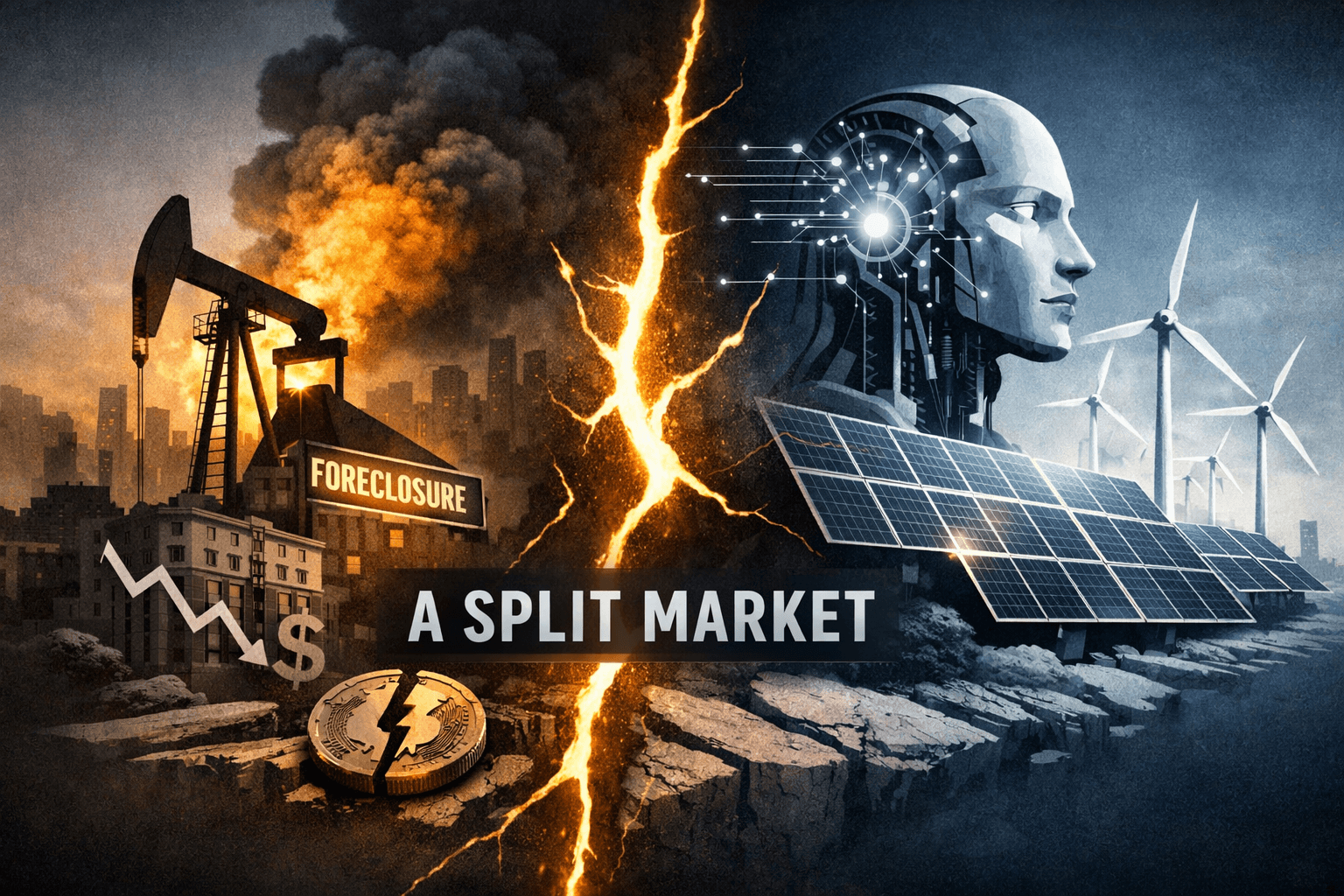
Geopolitics and AI Drive a Split Market: Oil Surges, Renewables Rally, Finance Feels the Strain
Podcast • Loading audio...
Share this article
Spread the word on social media
Key Takeaways
- •Geopolitical escalation (U.S.–Iran) produced an intraday oil spike exceeding 8%, driving cross-asset repricing and raising near-term inflation and rate sensitivities.
- •AI remains the cross-sector theme — product rollouts and infrastructure spend support tech, telecoms and industrial winners, while laggards risk compounding underperformance.
- •Renewables momentum is structural: Lazard’s LCOE+ and storage consolidation gave utilities a positive reallocation narrative despite regulatory and wildfire risks.
- •Finance and real estate showed rising risk signals (small‑bank failure, distressed studio asset), underscoring credit and liquidity as near-term vulnerabilities.
- •Crypto is bifurcated: stablecoin institutional adoption in Japan contrasts with bitcoin price softness (below $63,000), keeping the space volatile.
Executive summary
Markets on July 13 were defined by a stark divergence: an energy-led rally driven by renewed U.S.–Iran tensions sent oil sharply higher, while cross-cutting AI and renewables narratives supported pockets of strength in technology and utilities. At the same time, risk signals in finance and pockets of distress in real estate and crypto kept sentiment cautious. Geopolitical headlines were the immediate driver of the day’s largest move — oil spiked intraday, at times jumping more than 8% — but longer-term structural themes (AI adoption, falling LCOEs for renewables, stablecoin adoption, and supply-chain/tariff positioning for retail) shaped sector rotations beneath the headlines.
Data points to watch from July 13: oil rallied more than 8% at its intraday peak, bitcoin slipped back under $63,000, Kobada secured $208 million in financing, and Lazard’s updated LCOE+ calculus continued to favor wind and solar. Netflix ($NFLX) remained a near-term headline risk ahead of a critical July 16 report, and Shein won Beijing clearance for a Hong Kong IPO — a notable development for consumer and internet capital markets.
This recap groups sectors by performance, traces cross-sector correlations, highlights the biggest moves and why they happened, and offers investor-focused, non‑prescriptive takeaways to watch going into tomorrow.
Grouping sectors by performance
Note: Most sector summaries released today reported qualitative headlines rather than uniform intraday percentage returns. The groupings below reflect thematic momentum and headline-driven directional bias from July 13 coverage.
Outperformers (clear positive momentum)
- Energy: Oil’s dramatic spike after U.S.–Iran confrontation headlines was the day’s dominant market mover. The energy complex benefited broadly from flight-to-safety in commodity producers and tightness expectations.
- Utilities: Renewables and storage headlines — from Lazard’s LCOE+ favoring wind/solar to storage acquisitions and new hydropower builds — lent the sector momentum.
- Technology: AI product upgrades, Shein’s capital-markets move, and ongoing quantum/AI experimentation kept investor focus on growth opportunities.
- Materials/Mining: Funding rounds (Kobada $208m), high‑grade copper assays (Majuba Hill) and heightened LME activity supported miners and exploration plays.
- Consumer & Retail: Expansion headlines (Tailored Brands’ IPO and store expansion plans) and retailer-supplier deals (Walmart’s PPA moves) signaled constructive demand/profitability initiatives.
Underperformers (headline risk, stress or dampening factors)
- Finance & Banking: Risk indicators rose — a small‑bank failure, growing AI-related debt, and a major growth-name market‑value swoon — weighing on sentiment and credit-risk perceptions.
- Real Estate: Distress in a high‑profile studio asset, rising cap‑rate chatter after geopolitical-driven rate moves, and mortgage-rate sensitivity kept the sector under pressure.
- Crypto: Volatility persisted — bitcoin eased below $63k even as stablecoin adoption accelerated in parts of Asia — leaving the sector split between regulatory progress and price weakness.
- Healthcare & Cannabis (mixed‑to‑negative): Although there were clinical wins (notably Freenome) and promising research in oncology, payer and policy risks (Medicaid fights, caregiver cuts, cannabis legal uncertainty) created mixed signals.
Stable / Mixed (balanced headlines, direction unclear)
- Communications & Media: Consumer demand for streaming, events and merchandising was healthy, but near-term earnings (Netflix) and telecom strategic shifts kept the picture mixed.
- Industrials & Manufacturing: Automation / infrastructure tailwinds exist, but warnings about an AI adoption gap and company-level ESG backtracks introduced caution.
- Materials/Mining (some names mixed): While exploration and financing headlines were positive, commodity-price sensitivity and capex cycles create variability.
Cross‑sector themes and correlations
- Geopolitics as a cross-market amplifier
- The U.S.–Iran confrontation produced an outsized move in oil and immediate spillovers into commodity and interest-rate expectations. Energy responded first and most strongly, but the move also affected real‑estate sentiment (mortgage rates and cap‑rate expectations), bank risk pricing, and supply-chain risk calculations for industrials and consumer firms.
- AI: adoption vs. gap
- AI continues to be the thread linking technology, communications, telecoms and industrials. Telecoms’ AI infrastructure pushes and security tie-ups, product AI rollouts in software and consumer (Google’s Gemini layer expanded into Waze), and manufacturing warnings about an AI adoption gap all show the same bifurcation: winners with integration and scale see clear tailwinds; laggards risk structural underperformance. The finance sector flagged rising AI-related debt, suggesting capital markets are already financing AI bets — adding a credit‑risk angle.
- Renewables economics reshaping utilities and energy investment
- Lazard’s LCOE+ reaffirming the competitiveness of wind and solar — together with battery/ storage consolidation activity (Stryten’s acquisition) and new hydropower projects — is feeding a tangible reallocation toward clean-energy infrastructure. This is supporting certain utility names even as traditional power and oil names benefit from near-term supply shocks.
- Policy and regulatory calendars driving idiosyncratic movers
- Cannabis policy shifts (Minnesota momentum, 4th Circuit commentary on gun/cannabis intersections, Curaleaf’s Spain regulatory win) and healthcare policy fights (Medicaid funding debates) continue to move sector constituents unpredictably. Crypto also shows this pattern: regulatory audits and stablecoin services in Japan moved adoption even as global price action remains volatile.
- Market structure and capital activity matter
- Private capital and financings (Kobada’s $208m) and IPO approvals (Shein) are supporting equity markets in select pockets, while distress in specific real-estate and small‑bank episodes underscores the unevenness of liquidity and credit risk across markets.
The most significant moves and the context behind them
- Energy: oil jumps — more than 8% intraday; supply‑risk pricing spikes
- What moved: Renewed U.S.–Iran tensions and reported strikes/navigation risk in the Strait of Hormuz pushed traders to repriced near‑term supply risk. Headlines referenced the U.S. reinstating an Iran blockade and overnight strikes, producing intraday moves (some reports cited up to 5% earlier in the session and later more than 8% at peak).
- Why it matters: The jump pushed physical and futures curves tighter, amplified inflation and rate-sensitivity narratives, and set off cross-asset repricing. Higher oil can boost energy producers and inflation expectations while pressuring rate-sensitive sectors such as real estate and consumer discretionary.
- Watch for: follow-through from official government statements, tanker routing reports, sanctions updates, and OPEC+/producer responses.
- Utilities and renewables: structural economics support continued investment
- What moved: Lazard’s LCOE+ data continued to favor wind and solar, Stryten announced a battery-brand acquisition, Qcells shipments and new solar builds on reclaimed coal land hit press. These combined to create sector-level momentum around renewable project execution and storage scale.
- Why it matters: Lower effective cost of new-generation capacity supports capex and project finance, improving visibility for utilities’ long-horizon returns. It also shifts conversation from subsidy reliance to pure economic competitiveness in many markets.
- Watch for: project-level timelines, module and battery supply-chain constraints, and regulatory approvals on interconnection and permitting.
- Technology: AI product rollouts and major capital-market developments
- What moved: Google integrated Gemini into Waze, Shein cleared Beijing approval for a Hong Kong IPO, quantum/AI partnerships showed incremental results. Telecoms’ AI pushes and cybersecurity tie-ups showed structural, recurring revenue opportunities.
- Why it matters: Product monetization and capital-market access can accelerate earnings growth in winners, while regulatory resistance (EU rules) and device pushback temper near-term multiples.
- Watch for: product‑level adoption metrics, guidance in upcoming earnings, and EU regulatory developments.
- Finance & banking: rising risk signals
- What moved: The sector reported a small-bank failure and a notable rise in AI-related debt. Separately, a major growth-name saw a large market-value drop, weighing on bank and fintech sentiment.
- Why it matters: Bank stress — even at a small institution — combined with new forms of leverage tied to tech rollout can tighten credit conditions for some borrowers and prompt risk repricing for banks with concentrated exposures.
- Watch for: deposit flows at regional banks, credit spreads, and regulatory commentary on small-bank oversight.
- Crypto: stablecoin adoption vs price volatility
- What moved: Stablecoin adoption accelerated in Japan with big lenders moving into JPY stablecoin services while bitcoin traded lower, dipping below $63,000.
- Why it matters: Adoption of regulated stablecoins by traditional lenders can broaden on‑ramps and institutional usage, but spot-price volatility in bitcoin keeps trading and risk appetite volatile.
- Watch for: regulatory audits, stablecoin custody arrangements, and macro-driven liquidity shifts.
- Materials & mining: targeted financings and exploration upside
- What moved: Kobada raised $208 million, Majuba Hill reported high‑grade copper assays, and LME volumes rose in Q2.
- Why it matters: Fresh capital and positive drill results can catalyze small‑cap miners and exploration names; copper success stories tie into the electrification and infrastructure themes supporting basemetals demand.
- Watch for: assay follow-through, permitting timelines, and metal price reaction to the energy/industrial backdrop.
- Consumer & retail: strategic expansion, supply‑chain and tariff positioning
- What moved: Tailored Brands’ IPO and 500-store expansion plan, Walmart pursued long-term power agreements including a nuclear PPA, and grocers/testers experimented with AI and private‑label premiumization.
- Why it matters: Retailers are balancing physical expansion and margin improvement strategies (private label, AI efficiency) with exposure to import and tariff risk.
- Watch for: earnings cadence, same-store sales trends, and import/tariff developments.
Actionable insights for investors (informational, non‑prescriptive)
Position for volatility around geopolitics and energy: July 13 showed how quickly geopolitical headlines can reprice commodities and related equities. Data suggests short-term spikes in oil can persist until diplomatic clarity emerges. Monitor official government and shipping-route updates, and consider scenario planning for elevated energy price regimes.
Distinguish AI winners from laggards: The breadth of AI references across telecoms, tech, industrials and finance underlines that outcomes will be uneven. Track concrete signals of adoption: recurring revenue from AI services, capex commitment to AI infrastructure, customer retention improvements, and productivity gains. Momentum indicates early adopters may compound advantages, while laggards could face competitive erosion.
Treat renewables as a structural re‑allocation, not just a cyclical trade: Lazard’s persistent improvement in LCOE for wind/solar and active storage consolidation suggest utilities and infrastructure managers are reallocating capital. Investors should monitor project-level economics (PPA pricing, interconnection timelines, supply bottlenecks) rather than rely solely on thematic headlines.
Watch credit and liquidity metrics in finance and real estate: A small‑bank failure and stress-linked headlines on July 13 signal that idiosyncratic credit events can have outsized market effects. Track deposit flows, regional bank earnings, CRE distress indicators, and mortgage-rate sensitivity — these will be the proximate channels for contagion.
Monitor regulatory and policy calendars closely: Cannabis policy developments, healthcare funding debates, EU tech rules, and crypto audits can produce outsized idiosyncratic moves. Where policy risk is high, expect headline-driven volatility.
Use earnings and corporate guidance as differentiators: With Netflix ($NFLX) reporting July 16 and multiple sector-level catalysts approaching, company guidance and margin commentary will be primary drivers of stock dispersion.
Maintain liquidity and a multi-horizon view: The market’s split between headline-driven volatility (energy, crypto) and structural shifts (AI, renewables) argues for portfolios that can respond to near‑term dislocations while capturing longer-term thematic trends.
Important: This section is provided for informational purposes only. Analysts note varying outcomes across securities; this is not investment advice, nor a recommendation to buy, sell or hold any security.
Sector-by-sector quick read (what to watch next)
Energy: Watch Iran-related developments, tanker routing, OPEC+/producer commentary, and near-term inventory releases. Price volatility is likely to remain high until geopolitical uncertainty abates.
Utilities: Track project-level announcements, battery delivery schedules, and regulatory approvals. Lazard’s LCOE+ trends suggest a multi-year reallocation in generation mix.
Technology & Communications: Earnings cadence (notably $NFLX on July 16), product adoption metrics for AI features, and EU regulatory progress remain the key catalysts.
Materials/Mining: Follow assay follow-ups (Majuba Hill), financing deployment (Kobada), and metal-price sensitivity to energy and industrial demand.
Finance: Monitor regional bank deposit trends, credit spreads and the flow-through of AI-related financing into credit books.
Real Estate: Watch cap‑rate moves tied to macro headlines, mortgage-rate direction, and any incremental distress filings or liquidity events.
Crypto: Keep an eye on stablecoin regulatory developments, adoption signals from traditional banks (Japan updates), and bitcoin correlation to macro risk-on flows.
Consumer & Retail: Focus on same-store sales data, margin initiatives (private label), and supply‑chain/tariff headlines that could impact late‑summer inventory costs.
Healthcare & Cannabis: Track upcoming clinical readouts and regulatory/payer headlines; policy debates around Medicaid and cannabis legalization remain primary risk factors.
Industrials: Watch for capital-spend announcements tied to AI/automation and for any guidance on supply‑chain pressures that could influence margins.
Conclusion and forward-looking perspective
July 13 was a reminder that markets remain finely balanced between headline shocks and structural narratives. The day’s most obvious lesson: geopolitics can still move markets in an instant — energy prices surged and that ripple was felt across real estate, banking and industrials. At the same time, secular forces are reshaping capital allocation: AI is threading through technology, telecoms, and manufacturing while declining LCOEs for renewables are reordering utility investment priorities.
Looking ahead, expect continued bifurcation. Near‑term volatility will likely be driven by geopolitical updates (particularly Middle East developments), incoming earnings (Netflix and other big tech names), and policy actions across cannabis, healthcare and crypto. Over the medium term, investors and analysts will be watching which companies convert AI and clean-energy investment into consistent, durable revenues and margins — and which firms struggle with adoption, permitting or regulatory backlash.
Sentiment on July 13 is best characterized as neutral-to-cautious: pockets of bullish momentum exist in energy (short-term) and in renewables/AI (structural), but credit and policy risks argue for disciplined, information-driven positioning.
Investment disclaimer: This article is for informational purposes only. It does not constitute personalized investment advice or a recommendation to buy, sell or hold any security. Analysts note there are material risks in all sectors discussed; readers should consult their own advisors about their individual circumstances.
Sources
+ 14 more sources
Use these insights — enter this week's contest.
Free practice contests — earn Alpha CoinsExplore More Content
Disclaimer: StockAlpha.ai content is for informational and educational purposes only. It is not personalized investment advice. Sentiment ratings and market analysis reflect data-driven observations, not buy, sell, or hold recommendations. Always consult a qualified financial advisor before making investment decisions. Past performance does not guarantee future results.