 Sector Insights
Listen to this Recap
10:32
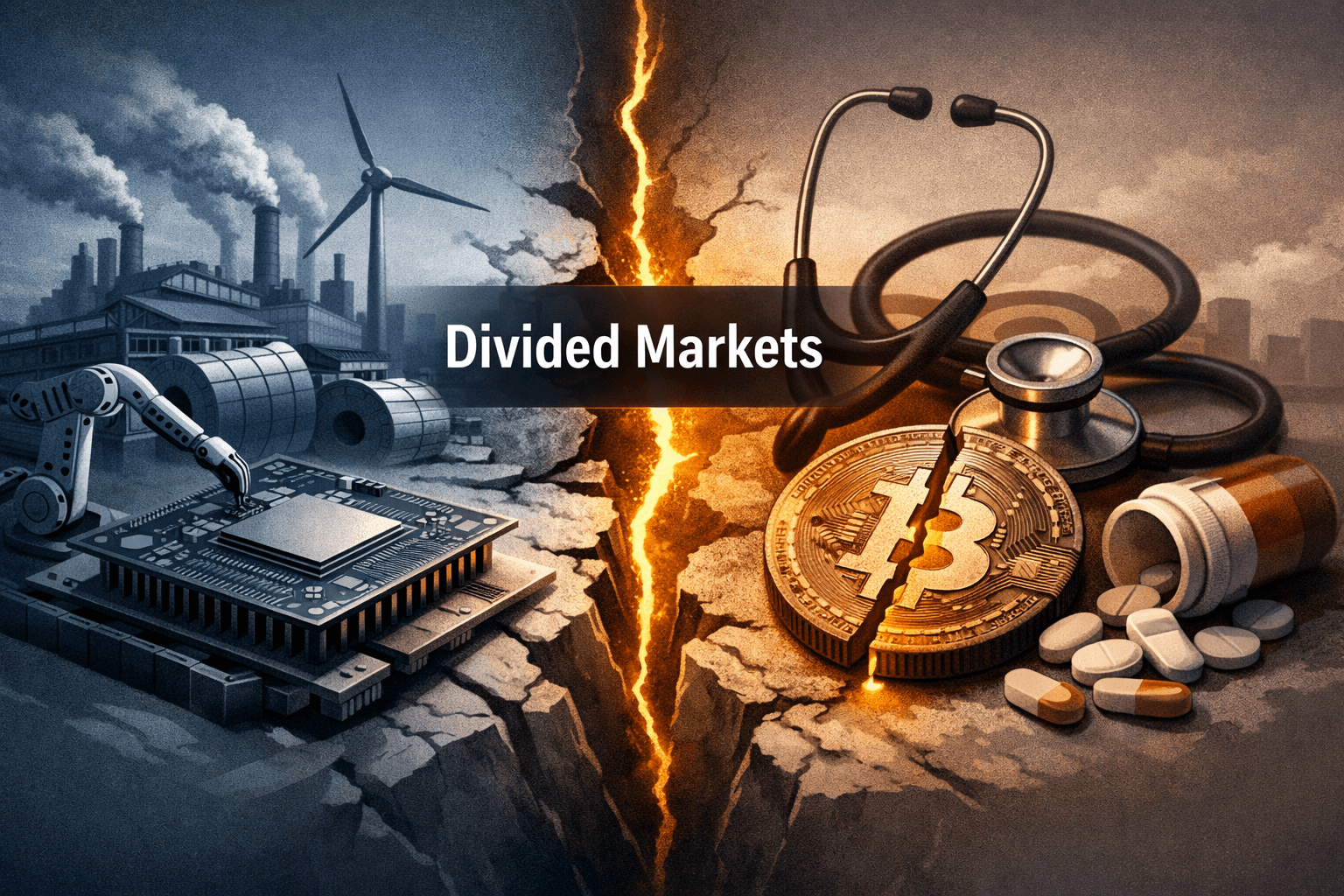
Reshoring, Renewables and AI Drive Divergence: Industrials, Energy and Materials Lead as Healthcare and Crypto Face Headwinds
Podcast • Loading audio...
Share this article
Spread the word on social media
Key Takeaways
- •Reshoring and capex headlines (AAPL-AVGO $30B chip push, Toyota $3.6B expansion) are lifting industrials and materials.
- •Energy sector is bifurcated: geopolitical supply risk supports traditional fuels while renewables, storage and nuclear reach commercialization milestones.
- •Healthcare faces acute policy and cost headwinds (14% median ACA premium hikes, nurses’ strikes) that can quickly affect earnings.
- •Crypto shows mixed signals: Bitcoin near $62k and major fundraising alongside Ethereum’s rare weekly death cross increase short-term volatility.
- •AI adoption is a cross-sector theme — from retail loyalty and property management to industrial automation — and is reshaping where productivity gains may appear.
Executive summary
Markets opened Jul 8 with a clear bifurcation: heavy industrial and energy headlines backed by policy and corporate investment contrasted with policy-driven weakness in healthcare and technical strain in crypto. Concrete data points — a 38% year-over-year surge in air freight spot rates, a reported $30 billion Apple-Broadcom deal to onshore chip production, and commercial milestones in renewables and advanced reactors — reinforced a narrative of capital spending and supply‑chain reconfiguration. At the same time, healthcare faced fresh policy and cost pressure (insurers proposing a median 14% ACA premium increase, nurses' strikes and insurer exits) while crypto showed mixed signals with Bitcoin near $62,000 and Ethereum printing a rare weekly death cross even as firms such as Paradigm raised substantial capital ($1.2 billion).
Taken together, the tape suggests a market re-rating around cyclical exposure, energy security and AI-driven productivity gains. That rotation is playing out unevenly: materials, industrials and energy look like near-term leaders, while healthcare and crypto are the most challenged sectors. Communication, consumer and finance sit in the middle, driven by policy headlines, retail initiatives and selective M&A.
Sector performance grouping: outperformers, underperformers, stable
Below we group sectors by observed momentum and the drivers surfaced July 8. These are thematic groupings based on news flow rather than intraday price returns.
Outperformers
Industrials & Manufacturing
- Why: Strong signs of reshoring and capacity investment. Notable items included air freight spot rates up 38% YoY, a reported $30 billion Apple-Broadcom chip production deal to expand U.S. manufacturing, and Toyota’s $3.6 billion Texas expansion. Together these items reinforce a capex and supply-chain reconfiguration narrative that favors industrials and capital goods.
Energy (Oil, Gas, Renewables, Nuclear)
- Why: A mix of geopolitics and commercialization wins. Sempra recorded its first LNG shipment; India advanced solar manufacturing commercialization; four U.S. advanced reactors hit milestones; and storage deployments continued to scale. Geopolitical strikes in the Gulf added near-term supply anxiety, supporting traditional energy while renewables gain traction on policy and tech progress.
Materials & Mining
- Why: Demand signals for copper and lithium increased (Latin America highlighted as a key supplier), and tech-adjacent deals such as Caterpillar’s acquisition of Skycatch and Weir’s crushing contract pointed to elevated project activity. Recycling scale-ups and funded drill programs provided additional momentum.
Underperformers / Headwinds
Healthcare
- Why: Elevated policy and cost pressure set a negative tone. Insurers sought a median 14% ACA premium increase as enrollment decreased, a major hospital nurses strike added operational risk, and several insurers signaled program exits or restructuring. Together these developments raise short-term revenue and margin uncertainty across providers and payors.
Cryptocurrency
- Why: Mixed technicals and regulatory noise. Bitcoin traded near $62,000—comfortably above cyclical lows—but Ethereum printed a rare weekly death cross, a risk-off technical sign. Regulatory and court developments created uncertainty even as large funding rounds (Paradigm $1.2 billion) and large ETH buys hinted at continued institutional engagement.
Finance & Banking (selective softness)
- Why: M&A and product moves were present, but regional retrenchment (a small UK pullback), Iran-related oil risk and profit-taking after recent rallies weighed on sentiment. The sector is effectively caught between deal-driven pockets of strength and macro-driven caution.
Stable / Middle ground
Consumer & Retail
- Why: A mix of positive execution and cost cuts. Retailers deepened loyalty programs and AI investments (Home Depot rewards, Dick’s paid tiers, Batteries Plus AI initiatives), but Mars plant closures and workforce reductions tempered the upbeat moves.
Communications, Media & Technology
- Why: AI, content and regulatory headlines created crosscurrents. Product launches and new IP (Grok 4.5 from SpaceXAI, Netflix greenlights and festival wins) drove attention, while regulatory rulings and Microsoft’s Xbox headcount reduction (about 3,200 roles) illustrated persistent execution and regulatory trade-offs.
Real Estate & Utilities
- Why: Real estate showed active leasing and financing (a $210 million LIHTC close, a $38.8 million Miami-Dade warehouse deal) while utilities continued to deploy storage and large-load solutions (a $1.75 billion stake and a 120 MWh battery energy storage system). These are structurally positive but sensitive to financing costs and local policy.
Cross-sector themes and correlations
Reshoring and industrial capex is a multi-sector story
- The Apple-Broadcom $30 billion push to boost U.S. chip production, Toyota’s $3.6 billion plant expansion in Texas and stronger freight rates are all consistent with a multi-year trend toward onshore manufacturing and higher supply‑chain resilience. This theme supports industrials, materials (for copper, steel and specialty inputs), and parts of the tech hardware ecosystem.
AI is migration capital: from enterprise software to retail and property management
- AI headlines spanned SpaceXAI’s Grok 4.5 launch to retailers embedding AI in loyalty and operations. The result: technology capex and software spending should remain a cross-cutting tailwind for IT service providers, semiconductors, and productivity tools. Real estate and property management also flagged AI in mortgage and workflow automation, showing how the technology cuts across traditional sector boundaries.
Energy transition sits alongside energy security
- Renewables, storage and nuclear milestones indicate structural progress in decarbonization. Simultaneously, geopolitical friction (e.g., Gulf strikes) sustains support for traditional energy markets. The balance means energy names tied to LNG, storage, and grid upgrades could see differentiated performance versus pure-play oil explorers.
Materials tightness and electrification demand
- Copper and lithium demand narratives — reinforced by Latin America supply focus and funded drill programs — link directly to energy transition and EV/charging infrastructure build‑outs. That tightness interacts with industrial equipment demand (crushers, automation) and recycling scale-ups.
Policy and regulation remain a toggle for healthcare and crypto
- Healthcare moves are being driven by premium dynamics, labor friction and regulatory change that can rapidly affect margins and volumes. Crypto’s path continues to be shaped by court rulings and regulatory clarity — even with large institutional funding rounds, technical price signals create short-term volatility.
Notable moves and why they mattered
Air freight spot rates +38% YoY
- Why it matters: Freight is an early indicator of goods demand and supply-chain stress. A 38% uplift points to elevated shipping costs that can pass through to margins, alter inventory strategies and prompt corporate capex to localize production.
Apple and Broadcom $30 billion U.S. chip production push
- Why it matters: A multibillion-dollar supply-chain repositioning by two large technology firms accelerates semiconductor onshoring. The immediate beneficiaries are domestic foundries, equipment suppliers and industrial subcontractors, and the move reduces strategic reliance on offshore capacity over time.
Toyota $3.6 billion Texas expansion
- Why it matters: Auto sector investment suggests continued confidence in U.S. demand and the EV/hybrid transition. Auto factory expansions stimulate regional suppliers, materials demand and logistics investment.
Sempra’s first LNG shipment and advanced-reactor milestones
- Why it matters: The LNG shipment underscores near-term commercial progress in U.S. export capacity and cash flow realization. Advanced-reactor milestones cement nuclear as part of the energy transition discussion and can alter long-term generation mix expectations.
Ethereum rare weekly death cross; Bitcoin near $62,000; Paradigm $1.2 billion raise
- Why it matters: The juxtaposition is important. Technical weakness in ETH signals near-term selling pressure or momentum loss in altcoins, while Bitcoin’s range-holding and large private funding rounds like Paradigm’s show continued institutional interest. This divergence increases the probability of episodic volatility as regulation and technicals collide.
Insurers propose median 14% ACA premium hikes; hospital nurses strike
- Why it matters: Rising premiums and labor disputes illustrate acute cost pressures across payors and providers. These dynamics can influence enrollment behavior, election-year policy debates and hospital operating margins.
Utilities' big storage and large-load solutions activity ($1.75bn stake; 120 MWh BESS)
- Why it matters: Utility-scale storage deployments are a critical enabler of renewables integration. Larger central investments signal that grid modernization is moving beyond pilots and toward commercial scale, creating longer-term capital deployment pathways for project developers and equipment manufacturers.
Caterpillar’s Skycatch purchase and Weir crushing contract
- Why it matters: Tech-enabled mining solutions and equipment contracts point to investment in productivity and capacity in materials extraction — a positive signal for mining capex and the supply chain that supports infrastructure and energy projects.
Actionable insights for investors (informational only)
Important: This section is for informational purposes only. It is not personalized investment advice and does not recommend buying, selling or holding any security.
Reassess exposure to cyclical capex and domestic manufacturing
- Data suggests higher odds of sustained capital spending in chipmaking, autos and heavy equipment. Analysts note that suppliers to semiconductor fabs, industrial automation, and tier‑1 auto parts could see order books lengthen. Investors may want to track announced production timelines, equipment bookings and freight indices as leading indicators.
Differentiate within energy: security vs. transition plays
- The market is pricing both near-term supply risk (geopolitics) and long-term transition opportunities (renewables, storage, advanced reactors). Investors might consider monitoring LNG export cadence (Sempra and peers), storage procurement awards, and pipeline approvals to understand which parts of the energy complex are closer to cash flow inflection points.
Watch materials flow and project timelines closely
- With copper and lithium narratives intensifying, pay attention to permitting milestones, drill program results and recycling-scaling news. Materials tightness tends to show up first in spreads, shipping, and equipment demand, so tracking project-level updates can provide early signals.
Treat healthcare headline risk as a distinct volatility source
- Policy changes, premium adjustments and labor actions can alter earnings trajectories quickly. For investors with healthcare exposure, monitor regulatory filings, state-by-state policy shifts and provider labor negotiations for near-term risk management.
For crypto allocations, balance technicals with institutional signals
- Ethereum’s weekly death cross is a technical warning while large fundraising rounds and institutional accumulation keep the longer-term narrative alive. Market participants should consider whether technicals or regulatory developments will drive short-term price swings and set risk parameters accordingly.
Use AI adoption as a cross-sector factor, not just a tech theme
- The proliferation of AI across retail, property management, industrial automation and software suggests earnings drivers may increasingly come from AI-enabled productivity. Track adoption KPIs — e.g., rollout tier announcements, pilot-to-production timelines, and incremental margin improvements — to assess where AI creates credible bottom-line impact.
The most significant moves to monitor next
- SAFE Banking and cannabis regulation — legislative progress could alter valuation frameworks for the cannabis industry and banking exposure. Watch congressional calendars and banking lobbying activity.
- Semiconductor onshoring execution — Apple-Broadcom execution milestones, supplier bookings and tariff/permitting outcomes will determine how quickly U.S. fabs scale up.
- Shipping and freight indices — further lift in freight rates could pressure margins for consumer-goods companies and accelerate reshoring decisions.
- Energy export and storage projects — monitoring Sempra shipments, new FID (final investment decision) announcements, and BESS procurement will indicate near-term revenue ramps.
- Healthcare policy headlines — premium filings, regulatory guidance and labor negotiations are likely to move provider and payor sentiment.
- Crypto regulatory rulings and technicals — court calendars, SEC guidance, and on‑chain flows will remain market-moving.
Conclusion and forward-looking perspective
July 8’s headlines illustrate a market in reconsolidation around structural themes: reshoring and capex, energy transition tempered by geopolitics, and AI’s incremental spread into non-tech sectors. Industrials, materials and parts of energy are benefitting from tangible project activity and spending commitments — from $30 billion reported chip deals and a $3.6 billion auto plant expansion to utility-scale storage and nuclear milestones. These developments suggest a medium-term bias toward cyclical sectors that participate in capital goods and infrastructure builds.
At the same time, policy and technical risk are creating differentiated outcomes. Healthcare’s margin pressures and regulatory uncertainty along with crypto’s mixed technicals illustrate that headline risk can quickly override longer-term narratives. Finance sits in between: pockets of deal activity are offset by macro uncertainty.
Looking ahead, the market’s near-term path will likely be set by execution: will onshored semiconductor capacity come online on schedule, will storage and nuclear projects clear permitting and reach commercial scale, and can healthcare and crypto find regulatory stability? Momentum indicators — freight rates, project FIDs, and policy calendars — should be watched closely for clues to how durable July 8’s moves are.
Investment professionals and market participants should incorporate these cross‑sector linkages into portfolio stress tests and scenario plans. Analysts note that the interplay of capex cycles, energy security, and regulatory developments will be the defining drivers of sector performance through the rest of the quarter.
Disclaimer: This article is for informational purposes only. It does not constitute personalized investment advice or a recommendation to buy, sell, or hold any security. Market analysis and sentiment reflect the data and headlines as of Jul 8 and are subject to change.
Sources
+ 13 more sources
Use these insights — enter this week's contest.
Free practice contests — earn Alpha CoinsExplore More Content
Disclaimer: StockAlpha.ai content is for informational and educational purposes only. It is not personalized investment advice. Sentiment ratings and market analysis reflect data-driven observations, not buy, sell, or hold recommendations. Always consult a qualified financial advisor before making investment decisions. Past performance does not guarantee future results.