 Sector Insights
Listen to this Recap
10:27
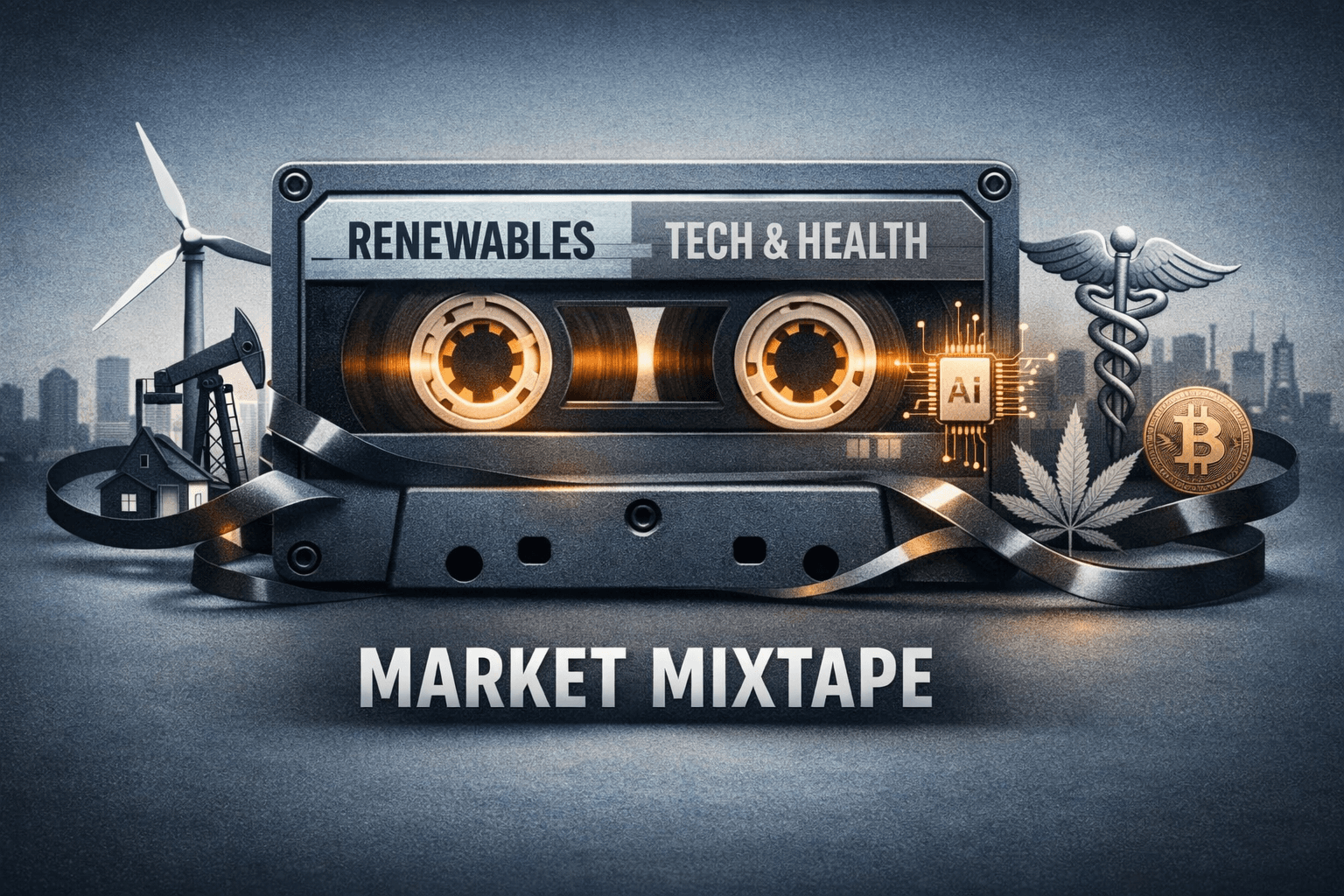
Renewables and Deals Drive a Mixed Tape: Energy, Utilities and Real Estate Outpace Tech and Health on Policy and M&A News
Podcast • Loading audio...
Share this article
Spread the word on social media
Key Takeaways
- •Deal flow and renewables headlines propelled energy, utilities and real estate into outperformance, driven by transactions and project pipelines.
- •AI remains both a demand driver (semiconductors, data centers, grid load) and a risk vector as regulatory and reliability concerns temper enthusiasm in tech.
- •Regulatory developments — MiCA authorization for Ripple, state cannabis bills, Medicaid rules — are major cross‑sector volatility drivers.
- •Large capital moves (e.g., SK Hynix share sale) and strategic M&A (Alcoa bid for South32 assets) are shifting near‑term sector positioning and investor focus.
Executive summary
Markets closed the day in a mixed but theme‑driven tape. Deal activity and renewables headlines powered outsized attention in energy, utilities and real estate, while technology and healthcare grappled with AI‑related risk messaging, capital raises and policy pressure. M&A and regulatory developments — from Alcoa’s $5.6 billion bid for South32 assets to Ripple’s MiCA authorization in the EEA — created pockets of sectoral divergence rather than a broad market move.
Across sectors, the day’s dominant forces were: dealmaking and capital redeployment, policy and regulatory shifts (particularly in crypto, cannabis and healthcare), and the continuing centripetal pull of AI on tech, semiconductors and infrastructure-facing industries such as utilities and industrials. These currents produced low‑to‑mid single‑digit swings in many sector leaders and sharper intra‑day volatility in smaller, policy‑sensitive names.
Investment disclaimer: This analysis is for informational purposes only and is not investment advice. The discussion that follows presents market observations, not recommendations to buy, sell, or hold any security.
Grouping sectors by performance
Below we group sectors by how they performed on the day, based on deal flow, headlines and implied market momentum across the summaries provided.
Outperformers
- Energy: Renewables and strategic deals (BP/JERA, Uniper expansions) and supply commentary lifted sentiment for the space. Expect low‑to‑mid single‑digit sector gains on deal and policy optimism.
- Utilities: Grid upgrade stories, PJM rate moves and storage demand tied to EV/AI loads supported names in the group; defensive capital‑intensive exposure drew positive flows.
- Real estate: Active deal pipeline, new funding structures and development momentum (including a highlighted $175M H‑E‑B project) drove transaction activity and price support.
Underperformers / More cautious
- Technology: A day of caution — SK Hynix’s $28 billion U.S. share sale, a U.S. Treasury alert on AI risk and mixed product/earnings signals from giants like Apple and Microsoft — produced a risk‑off tilt in parts of the sector.
- Healthcare: Policy pressure on drug pricing and Medicaid work‑rule headlines, plus clinical oversight issues for telehealth GLP‑1 scripts, weighed on sentiment. Biotech financing and IPO filings provided offsetting pockets of strength but didn’t erase the cautious stance.
- Cannabis: State regulatory headwinds and newly proposed product limits created fresh uncertainty for operators, leaving the sector on edge.
Stable / mixed
- Financials: A mix of regulatory skirmishes for small lenders, payments M&A chatter and volatility in silver and bank stress indicators left the sector rangebound.
- Materials & Industrials: Activity was balanced — equipment orders, recycling investments and an Alcoa bid (see below) mattered, but policy on critical minerals tightened the narrative.
- Crypto: Mixed newsflow — Ripple’s full MiCA authorization in the EEA was offset by a $6M DeFi exploit, governance attacks and exchange/regulatory scrutiny.
- Consumer / Communications / Media: Content catalysts, festival season demand and selective corporate actions produced idiosyncratic moves rather than sectorwide trends.
Cross‑sector themes and correlations
Renewables and infrastructure as a cross‑sector connective tissue
- Energy’s renewables deals and utilities’ grid upgrade stories formed a coherent narrative: higher renewables deployment is creating near‑term demand for grid investment, storage and distributed generation. That linkage supports both utility capex stories and certain industrial equipment suppliers.
AI: demand driver and risk vector
- AI remains a two‑sided force. On one hand, it underpins semiconductor and data‑center demand, boosting parts of the tech hardware ecosystem. On the other, Treasury warnings about AI‑era market risks and Microsoft’s mixed Game Pass update signaled model‑reliability and monetization concerns, prompting cautious positioning. Utilities and industrials also flagged AI as a driver of incremental power consumption (and grid strain), tying pockets of the market together.
Policy and regulatory risk as the primary volatility engine
- Crypto’s regulatory wins and losses (Ripple MiCA authorization vs. DeFi exploit and exchange pressure), cannabis state‑level bills, Medicaid rules in healthcare, and EU critical‑minerals policy all show regulators shaping returns more than fundamentals in many spots. This concentration of regulatory catalysts increases idiosyncratic volatility across sectors.
Deal activity and capital redeployment
- M&A (Alcoa’s $5.6B bid for South32 assets; Sky & ITV discussions; Optimum stock tender) and large capital raises (SK Hynix’s $28B share sale) drove re‑rating in tradeable names and created cross‑sector allocation effects — buyers of deal beneficiaries and sellers of capital‑constrained names.
Risk/reward divergence between large caps and policy‑sensitive small caps
- Big tech and energy majors are acting as anchors. Policy sensitive small‑cap healthcare, cannabis and crypto‑native firms showed outsized moves on headlines, widening dispersion between large caps and high‑beta names.
Notable individual moves and why they mattered
Alcoa’s $5.6B bid for South32 assets (industrial / materials)
- What happened: Alcoa proposed a roughly $5.6 billion bid to acquire major bauxite and related assets from South32.
- Why it mattered: The bid signals consolidation in upstream raw materials for aluminum — a strategic response to supply dynamics and cost control. For equipment suppliers, recyclers and freight operators, larger integrated players can change contract structures and capex profiles. The move also reflects a broader theme: vertically integrated plays to secure feedstock in materials sectors.
Ripple’s full MiCA CASP authorization across the EEA (crypto)
- What happened: Ripple secured full authorization under EU MiCA rules to operate as a crypto asset service provider across the 30‑country European Economic Area.
- Why it mattered: Regulatory clarity in the EU for a major crypto firm reduces geographic execution risk and can function as a precedent for other firms seeking similar authorizations. Market response was mixed — positive for regulated custodial models and stablecoins, but still offset by smart‑contract and DeFi exploits that highlight operational risk.
SK Hynix $28B U.S. share sale (technology / semiconductors)
- What happened: SK Hynix unveiled plans for a large share sale in the U.S. market.
- Why it mattered: Large capital raises from major memory vendors have historically pressured near‑term pricing and investor sentiment in the semiconductor sector. Markets often interpret these moves as dilution risk and a signal of nearer‑term balance‑sheet priorities over buybacks, especially amid mixed AI demand commentary. The capital raise amplifies sensitivity around chip pricing and capacity planning.
PJM rate change & grid upgrade urgency (utilities)
- What happened: PJM rate adjustments and explicit urgency for storage and digital customer upgrades were highlighted in the utilities summary.
- Why it mattered: Rate design and recovery mechanisms are critical for utility earnings and capex profiles. A clearer path to recovering storage and modernization spend can re‑rate utilities with large regulated footprints; conversely, rate uncertainty increases investor wariness on name‑by‑name regulatory outcomes.
BP/JERA and Uniper renewables expansion (energy)
- What happened: Strategic partnerships and project expansions around offshore wind and solar were emphasized.
- Why it mattered: Corporate partnerships between major oil & gas companies and utility/developer partners continue to accelerate renewables deployment. These deals matter for supply chain participants, developers and regional energy markets — they also feed the narrative that energy transition capex remains durable even if oil markets wobble.
SKETCH: Coinbase AI backlash, DeFi exploit and corporate downsizing (crypto / technology)
- What happened: Coinbase encountered user and developer backlash around AI features while the sector recorded a $6M DeFi exploit and governance attacks.
- Why it mattered: Operational incidents and community pushback constrain product rollouts and increase regulatory scrutiny for exchanges and DeFi platforms. Investors treat these events as conviction shocks that increase volatility across crypto tokens and listed intermediaries like COIN.
Real estate deal flows and funding innovation (real estate)
- What happened: Fresh deals and financing pathways (e.g., Arizona affordability districts, title automation) underscored deal momentum.
- Why it mattered: New funding approaches unlock projects that were previously marginal and support construction and materials demand. The active transaction pipeline suggests development capex is still finding financing, a positive for property services, constructors and capital providers.
Cannabis state bills and product limits (cannabis)
- What happened: Multiple state bills in Virginia, North Carolina and Tennessee introduced new restrictions and regulatory uncertainty.
- Why it mattered: State‑level regulation remains the primary driver of cannabis operator returns. New restrictions on product formats or distribution create near‑term headwinds for revenue visibility and can compress valuations for smaller operators dependent on single‑state markets.
Apple, Microsoft and tech product/news updates (technology)
- What happened: Apple rolled out Siri customization and had AirTag comparisons in headlines; Microsoft disclosed a weaker Game Pass cadence while naming a new Xbox COO.
- Why it mattered: Product updates and subscription performance act as leading indicators for consumer tech monetization. With AI risk talk in the background, incremental product news can sway sentiment quickly — particularly for companies that set expectations for software monetization.
Healthcare policy tension and telehealth oversight (healthcare)
- What happened: Policy pressure on drug payments, a California political backdrop, and concerns about telehealth GLP‑1 script oversight were key items.
- Why it mattered: Payment rule changes and state policy shifts impact forecasting for payers and large providers. Telehealth prescribing scrutiny affects margins for telehealth‑first businesses and drug manufacturers tied to GLP‑1 demand.
Actionable insights for investors (informational, non‑recommendatory)
Monitor regulatory calendars closely. Policy moves in the EU (MiCA enforcement, critical minerals rules), U.S. state legislatures on cannabis, and healthcare payment rule comment periods can generate outsized single‑name and sector moves. Track agency deadlines and major filings.
Watch capital‑markets signals in tech and semiconductors. Large share sales or cross‑border capital raises (e.g., SK Hynix) tend to foreshadow near‑term supply/pricing sensitivity for chips and related hardware — a key input for AI demand narratives. Earnings and guidance from chipmakers will be a crucial near‑term read.
Translate renewables deal flow into names exposed to construction, supply chains and grid services. Energy and utility deals support order books for equipment suppliers, installers and storage developers. Investors tracking durability of transition capex should watch partner pipelines and contract structures (PPAs, offtake terms).
Treat crypto headlines as bifurcated risk: regulatory clarity for incumbents (like Ripple in the EEA) reduces some cross‑jurisdictional execution risk, but protocol‑level hacks and governance attacks keep tail risks high. Operational security, custody structures and regulated status matter more than ever.
For real estate and construction exposure, focus on financing availability and basis risk. New funding mechanisms and active deal pipelines reduce liquidity risk for projects but rising construction input costs and labor constraints can compress margins. Watch local rate decisions (e.g., PJM) and municipal policy changes for project feasibility.
Maintain differentiation between policy‑sensitive small caps and macro‑anchored large caps. Regulatory headlines disproportionately move small‑cap, single‑market names in cannabis, healthcare and crypto. Large caps remain sensitive to AI risk narratives and capital‑allocation signals.
Forward‑looking perspective: what to watch next
Macro & Fed cues: Any shifts in Fed messaging, CPI prints or growth data will quickly re‑price risk assets. Higher rates would increase the discounting of long‑dated transition capex and strain highly levered small caps.
Semiconductor capex guidance and pricing: Weekly/monthly memory pricing, capex statements from major fabs, and SK Hynix funding updates will be a bellwether for AI hardware demand and the broader tech supply chain.
Regulatory milestones: MiCA implementation for other players, U.S. state voting calendars on cannabis bills, and any new CMS/Medicaid guidance could create discrete catalysts.
Deal execution: Watch Alcoa/South32 developments, confirmation of BP/JERA and Uniper projects and any announced timelines. M&A that moves from proposal to binding commitment often prompts re‑rating and flow shifts.
Operational risk events: DeFi exploits, exchange regulatory actions, and telehealth prescribing investigations will continue to trigger volatility. Firms with robust governance and compliance will find repricing relief sooner.
Weather and supply shocks in energy: Storm-driven outages and LNG flow tightness can produce short‑term price spikes that feed into energy names and commodity‑linked materials.
Conclusion
Today’s market was a study in concentrated sources of conviction: dealmaking and renewables drove optimism in energy, utilities and real estate, while policy uncertainty and AI risk kept pressure on technology, healthcare and cannabis. Regulatory milestones — from MiCA authorizations to state cannabis bills — are reshaping where volatility will arrive next, and capital‑markets actions like SK Hynix’s share sale act as tangible signals that may recalibrate near‑term sector positioning.
For investors, the day underscored the importance of parsing event drivers (deals, policy, capital raises) from underlying fundamentals (earnings, cash flow, project pipelines). The next phase of market moves will likely be dominated by execution: which deals close, which regulatory guidances land as expected, and whether AI‑driven demand for chips and power translates into durable revenue growth rather than transient hype.
Investment disclaimer (repeat): This analysis is informational only and does not constitute a recommendation to buy, sell, or hold any security. Readers should consult a qualified advisor for personalized advice.
Sources
+ 13 more sources
Use these insights — enter this week's contest.
Free practice contests — earn Alpha CoinsExplore More Content
Disclaimer: StockAlpha.ai content is for informational and educational purposes only. It is not personalized investment advice. Sentiment ratings and market analysis reflect data-driven observations, not buy, sell, or hold recommendations. Always consult a qualified financial advisor before making investment decisions. Past performance does not guarantee future results.