 Sector Insights
Listen to this Recap
10:50
AI, Renewables and Policy Shifts Lead a Patchwork Rally — Markets Digest July 2, 2026
Podcast • Loading audio...
Share this article
Spread the word on social media
Key Takeaways
- •AI and cloud demand remain key market drivers, supported by large private raises and new product rollouts.
- •Electrification and storage are producing tangible project milestones (pumped storage >200 GW; new modular storage), creating cross‑sector demand for materials and grid upgrades.
- •Policy actions (cannabis rescheduling, healthcare debates, banking regulation) are increasingly material for sector valuations and capital flows.
- •Real estate and parts of finance show elevated dispersion and credit risk; materials face execution‑sensitive supply dynamics.
- •Crypto shows stronger institutional activity but remains infrastructure‑sensitive and volatile.
Executive summary
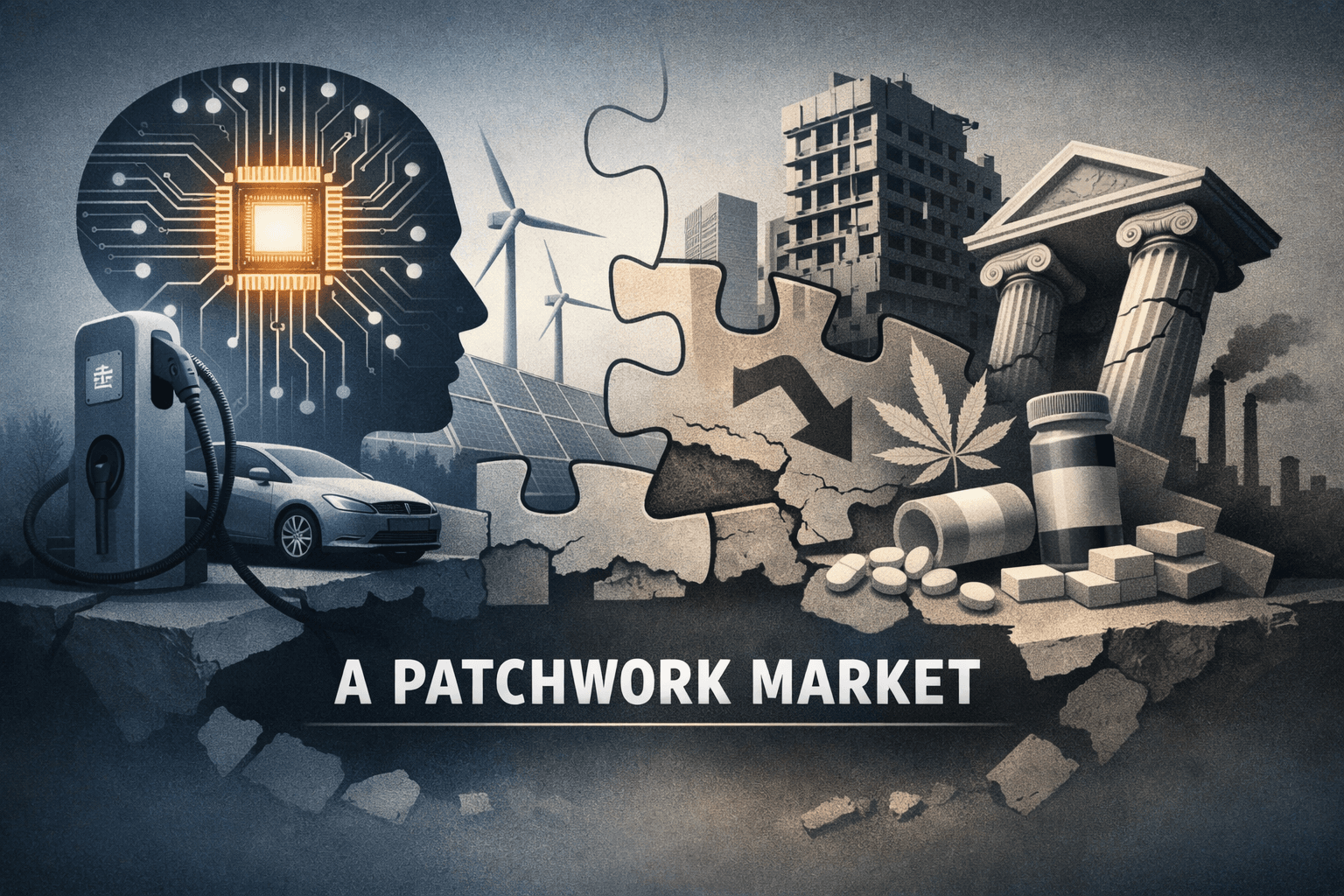
Markets opened July with a mixed but constructive tape dominated by three clear drivers: AI and cloud spending, accelerating electrification/renewables, and policy/regulatory headlines reshaping discrete sectors. Tech headlines ranged from eye‑catching private raises and product rollouts to renewed scrutiny on AI costs; energy and utilities saw tangible demand signals — from tighter crude flows and surging EV deliveries to grid storage milestones — that support commodity and power-sector momentum. At the same time, pockets of weakness appeared in real estate and parts of finance and materials, where lending trends, regulatory probes and operational hiccups tempered enthusiasm.
Across the 24 sector briefs we reviewed for July 2, the strongest near‑term momentum clustered in technology, energy and utilities. Notable cross‑market catalysts included a major $1.2 billion private raise in quantum/tech, Tesla (TSLA) outperforming delivery expectations and a marked acceleration in project financing for renewables and storage (pumped storage capacity passing 200 GW and new modular storage rollouts). Crypto activity remained high but volatile: Bitcoin held north of $60,000 with large exchange inflows and institution-style buys (2,823 BTC reported by Metaplanet), while on‑chain infrastructure fixes and tokenization investment continued.
Meanwhile, thematic risks underscored by the briefs include rising operational strain in materials (nuclear/mining restarts vs. Cameco hiccups), loan and delinquency pressure in parts of CRE and CMBS, and a steady flow of regulatory actions across healthcare, cannabis and banking that could alter near‑term fundamentals for affected names.
This recap groups sectors by performance signal, explains the why behind major moves, and offers cross‑sector takeaways and actionable investor considerations — strictly informational and not personalized investment advice.
Grouping sectors by performance
Note: sector-level performance in our summaries was qualitative. The groupings below reflect momentum signals and headline density on July 2.
Outperformers (positive momentum and clear catalysts)
- Technology: Funding rounds, product launches and AI integrations dominated the day. Highlights included a $1.2 billion raise for Quantum Systems, major startup valuation jumps, and cloud/AI integrations from incumbents. Analysts note continued demand for AI infrastructure despite rising cost controls across some corporates.
- Energy: Tightening supply signals and surging EV demand supported sector momentum. Crude inventory draws, Strait of Hormuz shipping frictions and strong Tesla (TSLA) delivery numbers were cited alongside renewed Saudi and Chinese crude flows that kept price action active. Renewables also picked up as storage demand and project financings accelerated.
- Utilities: Project milestones and private capital flows buoyed sentiment. Pumped storage capacity surpassing 200 GW, a U.S. modular storage product rollout from SolarEdge (SEDG), and a 600 MW supply deal plus private acquisitions (KKR’s $4.2 billion buy) were central.
Stable / Mixed (balanced headlines, offsetting catalysts and headwinds)
- Consumer & Retail: Corporate M&A and AI integrations (e.g., Kroger’s near $1.7 billion deal activity, Square’s ChatGPT/Claude integrations) lifted certain names, while regulatory and competitive pressures were present. Foot‑traffic and loyalty strategies matter here.
- Industrials & Manufacturing: New automation deployments, digital twins and a NIST quantum center drove optimism; however, June growth cooled. Robotics and logistics M&A produced positive structural signals even as cyclical indicators softened.
- Crypto: Bitcoin held above $60k with institutional buys (Metaplanet adding 2,823 BTC) and a large 49,000 BTC exchange inflow — mixed signs of adoption and near‑term volatility.
- Communications & Media: Wins on 5G/6G and cloud initiatives offset strain in film and exhibition; content cycles and spectrum decisions keep the sector rangebound.
Underperformers / Risk areas (headwinds, regulatory or operational setbacks)
- Real Estate: Two competing narratives arrived: deal momentum (large industrial leases, a $515 million Manhattan office loan) versus growing headwinds (rising CMBS delinquencies for retail/multifamily, deed‑fraud risks, regulatory probes). Net effect: increased dispersion and idiosyncratic risk.
- Finance & Banking: Mixed regulatory moves — from the OCC easing enforcement on Patriot Bank to abrupt CFPB notices — combined with margin pressure and corporate warnings (Fed commentary, a margin warning for FDX) left the sector cautious.
- Materials & Mining: Large investment plans (IHC‑Adani’s $11.5 billion aluminium plan) sat alongside operational hiccups at names like Cameco and restart complexities at processing sites. Supply chain and capex execution are focal risk points.
Cross‑sector themes and correlations
AI is a cross‑sector multiplier. Technology headlines (raises, launches, cloud integrations) spilled into retail, industrials and communications: retailers are integrating generative AI for personalization and logistics optimization; industrials are deploying AI for automation and digital twins; communications players are positioning 5G/edge infrastructure to support AI workloads. Data suggests AI is accelerating demand for chips, cloud services and skilled labor while raising scrutiny on corporate cost allocations.
Electrification and storage demand are tightening energy‑power linkages. EV delivery beats (notably TSLA) and automaker rollouts are increasing demand for metals and grid capacity. Utilities and renewables are capturing capital flows — pumped storage surpassing 200 GW and SolarEdge’s (SEDG) modular platform highlight investment moving from intermittent supply to dispatchable capacity. This dynamic correlates with higher near‑term commodity and battery component demand.
Policy and regulation are active cross‑currents. Cannabis benefited from DOJ rescheduling defenses and state-level market expansions; healthcare saw policy skirmishes over 340B and Medicare; finance grappled with OCC/CFPB actions. Where policy reduces uncertainty (e.g., clear regulatory approval paths or support for green projects), capital flows accelerate; where policy tightens (banking enforcement, real‑estate probes), liquidity retracts and spreads widen.
Capital is bifurcating between growth and de‑risked infrastructure. Private capital allocations favored infrastructure (KKR’s $4.2B, renewables project financing) and later‑stage tech (large raises), while public markets showed selective rotations into names with near‑term monetization paths (cloud, AI services, utilities with contracted PPAs). This yields higher volatility for cyclical and execution‑sensitive sectors like materials and CRE.
Crypto remains an institutionalized but volatile asset. Large inflows and corporate buys bolster on‑chain liquidity and institutional demand, but exploit recoveries and bridge restorations (e.g., Taiko restoring its bridge after a $1.7M exploit) underscore infrastructure risk. Correlation with risk assets appears limited but non‑zero; a sudden liquidity shock could propagate.
The most significant moves — context and implications
Below are the day’s most consequential headlines, why they matter and what they imply for markets.
Quantum Systems and big tech/private raises ($1.2B): A sizeable private capital injection signals sustained investor appetite for next‑generation compute and defense/space applications. Analysts note such raises have spillover effects: they expand the ecosystem for quantum‑enabling hardware and talent, strengthen IP valuations and pressure incumbents to accelerate product roadmaps. For markets, this reinforces tech’s leadership narrative, particularly among AI‑adjacent suppliers.
Pumped storage topping 200 GW and SolarEdge (SEDG) modular storage launch: These are tangible signs that grid operators and private capital are prioritizing long‑duration storage. Exceeding 200 GW of pumped storage indicates scale and institutional acceptance of storage as more than a niche. SolarEdge’s U.S. modular platform aims at faster deployments and cost efficiencies. Together, they point to a structural increase in demand for transmission upgrades, power electronics and project finance — a multi‑sector tailwind benefiting utilities, materials (copper, steel) and industrials.
Energy tightness: crude inventories down, shipping frictions, and TSLA delivery outperformance: Inventory draws and geopolitical friction in the Strait of Hormuz tightened near‑term oil market balances. Simultaneously, Tesla’s stronger‑than‑expected delivery figures reinforce EV adoption narratives that shift fuel demand structurally over time. The combined effect has kept oil price volatility higher, supporting energy producers while compounding input cost uncertainty for energy‑intensive industries.
Cannabis rescheduling push and state expansions: DOJ defending rescheduling and progress in states like Rhode Island and Illinois reduce policy risk and open addressable markets. These developments raise prospects for normalized banking access, insurance products and institutional investment — though full normalization depends on legislative and banking execution.
Banking/Regulatory moves: OCC easing at Patriot Bank, CFPB notices and Fed commentary: Regulatory back‑and‑forth keeps credit conditions nuanced. Eased enforcement can restore some confidence in smaller regional lenders, while surprise regulatory moves and margin pressures (e.g., the reported FDX warning) sustain higher funding costs and tighter lending standards in certain niches.
Real estate: $515M Manhattan office loan vs. rising CMBS delinquencies: Large loans and deal activity in selective assets contrast with rising delinquencies across retail and multifamily CMBS tranches. The implication is greater dispersion: high‑quality, income‑producing logistics and core assets continue to trade, while secondary assets face credit tightening and valuation pressures.
Materials: IHC‑Adani $11.5B aluminium plan and Sangdong restart vs. Cameco operational hiccups: Large greenfield investments and restarts indicate long‑term supply expansions for metals that feed electrification and infrastructure. However, operational setbacks at established producers highlight execution risk and potential near‑term supply shocks that can drive price swings.
Crypto flows: 49,000 BTC exchange inflow and institutional buys (Metaplanet +2,823 BTC): Large exchange flows typically precede enhanced trading and potential selling pressure, but institutionally sized buys also provide a base of demand. Combined with protocol fixes (Taiko bridge), the infrastructure appears to be maturing even as volatility remains.
Actionable insights for investors (informational, non‑personalized)
Reassess exposure to AI-capex and cloud service providers: Data suggests continued enterprise investments in AI and cloud despite cost scrutiny. Analysts note exposure to AI compute (infrastructure providers, semiconductor equipment, cloud operators) tends to capture durable revenue growth, but margin pressure from efficiency projects means selectivity matters.
Favor quality within renewables and utilities: Project milestones (pumped storage >200 GW) and modular storage rollouts indicate rising contracted demand. Investment-grade utilities with regulated earnings and companies with secured PPAs or strong balance sheets are better positioned to ride this wave than merchant‑exposed generators.
Watch credit dispersion in real estate: Large, top‑tier transactions continue, but CMBS delinquencies and deed‑fraud risk introduce idiosyncratic credit risk. Allocations to real estate should account for loan vintage, tenant mix and covenant protections rather than sector labels alone.
Monitor materials for execution risk: Big capex announcements can take years to impact supply. Short‑term price dynamics will be driven by production restarts (Sangdong), outages (Cameco), and inventory moves. Traders and allocators should track actual production reports and port inventory data.
Treat crypto as institutionalizing but infrastructure‑sensitive: Large BTC inflows and corporate purchases show stronger institutional demand, but bridge hacks and exploit recoveries highlight operational fragility. Position sizing and custody arrangements remain critical considerations.
Keep an eye on policy docket: Cannabis rescheduling, healthcare 340B debates and financial regulator actions can produce rapid re‑ratings for sectors directly impacted. Policy outcomes often matter more than near‑term earnings beats in these areas.
Sector snapshot — quick reference (selected callouts)
- Technology: Big private raises ($1.2B), Amazon’s AI (Leo) deployments, Bending Spoons’ strong debut — AI and cloud remain primary engines.
- Energy: Crude draws, Strait of Hormuz rules tightening, and EV demand; renewables receiving project financing.
- Utilities: SolarEdge (SEDG) modular storage, pumped storage milestones, KKR’s $4.2B utility buy — infrastructure capital flowing.
- Consumer & Retail: Kroger/Giant Eagle M&A activity, Square’s integrations with ChatGPT/Claude — technology bolstering traditional retail models.
- Finance & Banking: Mixed regulatory signals (OCC/CFPB), margin warnings — higher dispersion in credit markets.
- Real Estate: Large loans and deals contrasted with rising delinquencies — location and asset quality increasingly determinative.
- Materials & Mining: Major capex plans vs. operational setbacks; watch supply execution.
- Healthcare & Cannabis: Policy actions dominate; Roche posted a phase‑3 win and cannabis rescheduling momentum reduced legal uncertainty.
- Crypto: BTC > $60k, large inflows, on‑chain infrastructure repairs — institutional demand balanced with volatility risks.
Risks and what to watch next
- Macro/regulatory: Upcoming Fed comments and the broader regulatory docket (CFPB actions, DOJ rulings) can quickly reshape bank and consumer credit conditions.
- Execution risk in project rollouts: Materials and renewables projects face construction, permitting and supply chain risks that can delay supply and tighten raw material prices.
- Geopolitics and commodities: Shipping frictions and OPEC+ responses to inventory shifts can cause rapid commodity price swings.
- Market breadth: Tech and energy leadership can mask deteriorating breadth; investors should watch equal‑weighted indices and sector internals.
Forward‑looking perspective
Momentum into early July is being driven by structural narratives — AI and electrification — supported by fresh capital and tangible project milestones. That combination favors sectors where near‑term revenue read‑throughs exist (cloud, AI services, utilities with contracted PPAs) and increases dispersion elsewhere (materials, real estate). Policy developments across cannabis, healthcare and banking could create compressed windows of volatility that produce opportunities for active managers able to parse regulatory outcomes.
Volatility should remain elevated around earnings and policy announcements, but the market’s leadership profile suggests a preference for secular growth themes backed by durable cash flow pathways or regulated returns. Investors and allocators are likely to focus on execution clarity: who can deliver AI cost efficiencies, which projects achieve mechanical completion, and which balance sheets can weather transient credit tightening.
Important disclaimers
This article is for informational purposes only. It does not constitute investment advice, a recommendation to buy or sell any security, or personalized financial guidance. Analysts note trends and data that suggest potential market impacts, but investors should consult their own advisors and conduct due diligence before making financial decisions.
Market sentiment as of July 2, 2026, reflects a mixed market environment with concentrated leadership in technology, energy and utilities amid pockets of macro and regulatory risk. Dynamics can change quickly when new data or policy announcements arrive.
Key data points referenced
- Pumped storage capacity passing 200 GW
- SolarEdge (SEDG) U.S. modular storage platform launch
- IHC‑Adani $11.5 billion aluminium plan
- KKR’s $4.2 billion utility acquisition
- Manhattan office loan: $515 million
- McCormick tariff refund: $28 million
- Tesla (TSLA) delivery beats and EV demand commentary
- Bitcoin holding above $60,000; Metaplanet +2,823 BTC; a 49,000 BTC exchange inflow noted
- Taiko bridge fully restored after a $1.7 million exploit
- Quantum Systems raise: $1.2 billion
- Kroger near $1.7 billion purchase activity related to Giant Eagle reporting
- Sangdong processing restart and Cameco operational issues
- CMBS delinquencies rising in retail and multifamily segments
Closing
July started with a theme‑driven market: AI and electrification remain the primary engines of upside, while regulatory and credit frictions create localized pockets of risk. For now, sector leadership is concentrated, breadth is mixed, and execution will determine winners. Monitor policy calendars and project execution reports closely — they are likely to be the primary catalysts over the coming weeks.
Investment disclaimer: This report is informational only. It does not constitute investment advice or a recommendation to buy, sell or hold any security. Market views are subject to change and readers should consult qualified advisors before making financial decisions.
Sources
+ 14 more sources
Use these insights — enter this week's contest.
Free practice contests — earn Alpha CoinsExplore More Content
Disclaimer: StockAlpha.ai content is for informational and educational purposes only. It is not personalized investment advice. Sentiment ratings and market analysis reflect data-driven observations, not buy, sell, or hold recommendations. Always consult a qualified financial advisor before making investment decisions. Past performance does not guarantee future results.